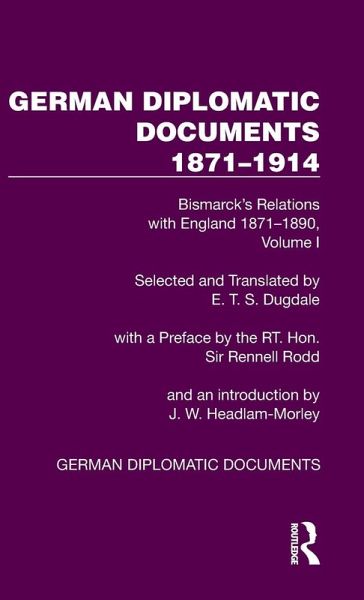
Originally published in English in 1928, this volume deals mainly with Anglo-German relations at the end of the 19th Century. Chancellor Otto von Bismarck's voice can be heard clearly in the documents which give an extensive picture of the alternating phases of relations between Great Britain and Germany, as influenced by their respective obligations and interests in the international issues which united or divided the Powers over a period of twenty years. The strongest impression which these documents leave is the revelation of how greatly the mentality of the western world changed since they…mehr
Originally published in English in 1928, this volume deals mainly with Anglo-German relations at the end of the 19th Century. Chancellor Otto von Bismarck's voice can be heard clearly in the documents which give an extensive picture of the alternating phases of relations between Great Britain and Germany, as influenced by their respective obligations and interests in the international issues which united or divided the Powers over a period of twenty years. The strongest impression which these documents leave is the revelation of how greatly the mentality of the western world changed since they were drafted, and especially during the decade which came after World War I. The shaping of policy, as exhibited in these despatches and memoranda, is governed almost exclusively by the ultimate idea of war as the deciding factor. The menace of war and the prospects of success or failure in aggression or defence appear to be the essential motives of policy.
E. T. S. Dugdale (1876-1964) chose and translated these four volumes of selections from the stupendously large collection of diplomatic documents held in Berlin after the First World War. Dugdale was a keen shot, an academic, a pipe-smoking stamp-collector, and an ardent admirer of Dickens, who for a time made the translation of German texts his métier. On leaving Balliol, he had hoped to join the British Foreign Office; and to that end in the late 1890s spent two years in Germany perfecting his grasp of German - an experience which admirably qualified him for the more literary occupation. In the event, having married in 1902, he instead became an underwriter at Lloyds, and ended the War, wounded, as a captain in the Leicester Yeomanry. The four volumes of Diplomatic Documents were Dugdale's chefs d'uvre. The very many and generous contemporary reviews of these are as uniformly struck by their historical importance as by the skill of their presentation and choice.
Inhaltsangabe
Preface Rennell Rodd. Historical Introduction J. W. Headlam-Morley. 1. The War Scare of 1875. 2. The Eastern Crisis, 1876 3. The Constantinople Conference, the London Protocol, and the Russo-Turkish War of 1877 4. The Congress of Berlin I 5. The Congress of Berlin II 6. The Congress of Berlin III 7. War Averted Between England and Russia 8. Germany's Estrangement from Russia. Central European Alliances. 9. The German Rapprochement with France, 1879 10. Anglo-German Relations, 1879-80 11. The Egyptian Question 12. The German Colonial Question 13. The Afghan Boundary Dispute 14. The Anglo-German Rapprochement of 1885 15. Zanzibar and Samoa, 1886-7 16. The Near East and Egypt, 1886-7 17. Zanzibar and the Pacific Ocean 1887 18. Negotiations for an Alliance Between England and Austria 19. Bulgaria, from the German Standpoint, December 1886 20. Negotiations for an Entente Between England and Italy, 1887 21. The Adhesion of Austria-Hungary to the Anglo-Italian Entente of 1887 22. The Bulgarian Crisis, 1886 23. The Entente Between England, Italy and Austria: The Eight Points 24. The Entente Between England, Italy and Austria: England's Adhesion to the Entente 25. The Battenberg Marriage Question 26. Bismarck's Offer of Alliance to England, 1889
Preface Rennell Rodd. Historical Introduction J. W. Headlam-Morley. 1. The War Scare of 1875. 2. The Eastern Crisis, 1876 3. The Constantinople Conference, the London Protocol, and the Russo-Turkish War of 1877 4. The Congress of Berlin I 5. The Congress of Berlin II 6. The Congress of Berlin III 7. War Averted Between England and Russia 8. Germany's Estrangement from Russia. Central European Alliances. 9. The German Rapprochement with France, 1879 10. Anglo-German Relations, 1879-80 11. The Egyptian Question 12. The German Colonial Question 13. The Afghan Boundary Dispute 14. The Anglo-German Rapprochement of 1885 15. Zanzibar and Samoa, 1886-7 16. The Near East and Egypt, 1886-7 17. Zanzibar and the Pacific Ocean 1887 18. Negotiations for an Alliance Between England and Austria 19. Bulgaria, from the German Standpoint, December 1886 20. Negotiations for an Entente Between England and Italy, 1887 21. The Adhesion of Austria-Hungary to the Anglo-Italian Entente of 1887 22. The Bulgarian Crisis, 1886 23. The Entente Between England, Italy and Austria: The Eight Points 24. The Entente Between England, Italy and Austria: England's Adhesion to the Entente 25. The Battenberg Marriage Question 26. Bismarck's Offer of Alliance to England, 1889
Es gelten unsere Allgemeinen Geschäftsbedingungen: www.buecher.de/agb
Impressum
www.buecher.de ist ein Internetauftritt der buecher.de internetstores GmbH
Geschäftsführung: Monica Sawhney | Roland Kölbl | Günter Hilger
Sitz der Gesellschaft: Batheyer Straße 115 - 117, 58099 Hagen
Postanschrift: Bürgermeister-Wegele-Str. 12, 86167 Augsburg
Amtsgericht Hagen HRB 13257
Steuernummer: 321/5800/1497
USt-IdNr: DE450055826