This work has been selected by scholars as being culturally important, and is part of the knowledge base of civilization as we know it. This work was reproduced from the original artifact, and remains as true to the original work as possible. Therefore, you will see the original copyright references, library stamps (as most of these works have been housed in our most important libraries around the world), and other notations in the work. This work is in the public domain in the United States of America, and possibly other nations. Within the United States, you may freely copy and distribute…mehr
This work has been selected by scholars as being culturally important, and is part of the knowledge base of civilization as we know it. This work was reproduced from the original artifact, and remains as true to the original work as possible. Therefore, you will see the original copyright references, library stamps (as most of these works have been housed in our most important libraries around the world), and other notations in the work. This work is in the public domain in the United States of America, and possibly other nations. Within the United States, you may freely copy and distribute this work, as no entity (individual or corporate) has a copyright on the body of the work. As a reproduction of a historical artifact, this work may contain missing or blurred pages, poor pictures, errant marks, etc. Scholars believe, and we concur, that this work is important enough to be preserved, reproduced, and made generally available to the public. We appreciate your support of the preservation process, and thank you for being an important part of keeping this knowledge alive and relevant.
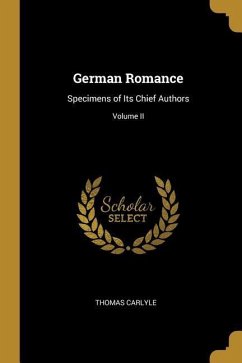
Thomas Carlyle was a British writer, historian, and philosopher who was born on December 4, 1795, and died on February 5, 1881. He was from the Scottish Lowlands. He was one of the most important writers of the Victorian age and had a big impact on art, literature, and philosophy in the 1800s. Born in Ecclefechan, Dumfriesshire, Scotland, Carlyle went to the University of Edinburgh and invented the Carlyle circle while there. When the arts course was over, he worked as a schoolmaster and studied to become a minister in the Burgher Church. He gave up on these and other things before he decided to write for the Edinburgh Encyclopaedia and work as a translator. Early on, he was successful by introducing little-known German literature to English readers through translations, his 1825 book Life of Friedrich Schiller, and review essays he wrote for a number of magazines. Ralph Waldo Emerson was an American essayist, speaker, philosopher, abolitionist, and poet who lived from May 25, 1803 to April 27, 1882. He went by his middle name, Waldo. He led the transcendentalist movement in the middle of the 1800s. People looked up to him as a supporter of freedom and critical thinking, as well as a wise critic of how society and conformity can make people feel bad about themselves. He was called ""the most gifted of the Americans"" by Friedrich Nietzsche, and Walt Whitman called him his ""master."" Emerson slowly moved away from the religious and social beliefs of his time. In his 1836 essay ""Nature,"" he formulated and explained the theory of transcendentalism. After this, in 1837, he gave a speech called ""The American Scholar."" Oliver Wendell Holmes Sr. thought it was America's ""intellectual Declaration of Independence.""
Es gelten unsere Allgemeinen Geschäftsbedingungen: www.buecher.de/agb
Impressum
www.buecher.de ist ein Internetauftritt der buecher.de internetstores GmbH
Geschäftsführung: Monica Sawhney | Roland Kölbl | Günter Hilger
Sitz der Gesellschaft: Batheyer Straße 115 - 117, 58099 Hagen
Postanschrift: Bürgermeister-Wegele-Str. 12, 86167 Augsburg
Amtsgericht Hagen HRB 13257
Steuernummer: 321/5800/1497
USt-IdNr: DE450055826