Horst Fuhrmann (Germany Universitat Regensburg)
Germany in the High Middle Ages, c. 1050-1200
Horst Fuhrmann (Germany Universitat Regensburg)
Germany in the High Middle Ages, c. 1050-1200
- Broschiertes Buch
- Merkliste
- Auf die Merkliste
- Bewerten Bewerten
- Teilen
- Produkt teilen
- Produkterinnerung
- Produkterinnerung
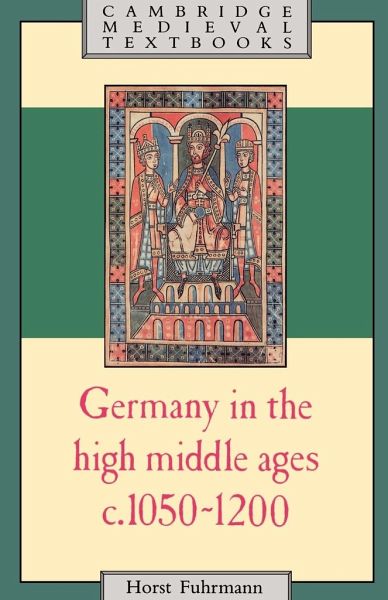
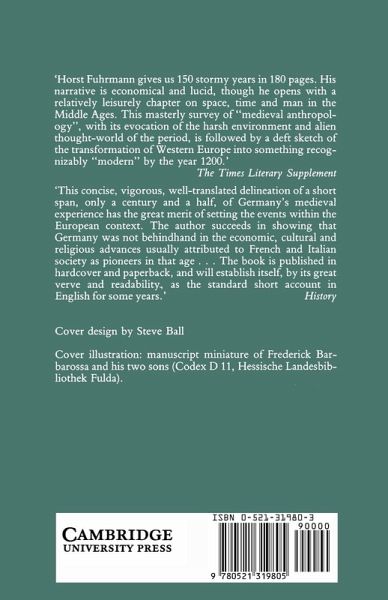
Germany in the High Middle Ages opens with a wide-ranging and yet detailed description of the conditions and changes under which men lived and their attitudes of mind during the period 1050â 1200. It explains how new classes emerged, universities were founded and how Germany rose and fell as a major empire.
Andere Kunden interessierten sich auch für
Florin Curta (University of Florida)Southeastern Europe in the Middle Ages, 500-125053,99 €
Bjorn Weiler (Aberystwyth University of Wales)Paths to Kingship in Medieval Latin Europe, c. 950-120045,99 €
Work and Worship at the Theotokos Evergetis 1050-120059,99 €
Nordic Elites in Transformation, c. 1050-1250, Volume III168,99 €
Caroline Brett (University of Cambridge)Brittany and the Atlantic Archipelago, 450-1200110,99 €
Caroline Brett (University of Cambridge)Brittany and the Atlantic Archipelago, 450-120035,99 €
Nora Berend (University of Cambridge)Central Europe in the High Middle Ages46,99 €-
-
-
Germany in the High Middle Ages opens with a wide-ranging and yet detailed description of the conditions and changes under which men lived and their attitudes of mind during the period 1050â 1200. It explains how new classes emerged, universities were founded and how Germany rose and fell as a major empire.
Produktdetails
- Produktdetails
- Cambridge Medieval Textbooks
- Verlag: Cambridge University Press
- Seitenzahl: 220
- Erscheinungstermin: 1. Dezember 1986
- Englisch
- Abmessung: 216mm x 140mm x 13mm
- Gewicht: 292g
- ISBN-13: 9780521319805
- ISBN-10: 0521319803
- Artikelnr.: 21303164
- Herstellerkennzeichnung
- Libri GmbH
- Europaallee 1
- 36244 Bad Hersfeld
- gpsr@libri.de
- Cambridge Medieval Textbooks
- Verlag: Cambridge University Press
- Seitenzahl: 220
- Erscheinungstermin: 1. Dezember 1986
- Englisch
- Abmessung: 216mm x 140mm x 13mm
- Gewicht: 292g
- ISBN-13: 9780521319805
- ISBN-10: 0521319803
- Artikelnr.: 21303164
- Herstellerkennzeichnung
- Libri GmbH
- Europaallee 1
- 36244 Bad Hersfeld
- gpsr@libri.de
Part I. German history in the High Middle Ages - Concepts, Explanations,
Facts: 1. The three 'essentials' of history - space, time, and man; 2.
Germany in the Europe of the high Middle Ages; Part II. 'Progress and
Promise': The German Empire in the Mid Eleventh Century: 3. Social
stratification and the structure of government in the Ottonian and Salian
period; 4. Rex et sacerdos - the priestly kingship of Henry III (1039-56);
5. Strengths and weaknesses of Salian kingship; 6. Henry III as Roman
patricius and the German popes; 7. The beginnings and aims of church
reform; 8. The distance from the rest of Europe: France, England and the
North; Part III. From Christus Domini to Antichrist: The King of Germany
and the Investiture Contest: 9. The reign of Henry IV and its consequences;
10. The rise of the secular state and the priestly church; Part IV.
Political Reorientation and Emergent Diversity: From Salian Imperial Church
System to Staufer Kingship: 11. The results of the investiture contest; 12.
'The love of learning and the desire for God': church and spirituality in
the age of Bernard of Clairvaux; 13. Lothar III: kingship without a future;
14. Conrad III: kingship without imperial glory; Part V. The Centre-Point
of the German Middle Ages: Frederick Barbarossa and His Age: 15. The
election of Frederick I and the policy of balance: Frederick and the Empire
before the Alexandrine schism; 16. Empire and papacy in the struggle for
supremacy; 17. New forms of government; 18. Henry VI and the shift in the
Empire's centre of gravity; Bibliography; Index.
Facts: 1. The three 'essentials' of history - space, time, and man; 2.
Germany in the Europe of the high Middle Ages; Part II. 'Progress and
Promise': The German Empire in the Mid Eleventh Century: 3. Social
stratification and the structure of government in the Ottonian and Salian
period; 4. Rex et sacerdos - the priestly kingship of Henry III (1039-56);
5. Strengths and weaknesses of Salian kingship; 6. Henry III as Roman
patricius and the German popes; 7. The beginnings and aims of church
reform; 8. The distance from the rest of Europe: France, England and the
North; Part III. From Christus Domini to Antichrist: The King of Germany
and the Investiture Contest: 9. The reign of Henry IV and its consequences;
10. The rise of the secular state and the priestly church; Part IV.
Political Reorientation and Emergent Diversity: From Salian Imperial Church
System to Staufer Kingship: 11. The results of the investiture contest; 12.
'The love of learning and the desire for God': church and spirituality in
the age of Bernard of Clairvaux; 13. Lothar III: kingship without a future;
14. Conrad III: kingship without imperial glory; Part V. The Centre-Point
of the German Middle Ages: Frederick Barbarossa and His Age: 15. The
election of Frederick I and the policy of balance: Frederick and the Empire
before the Alexandrine schism; 16. Empire and papacy in the struggle for
supremacy; 17. New forms of government; 18. Henry VI and the shift in the
Empire's centre of gravity; Bibliography; Index.
Part I. German history in the High Middle Ages - Concepts, Explanations,
Facts: 1. The three 'essentials' of history - space, time, and man; 2.
Germany in the Europe of the high Middle Ages; Part II. 'Progress and
Promise': The German Empire in the Mid Eleventh Century: 3. Social
stratification and the structure of government in the Ottonian and Salian
period; 4. Rex et sacerdos - the priestly kingship of Henry III (1039-56);
5. Strengths and weaknesses of Salian kingship; 6. Henry III as Roman
patricius and the German popes; 7. The beginnings and aims of church
reform; 8. The distance from the rest of Europe: France, England and the
North; Part III. From Christus Domini to Antichrist: The King of Germany
and the Investiture Contest: 9. The reign of Henry IV and its consequences;
10. The rise of the secular state and the priestly church; Part IV.
Political Reorientation and Emergent Diversity: From Salian Imperial Church
System to Staufer Kingship: 11. The results of the investiture contest; 12.
'The love of learning and the desire for God': church and spirituality in
the age of Bernard of Clairvaux; 13. Lothar III: kingship without a future;
14. Conrad III: kingship without imperial glory; Part V. The Centre-Point
of the German Middle Ages: Frederick Barbarossa and His Age: 15. The
election of Frederick I and the policy of balance: Frederick and the Empire
before the Alexandrine schism; 16. Empire and papacy in the struggle for
supremacy; 17. New forms of government; 18. Henry VI and the shift in the
Empire's centre of gravity; Bibliography; Index.
Facts: 1. The three 'essentials' of history - space, time, and man; 2.
Germany in the Europe of the high Middle Ages; Part II. 'Progress and
Promise': The German Empire in the Mid Eleventh Century: 3. Social
stratification and the structure of government in the Ottonian and Salian
period; 4. Rex et sacerdos - the priestly kingship of Henry III (1039-56);
5. Strengths and weaknesses of Salian kingship; 6. Henry III as Roman
patricius and the German popes; 7. The beginnings and aims of church
reform; 8. The distance from the rest of Europe: France, England and the
North; Part III. From Christus Domini to Antichrist: The King of Germany
and the Investiture Contest: 9. The reign of Henry IV and its consequences;
10. The rise of the secular state and the priestly church; Part IV.
Political Reorientation and Emergent Diversity: From Salian Imperial Church
System to Staufer Kingship: 11. The results of the investiture contest; 12.
'The love of learning and the desire for God': church and spirituality in
the age of Bernard of Clairvaux; 13. Lothar III: kingship without a future;
14. Conrad III: kingship without imperial glory; Part V. The Centre-Point
of the German Middle Ages: Frederick Barbarossa and His Age: 15. The
election of Frederick I and the policy of balance: Frederick and the Empire
before the Alexandrine schism; 16. Empire and papacy in the struggle for
supremacy; 17. New forms of government; 18. Henry VI and the shift in the
Empire's centre of gravity; Bibliography; Index.