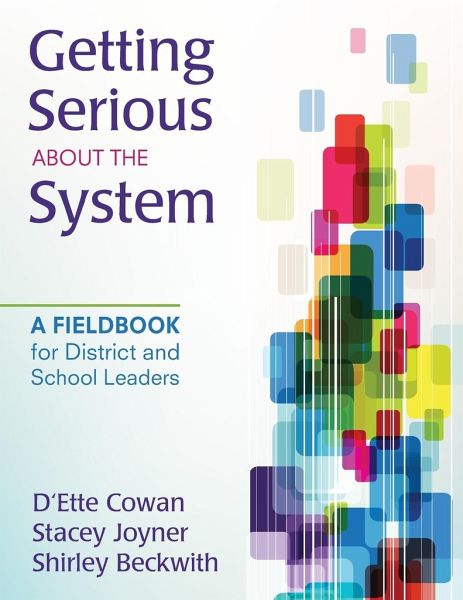
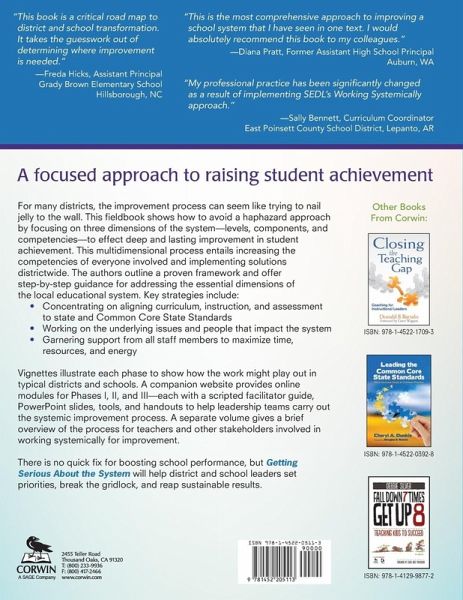
A focused approach to raising student achievement This fieldbook shows how to focus on the issues that have most impact upon student achievement. This multidimensional process also will increase the competencies of everyone involved while implementing solutions districtwide. The authors outline the framework and step-by-step guidance for simultaneously addressing the essential components and competencies at multiple levels of the local educational system. Key strategies include: Concentrating on aligning curriculum, instruction, and assessment to state and Common Core State Standards Working…mehr
A focused approach to raising student achievement This fieldbook shows how to focus on the issues that have most impact upon student achievement. This multidimensional process also will increase the competencies of everyone involved while implementing solutions districtwide. The authors outline the framework and step-by-step guidance for simultaneously addressing the essential components and competencies at multiple levels of the local educational system. Key strategies include: Concentrating on aligning curriculum, instruction, and assessment to state and Common Core State Standards Working on the underlying issues that are impacting the system Garnering support from all staff members to maximize time, resources, and energy
Before retiring from SEDL in October, 2010, D¿Ette F. Cowan led Texas Comprehensive Center efforts to assist state and intermediate agencies in providing high-needs districts and schools with technical assistance that is systemic in nature. In her 12-year career at SEDL, she also assisted low-performing districts and schools throughout a five-state region to improve student learning, and investigated strategies for transforming schools into professional learning communities. Currently, Cowan serves as a consultant to SEDL on a variety of projects. As one of the researchers and authors of Working Systemically in Action: A Guide for Facilitators, she has had first-hand experience in helping district and school leaders apply a systemic approach to improve learning outcomes for students. Her study of professional learning communities over her career has included conducting and applying research and presenting findings at conferences and in books and journals. She has authored chapters and articles in Demystifying Professional Learning Communities: School Leadership at Its Best; SEDL Letter; Journal of School Leadership; and Learning Together, Leading Together. Prior to joining SEDL in December 1997, she served as a junior high school teacher and an elementary school principal. Her continuing research interests include leadership for change, systemic improvement, and professional learning communities.
Inhaltsangabe
Preface Acknowledgments About the Authors Introduction to Systemic Improvement Systems Thinking Systems Thinking in Education Working Systemically: A Process Grounded in Research Testing and Refining the Working Systemically Approach The Working Systemically Approach: Levels, Components, and Competencies What It Takes Summary References 1. The "Works" of Working Systemically Levels of the System Components of the System Competencies for Working Systemically The Working Systemically Approach in Action 2. Phase I: Understanding Systemic Improvement Step 1. Study the Approach Step 2. Collect and Analyze Preliminary Data Step 3. Present the Approach at the School Level Step 4. Commit to Systemic Improvement 3. Phase II: Analyzing the System Step 1. Form the District and School Leadership Teams Step 2. Begin the Comprehensive Needs Assessment Step 3. Conduct a Gap Analysis Step 4. Begin the Process at the School Level Step 5. Formulate Problem Statements Step 6. Describe the Ideal State Step 7. Review System Initiatives Step 8. Continue the Process at the School Level 4. Phase III: Planning Action Step 1. Investigate Research-Based Practices Step 2. Explore the Professional Teaching and Learning Cycle (PTLC) Step 3. Review Progress Made to Date and Existing Plan Step 4. Develop a District Improvement Plan Step 5. Formalize and Communicate the District Improvement Plan Step 6. Develop School Improvement Plans 5. Phase IV: Taking Action & Monitoring Progress Step 1. Implement and Monitor the Improvement Plans Step 2. Provide Continuing Leadership for the Improvement Work Step 3. Address Unique Challenges as They Arise 6. Phase V: Assessing & Reflecting on Outcomes Step 1. Analyze and Reflect on Evidence of Implementation and Impact Step 2. Decide on a Focus for Continuing the Improvement Work Step 3. Recognize Work, Progress, and Accomplishments Bibliography Matrix Index
Preface Acknowledgments About the Authors Introduction to Systemic Improvement Systems Thinking Systems Thinking in Education Working Systemically: A Process Grounded in Research Testing and Refining the Working Systemically Approach The Working Systemically Approach: Levels, Components, and Competencies What It Takes Summary References 1. The "Works" of Working Systemically Levels of the System Components of the System Competencies for Working Systemically The Working Systemically Approach in Action 2. Phase I: Understanding Systemic Improvement Step 1. Study the Approach Step 2. Collect and Analyze Preliminary Data Step 3. Present the Approach at the School Level Step 4. Commit to Systemic Improvement 3. Phase II: Analyzing the System Step 1. Form the District and School Leadership Teams Step 2. Begin the Comprehensive Needs Assessment Step 3. Conduct a Gap Analysis Step 4. Begin the Process at the School Level Step 5. Formulate Problem Statements Step 6. Describe the Ideal State Step 7. Review System Initiatives Step 8. Continue the Process at the School Level 4. Phase III: Planning Action Step 1. Investigate Research-Based Practices Step 2. Explore the Professional Teaching and Learning Cycle (PTLC) Step 3. Review Progress Made to Date and Existing Plan Step 4. Develop a District Improvement Plan Step 5. Formalize and Communicate the District Improvement Plan Step 6. Develop School Improvement Plans 5. Phase IV: Taking Action & Monitoring Progress Step 1. Implement and Monitor the Improvement Plans Step 2. Provide Continuing Leadership for the Improvement Work Step 3. Address Unique Challenges as They Arise 6. Phase V: Assessing & Reflecting on Outcomes Step 1. Analyze and Reflect on Evidence of Implementation and Impact Step 2. Decide on a Focus for Continuing the Improvement Work Step 3. Recognize Work, Progress, and Accomplishments Bibliography Matrix Index
Es gelten unsere Allgemeinen Geschäftsbedingungen: www.buecher.de/agb
Impressum
www.buecher.de ist ein Internetauftritt der buecher.de internetstores GmbH
Geschäftsführung: Monica Sawhney | Roland Kölbl | Günter Hilger
Sitz der Gesellschaft: Batheyer Straße 115 - 117, 58099 Hagen
Postanschrift: Bürgermeister-Wegele-Str. 12, 86167 Augsburg
Amtsgericht Hagen HRB 13257
Steuernummer: 321/5800/1497
USt-IdNr: DE450055826