
Brousseau Et Al
GLOBAL ENVIRONMENTAL COMMONS C
Brousseau Et Al
GLOBAL ENVIRONMENTAL COMMONS C
- Gebundenes Buch
- Merkliste
- Auf die Merkliste
- Bewerten Bewerten
- Teilen
- Produkt teilen
- Produkterinnerung
- Produkterinnerung
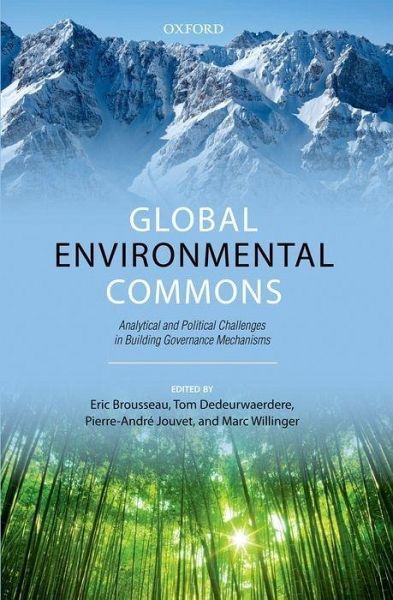
This volume provides an overview of global environmental governance and the effectiveness of different governance mechanisms. Bringing together a broad range of perspectives, it addresses key challenges in contemporary global governance of environmental change.
Andere Kunden interessierten sich auch für
 Blake HudsonConstitutions and the Commons162,99 €
 The Cambridge Handbook of Commons Research Innovations168,99 €
 George Jarvis FosterDoctors' Commons29,99 €
 Attard Et AlIMLI GLOBAL OCEAN GOVERNANCE VOL2 C222,99 €
 International Environmental Law and the Global South155,99 €
 Charles H. EcclestonGlobal Environmental Policy237,99 €
 James R. MayGlobal Environmental Constitutionalism127,99 €
-
-
-





This volume provides an overview of global environmental governance and the effectiveness of different governance mechanisms. Bringing together a broad range of perspectives, it addresses key challenges in contemporary global governance of environmental change.
Produktdetails
- Produktdetails
- Verlag: ACADEMIC
- Seitenzahl: 460
- Erscheinungstermin: 26. Juli 2012
- Englisch
- Abmessung: 240mm x 161mm x 29mm
- Gewicht: 851g
- ISBN-13: 9780199656202
- ISBN-10: 0199656207
- Artikelnr.: 35483078
- Herstellerkennzeichnung
- Libri GmbH
- Europaallee 1
- 36244 Bad Hersfeld
- gpsr@libri.de
- Verlag: ACADEMIC
- Seitenzahl: 460
- Erscheinungstermin: 26. Juli 2012
- Englisch
- Abmessung: 240mm x 161mm x 29mm
- Gewicht: 851g
- ISBN-13: 9780199656202
- ISBN-10: 0199656207
- Artikelnr.: 35483078
- Herstellerkennzeichnung
- Libri GmbH
- Europaallee 1
- 36244 Bad Hersfeld
- gpsr@libri.de
Eric Brousseau is a member of Dauphine Research in Management (DRM) a Joint Research Center between the CNRS and Paris-Dauphine. He is the founder and the director of the European School for New-Institutional Economics (ESNIE), and Vice-President of the International Society for New-Institutional Economics (ISNIE). His research agenda focuses on the economics of governance, with three main applied fields: innovation and intellectual property, Internet and digital economics, and environment. He has published more than 80 papers in various academic journals and books, authored one book, and edited more than 15 books or journal issues. He has been involved in researches funded by the French Government, the European Commission, the US National Science Foundation, the UN, and the OECD. Tom Dedeurwaerdere is a graduate in polytechnical sciences and philosophy, with a PhD in philosophy. He is in charge of the direction of the global public goods sub-network of the European REFGOV network (6th framework program) and the biodiversity sub-network of Belgian Interuniversity network IUAPVI on democratic governance. Recent publications include 'From bioprospection to reflexive governance' in Ecological Economics and a special issue on the Microbiological Commons in The International Social Science Journal (fall 2006, vol. 188). Pierre-AndrÃ(c) Jouvet has been dean of the faculty of Economics, Management, Mathematics and Computer Science at the University of Paris Ouest-Nanterre, La DÃ(c)fense. He heads the Economics of Sustainable Development Masters (EDDEE) and the Environment and Territory Development Masters. Professor Jouvet is the Scientific Director of the Climate Economics Chair. He is an economist that specializes in environmental economics, particularly the economics of public and political regulation (taxes, pollution permits, and voluntary contributions). His research is theoretical and covers EU-ETS analysis, risk, the relation between environment and longevity, and economic growth. Marc Willinger is Director of LAMETA. His background is on risk and decision analysis. His current research combines environmental economics and experimental economics, with a special focus on the design of policies and incentives schemes applied to social dilemmas (contributions to public goods and common pool resources dilemmas). Recent papers deal with taxation schemes, binding agreements, and contract design under asymmetric information.
* 1: Eric Brousseau, Tom Dedeurwaerdere, Pierre-AndrÃ(c) Jouvet, and
Marc Willinger: Introduction: Global Environmental Commons:
Analytical and Political Challenges in Building Governance Mechanisms
* Part I: Global Issues: Environmental and Governance Challenges
* 2: Arild Vatn: Environmental Governance: The Aspect of Coordination
* 3: Charles Perrings: The Governance of International Environmental
Public Goods
* 4: Oran Young: Navigating the Sustainability Transition: Governing
Complex and Dynamic Socioecological Systems
* Part II: Addressing Global Issues by Articulating Local Governance
Frameworks
* 5: Elinor Ostrom: Polycentric Systems: Multilevel Governance
Involving a Diversity of Organizations
* 6: Ben Groom, Rupert Gatti, Timo Goeschl, and Timothy Swanson:
Bargaining over Global Public Goods
* 7: Thierry BrÃ(c)chet and Johan Eyckmans: Coalition Theory and
Integrated Assessment Modeling: Lessons for Climate Governance
* 8: Denny Ellerman: Governance Issues in a Multinational Cap-and-Trade
System: Centralization and Harmonization
* Part III: Designing Institutions taking into account Social
Preferences
* 9: Hiroe Ishihara and Unai Pascual: Social Capital and Collective
Action in Environmental Governance, Revisited
* 10: Andries Richter and Daan Van Soest: Global Environmental
Problems, Voluntary Action, and Government Intervention
* 11: Paulo A. L. D. Nunes and Laura Onofri: De Rationes Disputandum
Est: The Profile of a "Warm-Glower", a Note on Consumers' Behavior,
and Public Policy Implications
* Part IV: Designing Incentives Mechanisms under the Constraints of the
Socio-political Game
* 12: Michael Faure: Designing Incentives Regulation for the
Environment
* 13: Gary Libecap: Property Rights as Solutions to the Problems of
Open Access: Options and Constraints
* 14: Graciela Chichilnisky: Managing the Global Commons: Principles
and Practice
* 15: Eric Brousseau, Tom Dedeurwaerdere, Pierre-AndrÃ(c) Jouvet , and
Marc Willinger: Conclusion: Governance And Environment: Policy
Challenges and Research Questions
Marc Willinger: Introduction: Global Environmental Commons:
Analytical and Political Challenges in Building Governance Mechanisms
* Part I: Global Issues: Environmental and Governance Challenges
* 2: Arild Vatn: Environmental Governance: The Aspect of Coordination
* 3: Charles Perrings: The Governance of International Environmental
Public Goods
* 4: Oran Young: Navigating the Sustainability Transition: Governing
Complex and Dynamic Socioecological Systems
* Part II: Addressing Global Issues by Articulating Local Governance
Frameworks
* 5: Elinor Ostrom: Polycentric Systems: Multilevel Governance
Involving a Diversity of Organizations
* 6: Ben Groom, Rupert Gatti, Timo Goeschl, and Timothy Swanson:
Bargaining over Global Public Goods
* 7: Thierry BrÃ(c)chet and Johan Eyckmans: Coalition Theory and
Integrated Assessment Modeling: Lessons for Climate Governance
* 8: Denny Ellerman: Governance Issues in a Multinational Cap-and-Trade
System: Centralization and Harmonization
* Part III: Designing Institutions taking into account Social
Preferences
* 9: Hiroe Ishihara and Unai Pascual: Social Capital and Collective
Action in Environmental Governance, Revisited
* 10: Andries Richter and Daan Van Soest: Global Environmental
Problems, Voluntary Action, and Government Intervention
* 11: Paulo A. L. D. Nunes and Laura Onofri: De Rationes Disputandum
Est: The Profile of a "Warm-Glower", a Note on Consumers' Behavior,
and Public Policy Implications
* Part IV: Designing Incentives Mechanisms under the Constraints of the
Socio-political Game
* 12: Michael Faure: Designing Incentives Regulation for the
Environment
* 13: Gary Libecap: Property Rights as Solutions to the Problems of
Open Access: Options and Constraints
* 14: Graciela Chichilnisky: Managing the Global Commons: Principles
and Practice
* 15: Eric Brousseau, Tom Dedeurwaerdere, Pierre-AndrÃ(c) Jouvet , and
Marc Willinger: Conclusion: Governance And Environment: Policy
Challenges and Research Questions
* 1: Eric Brousseau, Tom Dedeurwaerdere, Pierre-AndrÃ(c) Jouvet, and
Marc Willinger: Introduction: Global Environmental Commons:
Analytical and Political Challenges in Building Governance Mechanisms
* Part I: Global Issues: Environmental and Governance Challenges
* 2: Arild Vatn: Environmental Governance: The Aspect of Coordination
* 3: Charles Perrings: The Governance of International Environmental
Public Goods
* 4: Oran Young: Navigating the Sustainability Transition: Governing
Complex and Dynamic Socioecological Systems
* Part II: Addressing Global Issues by Articulating Local Governance
Frameworks
* 5: Elinor Ostrom: Polycentric Systems: Multilevel Governance
Involving a Diversity of Organizations
* 6: Ben Groom, Rupert Gatti, Timo Goeschl, and Timothy Swanson:
Bargaining over Global Public Goods
* 7: Thierry BrÃ(c)chet and Johan Eyckmans: Coalition Theory and
Integrated Assessment Modeling: Lessons for Climate Governance
* 8: Denny Ellerman: Governance Issues in a Multinational Cap-and-Trade
System: Centralization and Harmonization
* Part III: Designing Institutions taking into account Social
Preferences
* 9: Hiroe Ishihara and Unai Pascual: Social Capital and Collective
Action in Environmental Governance, Revisited
* 10: Andries Richter and Daan Van Soest: Global Environmental
Problems, Voluntary Action, and Government Intervention
* 11: Paulo A. L. D. Nunes and Laura Onofri: De Rationes Disputandum
Est: The Profile of a "Warm-Glower", a Note on Consumers' Behavior,
and Public Policy Implications
* Part IV: Designing Incentives Mechanisms under the Constraints of the
Socio-political Game
* 12: Michael Faure: Designing Incentives Regulation for the
Environment
* 13: Gary Libecap: Property Rights as Solutions to the Problems of
Open Access: Options and Constraints
* 14: Graciela Chichilnisky: Managing the Global Commons: Principles
and Practice
* 15: Eric Brousseau, Tom Dedeurwaerdere, Pierre-AndrÃ(c) Jouvet , and
Marc Willinger: Conclusion: Governance And Environment: Policy
Challenges and Research Questions
Marc Willinger: Introduction: Global Environmental Commons:
Analytical and Political Challenges in Building Governance Mechanisms
* Part I: Global Issues: Environmental and Governance Challenges
* 2: Arild Vatn: Environmental Governance: The Aspect of Coordination
* 3: Charles Perrings: The Governance of International Environmental
Public Goods
* 4: Oran Young: Navigating the Sustainability Transition: Governing
Complex and Dynamic Socioecological Systems
* Part II: Addressing Global Issues by Articulating Local Governance
Frameworks
* 5: Elinor Ostrom: Polycentric Systems: Multilevel Governance
Involving a Diversity of Organizations
* 6: Ben Groom, Rupert Gatti, Timo Goeschl, and Timothy Swanson:
Bargaining over Global Public Goods
* 7: Thierry BrÃ(c)chet and Johan Eyckmans: Coalition Theory and
Integrated Assessment Modeling: Lessons for Climate Governance
* 8: Denny Ellerman: Governance Issues in a Multinational Cap-and-Trade
System: Centralization and Harmonization
* Part III: Designing Institutions taking into account Social
Preferences
* 9: Hiroe Ishihara and Unai Pascual: Social Capital and Collective
Action in Environmental Governance, Revisited
* 10: Andries Richter and Daan Van Soest: Global Environmental
Problems, Voluntary Action, and Government Intervention
* 11: Paulo A. L. D. Nunes and Laura Onofri: De Rationes Disputandum
Est: The Profile of a "Warm-Glower", a Note on Consumers' Behavior,
and Public Policy Implications
* Part IV: Designing Incentives Mechanisms under the Constraints of the
Socio-political Game
* 12: Michael Faure: Designing Incentives Regulation for the
Environment
* 13: Gary Libecap: Property Rights as Solutions to the Problems of
Open Access: Options and Constraints
* 14: Graciela Chichilnisky: Managing the Global Commons: Principles
and Practice
* 15: Eric Brousseau, Tom Dedeurwaerdere, Pierre-AndrÃ(c) Jouvet , and
Marc Willinger: Conclusion: Governance And Environment: Policy
Challenges and Research Questions