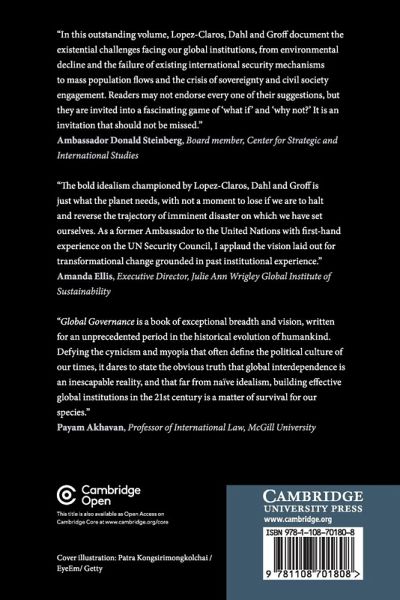
All those who despair at the state of the world and its multiple problems will find in this book ambitious but reasonable proposals that will give our globalized world the institutions of international governance necessary to resolve pressing problems including peace, security, and climate change. This title is also available as Open Access.
All those who despair at the state of the world and its multiple problems will find in this book ambitious but reasonable proposals that will give our globalized world the institutions of international governance necessary to resolve pressing problems including peace, security, and climate change. This title is also available as Open Access.
Augusto Lopez-Claros is Senior Fellow in the School of Foreign Service at Georgetown University, Washington DC, former Director of the Global Indicators Group at the World Bank, and Chief Economist and Director of the Global Competitiveness Program at the World Economic Forum. He is the author of Equality for Women = Prosperity for All (2018).
Inhaltsangabe
Part I. Background: 1. The challenges of the twenty-first century 2. A history of global governance 3. European integration: building supranational institutions Part II. Reforming the Central Institutions of the United Nations: 4. The general assembly: reforms to strengthen its effectiveness 5. A world parliamentary assembly: a catalyst for change 6. Advisory mechanisms to support global policy-making 7. UN Executive Council: beyond an outdated paradigm 8. Completing the collective security mechanism of the Charter: establishing an international peace force 9. Towards systemic disarmament: resetting global priorities 10. Strengthening the international rule of law 11. Human rights for the twenty-first century 12. A new UN funding mechanism Part III. Governance and the Management of Multiple Global Risks: 13. UN specialized agencies and governance for global risks 14. Economic governance for inequality and the private sector 15. Global financial architecture and the international monetary fund 16. Responding to global environmental crises 17. Population and migration Part IV. Cross-cutting Issues: 18. Corruption as a destroyer of prosperity and the need for international enforcement 19. Education for transformation Part V. Foundations for a New Global Governance System: 20. Values and principles for an enhanced international system: operationalizing global 'good governance' 21. Some immediate steps forward: getting 'from here to there' Part VI. Conclusions: 22. Bridging the governance gap.
Part I. Background: 1. The challenges of the twenty-first century 2. A history of global governance 3. European integration: building supranational institutions Part II. Reforming the Central Institutions of the United Nations: 4. The general assembly: reforms to strengthen its effectiveness 5. A world parliamentary assembly: a catalyst for change 6. Advisory mechanisms to support global policy-making 7. UN Executive Council: beyond an outdated paradigm 8. Completing the collective security mechanism of the Charter: establishing an international peace force 9. Towards systemic disarmament: resetting global priorities 10. Strengthening the international rule of law 11. Human rights for the twenty-first century 12. A new UN funding mechanism Part III. Governance and the Management of Multiple Global Risks: 13. UN specialized agencies and governance for global risks 14. Economic governance for inequality and the private sector 15. Global financial architecture and the international monetary fund 16. Responding to global environmental crises 17. Population and migration Part IV. Cross-cutting Issues: 18. Corruption as a destroyer of prosperity and the need for international enforcement 19. Education for transformation Part V. Foundations for a New Global Governance System: 20. Values and principles for an enhanced international system: operationalizing global 'good governance' 21. Some immediate steps forward: getting 'from here to there' Part VI. Conclusions: 22. Bridging the governance gap.
Es gelten unsere Allgemeinen Geschäftsbedingungen: www.buecher.de/agb
Impressum
www.buecher.de ist ein Internetauftritt der buecher.de internetstores GmbH
Geschäftsführung: Monica Sawhney | Roland Kölbl | Günter Hilger
Sitz der Gesellschaft: Batheyer Straße 115 - 117, 58099 Hagen
Postanschrift: Bürgermeister-Wegele-Str. 12, 86167 Augsburg
Amtsgericht Hagen HRB 13257
Steuernummer: 321/5800/1497
USt-IdNr: DE450055826