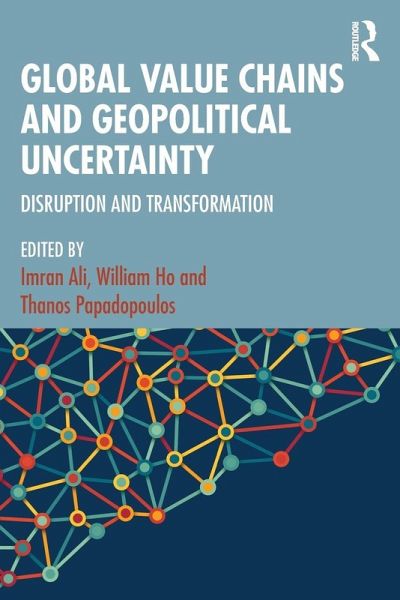
This book offers a timely and insightful look at how political tensions, economic disruptions, and technological advances are reshaping the way goods and services move across borders. At a time when global trade faces mounting pressure, this book explores how businesses, governments, and communities can adapt to an increasingly uncertain world. Spanning diverse geographic areas and themes, the book delves into the evolving trade dynamics between developed and developing countries, the involvement of governments alongside international partnerships, as well as the impact of emerging digital…mehr
This book offers a timely and insightful look at how political tensions, economic disruptions, and technological advances are reshaping the way goods and services move across borders. At a time when global trade faces mounting pressure, this book explores how businesses, governments, and communities can adapt to an increasingly uncertain world.
Spanning diverse geographic areas and themes, the book delves into the evolving trade dynamics between developed and developing countries, the involvement of governments alongside international partnerships, as well as the impact of emerging digital technologies such as automation and artificial intelligence. Additionally, it addresses how companies are reevaluating their business models to enhance resilience, adopt sustainable practices, and meet rising demands for ethical conduct. Rich case studies from recent years bring these themes to life, highlighting real-world examples of innovation, adaptation, and strategic thinking.
This volume serves as a vital resource for students, researchers, policymakers, and business executives aiming to comprehend and tackle the intricate challenges currently confronting global value chains. Whether engaged in international trade studies or overseeing a multinational enterprise, readers will find practical advice and forward-looking strategies essential for navigating a period characterized by transformation.
Imran Ali is a globally ranked researcher and Senior Lecturer at Central Queensland University. His expertise spans digital transformation, logistics, and sustainable supply chains. He has published in leading journals, received the Emerald Literati Award, and serves on editorial boards. His work bridges academic research and industry transformation. William Ho teaches at the University of Melbourne and studies supply chain risk, sustainability, and strategic sourcing. He has published 60+ articles, earned over 13,000 citations, and secured major international grants. He is the Associate Editor of Decision Sciences and OR Spectrum, promoting practice-oriented, job-ready graduate education. Thanos Papadopoulos is a researcher who focuses on digital transformation, supply chains, and global value chains. He has published 150+ articles and serves on top-tier editorial boards. A Clarivate Highly Cited Researcher and British Academy Fellow, he is recognized among the world's top 2% of scientists (2021-2023).
Inhaltsangabe
Contents About the Editors vii List of Contributors x 1 Introduction to Global Value Chains and Geopolitical Turmoil 1 Imran Ali, William Ho, Thanos Papadopoulos and Cait White 2 The Changing Dynamics of Trade in Global Value Chains Between Developed and Developing Economies 17 Agus Wicaksana and William Ho 3 Geopolitical Turmoil and the Changing Nature of Globalization 40 Arza Faldy Prameswara, Huashan (Jason) Li, Donella Caspersz and Arnoldus (Ron) Maas 4 The Impact of Global Value Chains on Labour Markets and Employment 62 Ahmad Arslan 5 The Evolution of Production Networks and Business Model Innovation in Global Value Chains 68 Towfique Rahman and Sanjoy Kumar Paul 6 The Role of Technology in Transforming Global Value Chains 92 Dolly Gaur, Abhinav Pal, Kanishka Gupta, Rashida Salmani and Abhishek Behl 7 The Role of Governments in Shaping Global Value Chains amid Geopolitical Tumult 109 Waqas Khan and Qasim Ali Nisar 8 Risk Assessment in Global Value Chains 124 Renata Klafke, Imran Ali and Tage Andersson 9 Supply Chain Resilience in the Face of Geopolitical Turmoil 142 Anas Iftikhar and Ilias Vlachos 10 Sustainability and ESG in Global Value Chains 157 Said Usman, Nasrin Asgari and Wantao Yu 11 Regional Blocs and Economic Alliances: Impact on Global Value Chain Integration 178 David M. Herold 12 Navigating the Path Ahead: A Roadmap for Future Global Value Chains 195 Imran Ali, William Ho and Thanos Papadopoulos Index 223
Contents About the Editors vii List of Contributors x 1 Introduction to Global Value Chains and Geopolitical Turmoil 1 Imran Ali, William Ho, Thanos Papadopoulos and Cait White 2 The Changing Dynamics of Trade in Global Value Chains Between Developed and Developing Economies 17 Agus Wicaksana and William Ho 3 Geopolitical Turmoil and the Changing Nature of Globalization 40 Arza Faldy Prameswara, Huashan (Jason) Li, Donella Caspersz and Arnoldus (Ron) Maas 4 The Impact of Global Value Chains on Labour Markets and Employment 62 Ahmad Arslan 5 The Evolution of Production Networks and Business Model Innovation in Global Value Chains 68 Towfique Rahman and Sanjoy Kumar Paul 6 The Role of Technology in Transforming Global Value Chains 92 Dolly Gaur, Abhinav Pal, Kanishka Gupta, Rashida Salmani and Abhishek Behl 7 The Role of Governments in Shaping Global Value Chains amid Geopolitical Tumult 109 Waqas Khan and Qasim Ali Nisar 8 Risk Assessment in Global Value Chains 124 Renata Klafke, Imran Ali and Tage Andersson 9 Supply Chain Resilience in the Face of Geopolitical Turmoil 142 Anas Iftikhar and Ilias Vlachos 10 Sustainability and ESG in Global Value Chains 157 Said Usman, Nasrin Asgari and Wantao Yu 11 Regional Blocs and Economic Alliances: Impact on Global Value Chain Integration 178 David M. Herold 12 Navigating the Path Ahead: A Roadmap for Future Global Value Chains 195 Imran Ali, William Ho and Thanos Papadopoulos Index 223
Es gelten unsere Allgemeinen Geschäftsbedingungen: www.buecher.de/agb
Impressum
www.buecher.de ist ein Internetauftritt der buecher.de internetstores GmbH
Geschäftsführung: Monica Sawhney | Roland Kölbl | Günter Hilger
Sitz der Gesellschaft: Batheyer Straße 115 - 117, 58099 Hagen
Postanschrift: Bürgermeister-Wegele-Str. 12, 86167 Augsburg
Amtsgericht Hagen HRB 13257
Steuernummer: 321/5800/1497
USt-IdNr: DE450055826