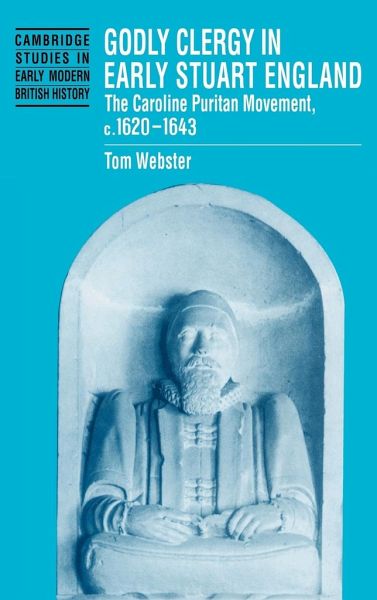

This book reconsiders the existence of an early Stuart Puritan movement, and examines the ways in which Puritan clergymen encouraged greater sociability with their like-minded colleagues, both in theory and in practice, to such an extent that they came to define themselves as 'a peculiar people', a community distinct from their less faithful rivals. Their voluntary communal rituals encouraged a view of the world divided between 'us' and 'them'. This provides a context for a renewed examination of the thinking behind debates on ceremonial nonconformity and reactions to the Laudian changes of…mehr
This book reconsiders the existence of an early Stuart Puritan movement, and examines the ways in which Puritan clergymen encouraged greater sociability with their like-minded colleagues, both in theory and in practice, to such an extent that they came to define themselves as 'a peculiar people', a community distinct from their less faithful rivals. Their voluntary communal rituals encouraged a view of the world divided between 'us' and 'them'. This provides a context for a renewed examination of the thinking behind debates on ceremonial nonconformity and reactions to the Laudian changes of the 1630s. From this a new perspective is developed on arguments about emigration and church government, arguments that proved crucial to Parliamentarian unity during the English Civil War.
Tom Webster, a pioneer of the podcast industry, has thirty years of experience in streaming, podcasting, and radio. He is an expert in audience behavior and his influential audio research is widely cited. Webster works with over half of the Top 50 podcasts and Top 20 podcast networks, and his clients include NPR, Spotify, Google, and Amazon. He is a partner at Sounds Profitable, a member-supported trade organization for the podcast industry. He lives lives in Boston with his wife, Tamsen.
Inhaltsangabe
Acknowledgments List of abbreviations Introduction Part I. Society, Clerical Conference and the Church of England: 1. Clerical education and the household seminary 2. Profitable conferences and the settlement of godly ministers 3. Fasting and prayer 4. Clerical associations and the Church of England Part II. The Godly Ministry: Piety and Practice: 5. The image of a godly minister 6. Religiosity and sociability Part III. 'These Uncomfortable Times': Conformity and the Godly Ministers 1628-38: 7. Thomas Hooker and the conformity debate 8. Trajectories of response to Laudianism 9. The ecclesiastical courts and the Essex visitation of 1631 10. Juxon, Wren and the implementation of Laudianism 11. The diocese of Peterborough: a see of conflict 12. The metropolitical visitation of Essex and the strategies of evasion Part IV. 'These Dangerous Times': The Puritan Diaspora 1631-42 13. John Dury and the godly ministers 14. Choices of suffering and flight 15. The 'non-separating Congregationalists' and Massachusetts 16. Thomas Hooker and the Amesians 17. Alternative ecclesiologists to 1642 18. Conclusion.
Es gelten unsere Allgemeinen Geschäftsbedingungen: www.buecher.de/agb
Impressum
www.buecher.de ist ein Internetauftritt der buecher.de internetstores GmbH
Geschäftsführung: Monica Sawhney | Roland Kölbl | Günter Hilger
Sitz der Gesellschaft: Batheyer Straße 115 - 117, 58099 Hagen
Postanschrift: Bürgermeister-Wegele-Str. 12, 86167 Augsburg
Amtsgericht Hagen HRB 13257
Steuernummer: 321/5800/1497
USt-IdNr: DE450055826