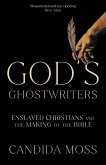
Winner of the 2026 Grawemeyer Award in Religion A 2025 Nautilus Book Awards Silver Winner From an award-winning biblical scholar, the “monumental and eye-opening” story of how enslaved people created, gave meaning to, and spread the message of the New Testament, shaping the very foundations of Christianity in ways both subtle and profound (Reza Aslan). For the past two thousand years, Christian tradition, scholarship, and pop culture have credited the authorship of the New Testament to a select group of men: Matthew, Mark, Luke, John, and Paul. But hidden behind these named and sainted…mehr
Winner of the 2026 Grawemeyer Award in Religion A 2025 Nautilus Book Awards Silver Winner From an award-winning biblical scholar, the “monumental and eye-opening” story of how enslaved people created, gave meaning to, and spread the message of the New Testament, shaping the very foundations of Christianity in ways both subtle and profound (Reza Aslan). For the past two thousand years, Christian tradition, scholarship, and pop culture have credited the authorship of the New Testament to a select group of men: Matthew, Mark, Luke, John, and Paul. But hidden behind these named and sainted individuals are a cluster of unnamed, enslaved coauthors and collaborators. These essential workers were responsible for producing the earliest manuscripts of the New Testament: making the parchment on which the texts were written, taking dictation, and refining the words of the apostles. And as the Christian message grew in influence, it was enslaved missionaries who undertook the arduous journey across the Mediterranean and along dusty roads to move Christianity to Rome, Spain, and North Africa—and into the pages of history. The impact of these enslaved contributors on the spread of Christianity, the development of foundational Christian concepts, and the making of the Bible was enormous, yet their role has been almost entirely overlooked until now. Filled with profound revelations both for what it means to be a Christian and for how we read individual texts themselves, God’s Ghostwriters is a groundbreaking and rigorously researched book about how enslaved people shaped the Bible, and with it all of Christianity.
Candida Moss is Edward Cadbury Chair of Theology at the University of Birmingham, prior to which she taught for almost a decade at the University of Notre Dame. She holds an undergraduate degree from the University of Oxford and an MA and PhD from Yale University. The award-winning author or co-author of seven books, she has also served as Papal News Commentator for CBS News and writes a column for The Daily Beast. She has written for and had her work reported on in the New York Times, LA Times, Washington Post, The Atlantic Monthly, Times Higher Education Supplement, The Guardian, Slate, New Scientist, BBC.com, Chronicle of High Education, CNN.com, POLITICO, POLITICO Europe, Huffington Post, Newsweek, Christian Century, The Daily Mail, and Le Monde. In addition to regularly commenting on religious affairs for CBS, Dr. Moss has also served as an on air expert for CNN and Fox News, and presented or appeared in documentaries for CNN, NBC, National Geographic, History Channel, Discovery Channel, CNN, Travel Channel, Lifetime, BBC, PBS, E!, and the Smithsonian Channel. An International Honorary Member of the American Academy of Arts and Sciences, she lives in New York.
Es gelten unsere Allgemeinen Geschäftsbedingungen: www.buecher.de/agb
Impressum
www.buecher.de ist ein Internetauftritt der buecher.de internetstores GmbH
Geschäftsführung: Monica Sawhney | Roland Kölbl | Günter Hilger
Sitz der Gesellschaft: Batheyer Straße 115 - 117, 58099 Hagen
Postanschrift: Bürgermeister-Wegele-Str. 12, 86167 Augsburg
Amtsgericht Hagen HRB 13257
Steuernummer: 321/5800/1497
USt-IdNr: DE450055826