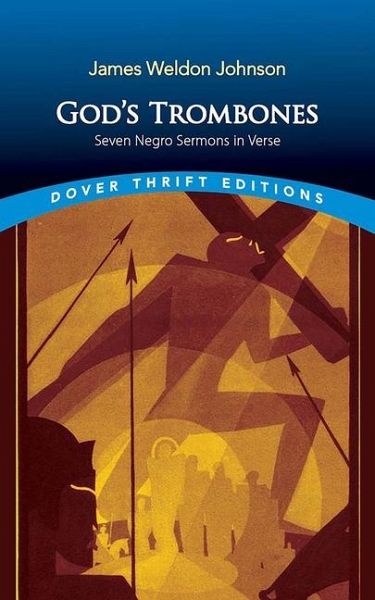
In one of his most acclaimed works, James Weldon Johnson (1871-1938) transforms seven inspiring spiritual sermons of African American preachers into poetry. Johnson equates the Black oral tradition and its characteristic cadence with the sweeping tonal ranges of the trombone, which most closely resembles the human voice. Each poem includes punctuation and line breaks that represent the preacher's tempo and voice. This eloquent collection includes "Listen, Lord--A Prayer"; "The Creation"; "The Prodigal Son"; "Go Down Death--A Funeral Sermon"; "Noah Built the Ark"; "The Crucifixion"; "Let My…mehr
In one of his most acclaimed works, James Weldon Johnson (1871-1938) transforms seven inspiring spiritual sermons of African American preachers into poetry. Johnson equates the Black oral tradition and its characteristic cadence with the sweeping tonal ranges of the trombone, which most closely resembles the human voice. Each poem includes punctuation and line breaks that represent the preacher's tempo and voice. This eloquent collection includes "Listen, Lord--A Prayer"; "The Creation"; "The Prodigal Son"; "Go Down Death--A Funeral Sermon"; "Noah Built the Ark"; "The Crucifixion"; "Let My People Go"; and "The Judgment Day." People of all faiths will enjoy Johnson's poetic reimagining of classic African American sermons. A key figure in the Harlem Renaissance, Johnson was a revered African American civil rights leader, diplomat, lawyer, novelist, poet, and songwriter. He coauthored the hymn "Lift Every Voice and Sing," known as the Black national anthem.
James Weldon Johnson was born on June 17, 1871, in Jacksonville, Florida, to James Johnson and Helen Louise Dillet. He attended Atlanta University, earning his Bachelor of Arts in 1894. After graduation, he returned to Jacksonville to serve as principal of Stanton College Preparatory School.In 1900, Johnson wrote the lyrics for ""Lift Every Voice and Sing,"" with music composed by his brother, J. Rosamond Johnson; this song became known as the Black National Anthem. He also authored The Autobiography of an Ex-Colored Man in 1912 and God's Trombones in 1927. His literary contributions significantly influenced the Harlem Renaissance.Johnson joined the NAACP in 1917 and became its executive secretary in 1920, serving until 1930. He was a prominent civil rights activist, advocating for anti-lynching legislation and equal rights. In 1934, he became the first African American professor at New York University.
Es gelten unsere Allgemeinen Geschäftsbedingungen: www.buecher.de/agb
Impressum
www.buecher.de ist ein Internetauftritt der buecher.de internetstores GmbH
Geschäftsführung: Monica Sawhney | Roland Kölbl | Günter Hilger
Sitz der Gesellschaft: Batheyer Straße 115 - 117, 58099 Hagen
Postanschrift: Bürgermeister-Wegele-Str. 12, 86167 Augsburg
Amtsgericht Hagen HRB 13257
Steuernummer: 321/5800/1497
USt-IdNr: DE450055826