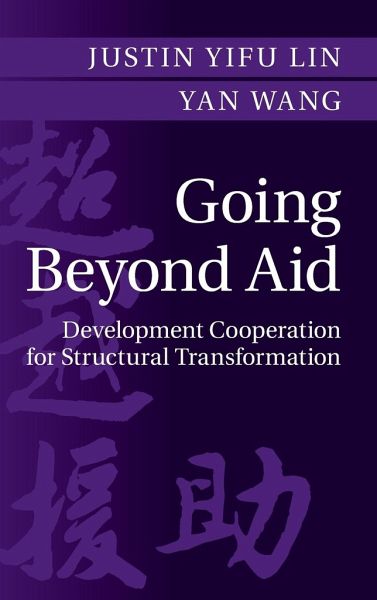
Developing countries have for decades been trying to catch up with the industrialized high-income countries, but only a few have succeeded. Historically, structural transformation has been a powerful engine of growth and job creation. Traditional development aid is inadequate to address the bottlenecks for structural transformation, and is hence ineffective. In this book, Justin Yifu Lin and Yan Wang use the theoretical foundations of New Structural Economics to examine South-South development aid and cooperation from the angle of structural transformation. By studying the successful economic…mehr
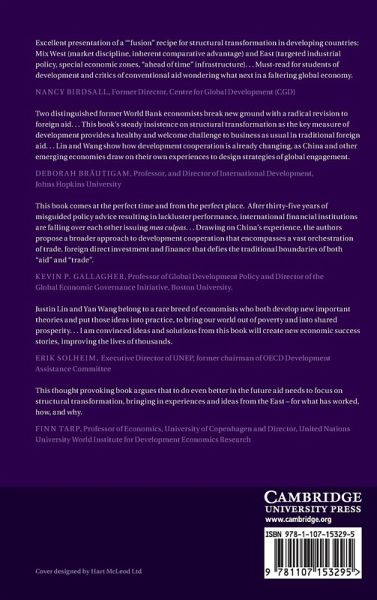
Developing countries have for decades been trying to catch up with the industrialized high-income countries, but only a few have succeeded. Historically, structural transformation has been a powerful engine of growth and job creation. Traditional development aid is inadequate to address the bottlenecks for structural transformation, and is hence ineffective. In this book, Justin Yifu Lin and Yan Wang use the theoretical foundations of New Structural Economics to examine South-South development aid and cooperation from the angle of structural transformation. By studying the successful economic transformation of countries such as China and South Korea through 'multiple win' solutions based on comparative advantages and economy of scale, and by presenting new ideas and different perspectives from emerging market economies such as Brazil, India and other BRICS countries, they bring a new narrative to broaden the ongoing discussions of post-2015 development aid and cooperation as well as the definitions of aid and cooperation.
Justin Yifu Lin is Professor and Director at the Center for New Structural Economics, and Professor and Honorary Dean at the National School of Development at Peking University, Beijing. He is Vice Chairman of the All-China Federation of Industry and Commerce, and was the Senior Vice President and Chief Economist of the World Bank from 2008-12. Prior to joining the World Bank, Lin served for fifteen years as Founding Director and Professor of the China Centre for Economic Research (CCER) at Peking University. He is the author of twenty-four books, including Against the Consensus: Reflections on the Great Recession (Cambridge, 2013), The Quest for Prosperity: How Developing Economies Can Take Off (2012), New Structural Economics: A Framework for Rethinking Development and Policy (2012), Demystifying the Chinese Economy (Cambridge, 2011), Benti and Changwu: Dialogues on Methodology in Economics (2012), and Economic Development and Transition: Thought, Strategy, and Viability (Cambridge, 2009).
Inhaltsangabe
Preface List of figures List of tables 1. Introduction and objectives 2. Structural transformation is key to development 3. Traditional aid is ineffective for structural transformation 4. South-South development cooperation helps structural transformation 5. Using China's comparative advantage to address Africa's infrastructure bottlenecks 6. China uses its comparative advantage to help Africa in light manufacturing 7. Effectiveness for transformation: the secret for quick wins 8. Prospects for development finance References Index.
Preface List of figures List of tables 1. Introduction and objectives 2. Structural transformation is key to development 3. Traditional aid is ineffective for structural transformation 4. South-South development cooperation helps structural transformation 5. Using China's comparative advantage to address Africa's infrastructure bottlenecks 6. China uses its comparative advantage to help Africa in light manufacturing 7. Effectiveness for transformation: the secret for quick wins 8. Prospects for development finance References Index.
Es gelten unsere Allgemeinen Geschäftsbedingungen: www.buecher.de/agb
Impressum
www.buecher.de ist ein Internetauftritt der buecher.de internetstores GmbH
Geschäftsführung: Monica Sawhney | Roland Kölbl | Günter Hilger
Sitz der Gesellschaft: Batheyer Straße 115 - 117, 58099 Hagen
Postanschrift: Bürgermeister-Wegele-Str. 12, 86167 Augsburg
Amtsgericht Hagen HRB 13257
Steuernummer: 321/5800/1497
USt-IdNr: DE450055826