This book offers an intimate and personal look at what China's poverty alleviation has meant for individuals. The dramatic progress in reducing poverty in China over the past three decades is well known. According to the World Bank, more than 500 million people were lifted out of extreme poverty as China's poverty rate fell from 88 percent in 1981 to 6.5 percent in 2012. Behind this statistic are the millions of families in rural China who have moved from extreme poverty to a more comfortable way of life in modern China. This is the story of four generations of one such family. Grandma Zhen…mehr
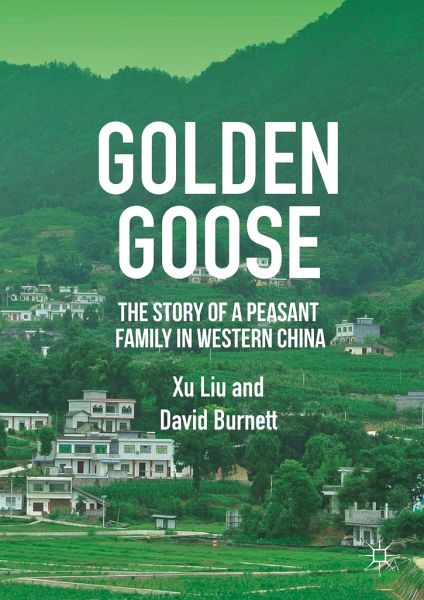
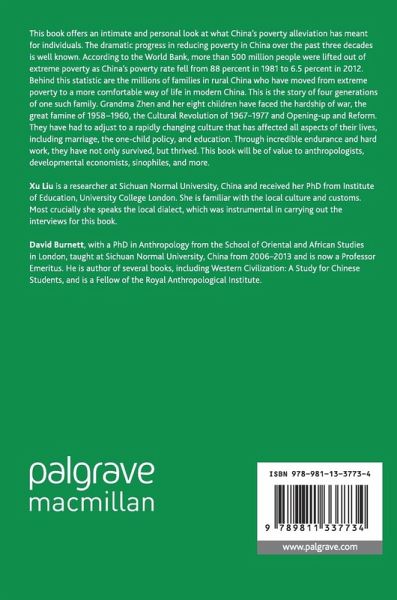
This book offers an intimate and personal look at what China's poverty alleviation has meant for individuals. The dramatic progress in reducing poverty in China over the past three decades is well known. According to the World Bank, more than 500 million people were lifted out of extreme poverty as China's poverty rate fell from 88 percent in 1981 to 6.5 percent in 2012. Behind this statistic are the millions of families in rural China who have moved from extreme poverty to a more comfortable way of life in modern China. This is the story of four generations of one such family. Grandma Zhen and her eight children have faced the hardship of war, the great famine of 1958-1960, the Cultural Revolution of 1967-1977 and Opening-up and Reform. They have had to adjust to a rapidly changing culture that has affected all aspects of their lives, including marriage, the one-child policy, and education. Through incredible endurance and hard work, they have not only survived, but thrived. This book will be of value to anthropologists, developmental economists, sinophiles, and more.
Shuang Li received his B.S.E, M.S.E, and Ph.D. degrees all in the spacecraft design from the Department of Aerospace Engineering at Harbin Institute of Technology, China, in 2001, 2003, and 2007, respectively. Since 2007, he has been with the College of Astronautics, Nanjing University of Aeronautics and Astronautics, China, where he is a full professor and the founding director of Advanced Space Technology Laboratory (ASTL) now. His research interests include spacecraft guidance navigation and control (GNC), astrodynamics, and space mission design and analysis. He has been the author of over 120 articles in reputable journals and conference proceedings. He is an associate editor for Journal of Spacecraft and Rockets and Astrodynamics and an editorial board member of Space: Science & Technology, Chinese Space Science and Technology (in Chinese), Journal of NUAA (in Chinese), Journal of Deep Space Exploration (in Chinese), and Flight Control & Detection (in Chinese). He served for ActaAstronautica as a guest editor for a special issue (Fourth IAA Conference on Dynamics and Control of Space Systems) and a special section (Special Section on 9th China Trajectory Optimization Competition). Xu Liu received the B.S. and Ph.D. degrees in Guidance, Navigation, and Control from Nanjing University of Aeronautics and Astronautics, Nanjing, China, in 2017 and 2023, respectively. He is a Lecturer with the Department of Automation, Nanchang University, Nanchang, China. His research interests include the trajectory optimization, guidance, navigation, and control technologies of flight vehicles. Xiuqiang Jiang received his Ph.D. degree from the Nanjing University of Aeronautics and Astronautics, China. He was a visiting scholar at the University of Arizona, USA, during 2017-2018. He is currently an associate professor at the Department of Flight Vehicle Control and Information Engineering, Sichuan University, China. His research interests include trajectory optimization, uncertainty quantification, and guidance technologies for spacecraft. He published 21 papers in authoritative aerospace journals, including Progress in Aerospace Sciences, Aerospace Science and Technology, Acta Astronautica, etc., and also served as the reviewer for 11 academic journals. Yuming Peng received his M.S.E. degree from Nanjing University of Aeronautics and Astronautics in 2011 and his Ph.D. degree from Nanjing University in 2019. Since 2011, he has worked as an engineer and a senior engineer at the Shanghai Institute of Satellite Engineering, Shanghai, China. He worked as an engineer in Orbit Dynamics and Control for China's first Mars probe, Tianwen 1.
Inhaltsangabe
1. Zhen's Story.- 2. Shun's Story: Number One Daughter.- 3. Ze's Story: Husband of First Daughter.- 4. Shi's Story: Second Daughter.- 5. Hua's Story: Third Daughter.- 6. Chun's Story: First Son, Fourth Child.- 7. Xia's Story: Second Son.- 8. Kai's Story: Fourth Daughter.- 9. Qiu's Story: Third Son.- 10. Dong's Story: Fourth Son.- 11. Grandma Remembers.- 12. Anthropological Themes.