
Andere Kunden interessierten sich auch für
 The History and Antiquities of Eyam: With a Minute Account of the Great Plague Which Desolated That Village in the Year 166618,99 €
![A Plain and Easie Method FOR Preserving [by God's Blessing] Those That Are WELL From the Infection of the PLAGUE, Or Any Contagious Distemper, In CITY, CAMP, FLEET, &c. AND For Curing Such as Are Infected With It.]( "A Plain and Easie Method FOR Preserving [by God's Blessing] Those That Are WELL From the Infection of the PLAGUE, Or Any Contagious Distemper, In CITY, CAMP, FLEET, &c. AND For Curing Such as Are Infected With It.") A Plain and Easie Method FOR Preserving [by God's Blessing] Those That Are WELL From the Infection of the PLAGUE, Or Any Contagious Distemper, In CITY, CAMP, FLEET, &c. AND For Curing Such as Are Infected With It.14,99 €
A Plain and Easie Method FOR Preserving [by God's Blessing] Those That Are WELL From the Infection of the PLAGUE, Or Any Contagious Distemper, In CITY, CAMP, FLEET, &c. AND For Curing Such as Are Infected With It.14,99 € Aids to the Identification of Rats Connected With Plague in India: With Suggestions as to the Collection of Specimens14,99 €
![Visitations of the Plague in Cumberland and Westmorland [electronic Resource]]( "Visitations of the Plague in Cumberland and Westmorland [electronic Resource]") Visitations of the Plague in Cumberland and Westmorland [electronic Resource]14,99 €
Visitations of the Plague in Cumberland and Westmorland [electronic Resource]14,99 € The Cause and Prevention of the Spread of Plague in India. A Lecture Delivered Before the Bombay Sanitary Association on 11th December 190723,99 €
 A Succinct Account of the Plague at Marseilles: Its Symptoms, and the Methods and Medicines Used for Curing It; c.214,99 €
 The Plague at Marseilles Consider'd: With Remarks Upon the Plague in General, Shewing Its Cause and Nature of Infection, With Necessary Precautions to15,99 €

![A Plain and Easie Method FOR Preserving [by God's Blessing] Those That Are WELL From the Infection of the PLAGUE, Or Any Contagious Distemper, In CITY, CAMP, FLEET, &c. AND For Curing Such as Are Infected With It.](https://bilder.buecher.de/produkte/74/74007/74007979m.jpg "A Plain and Easie Method FOR Preserving [by God's Blessing] Those That Are WELL From the Infection of the PLAGUE, Or Any Contagious Distemper, In CITY, CAMP, FLEET, &c. AND For Curing Such as Are Infected With It.")
![Visitations of the Plague in Cumberland and Westmorland [electronic Resource]](https://bilder.buecher.de/produkte/66/66119/66119577m.jpg "Visitations of the Plague in Cumberland and Westmorland [electronic Resource]")
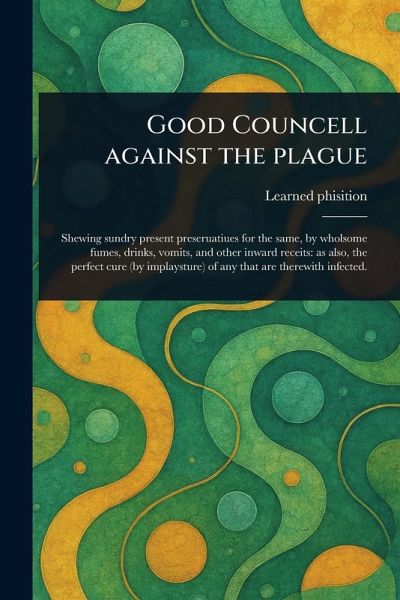
"Good Councell against the plague, Shewing sundry preset preseruatiues for the same" offers a fascinating glimpse into 17th-century approaches to epidemics and disease prevention. Written anonymously, this historical text provides insight into early medical thought concerning the plague and its treatment. As a primary source from a time when understanding of disease was limited, the book details various "preseruatiues" believed to offer protection against the plague. This volume, meticulously prepared for print republication, will interest readers curious about the history of medicine, public health crises, and the social impact of widespread disease in Europe. It sheds light on the anxieties and preventative measures of a society grappling with a terrifying illness, offering a unique perspective on a pivotal era in medical history. It provides a window into a world vastly different from our own, revealing early attempts to combat a disease that shaped the course of history. This work has been selected by scholars as being culturally important, and is part of the knowledge base of civilization as we know it. This work is in the public domain in the United States of America, and possibly other nations. Within the United States, you may freely copy and distribute this work, as no entity (individual or corporate) has a copyright on the body of the work. Scholars believe, and we concur, that this work is important enough to be preserved, reproduced, and made generally available to the public. We appreciate your support of the preservation process, and thank you for being an important part of keeping this knowledge alive and relevant.