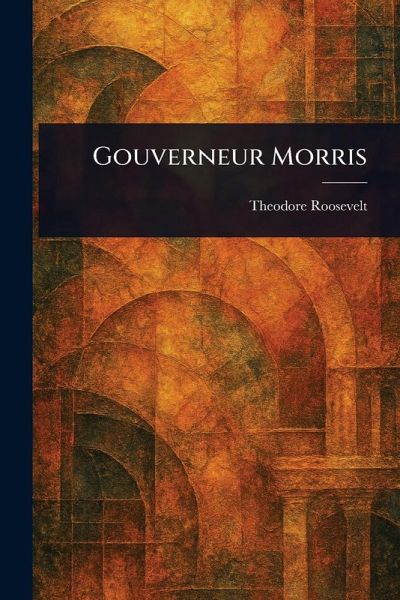
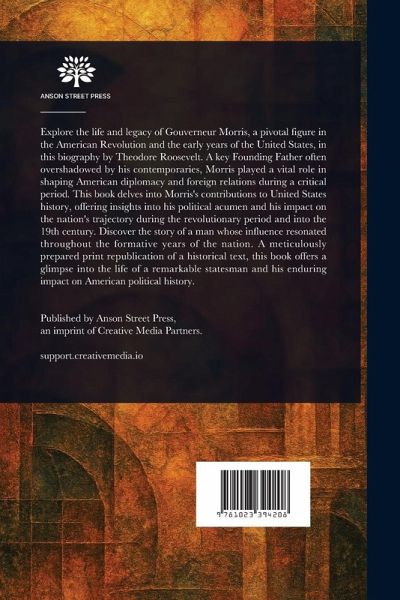
Explore the life and legacy of Gouverneur Morris, a pivotal figure in the American Revolution and the early years of the United States, in this biography by Theodore Roosevelt. A key Founding Father often overshadowed by his contemporaries, Morris played a vital role in shaping American diplomacy and foreign relations during a critical period. This book delves into Morris's contributions to United States history, offering insights into his political acumen and his impact on the nation's trajectory during the revolutionary period and into the 19th century. Discover the story of a man whose…mehr
Explore the life and legacy of Gouverneur Morris, a pivotal figure in the American Revolution and the early years of the United States, in this biography by Theodore Roosevelt. A key Founding Father often overshadowed by his contemporaries, Morris played a vital role in shaping American diplomacy and foreign relations during a critical period. This book delves into Morris's contributions to United States history, offering insights into his political acumen and his impact on the nation's trajectory during the revolutionary period and into the 19th century. Discover the story of a man whose influence resonated throughout the formative years of the nation. A meticulously prepared print republication of a historical text, this book offers a glimpse into the life of a remarkable statesman and his enduring impact on American political history. This work has been selected by scholars as being culturally important, and is part of the knowledge base of civilization as we know it. This work is in the public domain in the United States of America, and possibly other nations. Within the United States, you may freely copy and distribute this work, as no entity (individual or corporate) has a copyright on the body of the work. Scholars believe, and we concur, that this work is important enough to be preserved, reproduced, and made generally available to the public. We appreciate your support of the preservation process, and thank you for being an important part of keeping this knowledge alive and relevant.
Theodore Roosevelt ( October 27, 1858 - January 6, 1919) was an American statesman, politician, conservationist, naturalist, and writer who served as the 26th president of the United States from 1901 to 1909. He served as the 25th vice president from March to September 1901 and as the 33rd governor of New York from 1899 to 1900. Roosevelt emerged as a leader of the Republican Party and became a driving force for the anti-trust policy while supporting Progressive Era policies in the United States in the early 20th century. His face is depicted on Mount Rushmore alongside George Washington, Thomas Jefferson, and Abraham Lincoln. He is generally ranked in polls of historians and political scientists as one of the five best presidents.[3] Roosevelt was a sickly child with debilitating asthma, but he overcame his health problems by embracing a strenuous lifestyle, as well as growing out of his asthma naturally in his young adult years. He integrated his exuberant personality, a vast range of interests, and world-famous achievements into a "cowboy" persona defined by robust masculinity. He was home-schooled, and he began a lifelong naturalist avocation before attending Harvard College. His book The Naval War of 1812 (1882) established his reputation as a learned historian and as a popular writer. Upon entering politics, he became the leader of the reform faction of Republicans in New York's state legislature. His wife and his mother both died in rapid succession, and he escaped to a cattle ranch in the Dakotas. He served as Assistant Secretary of the Navy under President William McKinley, but he resigned from that post to lead the Rough Riders during the Spanish-American War, returning a war hero. He was elected governor of New York in 1898. After Vice President Garret Hobart died in 1899, the New York state party leadership convinced McKinley to accept Roosevelt as his running mate in the 1900 election. Roosevelt campaigned vigorously, and the McKinley-Roosevelt ticket won a landslide victory based on a platform of peace, prosperity, and conservation. Roosevelt took office as vice president in March 1901 and assumed the presidency at age 42 after McKinley was assassinated the following September. He remains the youngest person to become President of the United States. Roosevelt was a leader of the progressive movement, and he championed his "Square Deal" domestic policies, promising the average citizen fairness, breaking of trusts, regulation of railroads, and pure food and drugs. He made conservation a top priority and established many new national parks, forests, and monuments intended to preserve the nation's natural resources. In foreign policy, he focused on Central America where he began construction of the Panama Canal. He expanded the Navy and sent the Great White Fleet on a world tour to project the United States' naval power around the globe. His successful efforts to broker the end of the Russo-Japanese War won him the 1906 Nobel Peace Prize. He avoided controversial tariff and money issues. Roosevelt was elected to a full term in 1904 and continued to promote progressive policies, many of which were passed in Congress. He groomed his close friend William Howard Taft to successfully succeed him in the 1908 presidential election.
Es gelten unsere Allgemeinen Geschäftsbedingungen: www.buecher.de/agb
Impressum
www.buecher.de ist ein Internetauftritt der buecher.de internetstores GmbH
Geschäftsführung: Monica Sawhney | Roland Kölbl | Günter Hilger
Sitz der Gesellschaft: Batheyer Straße 115 - 117, 58099 Hagen
Postanschrift: Bürgermeister-Wegele-Str. 12, 86167 Augsburg
Amtsgericht Hagen HRB 13257
Steuernummer: 321/5800/1497
USt-IdNr: DE450055826