
Andere Kunden interessierten sich auch für
 Gramsci34,99 €
 Territories, Boundaries and Consciousness44,99 €
 Privatization33,99 €
 Putting Workfare in Place89,99 €
 Working the Spaces of Neoliberalism34,99 €
 State / Space157,99 €
 A Geography of Russia and Its Neighbors108,99 €


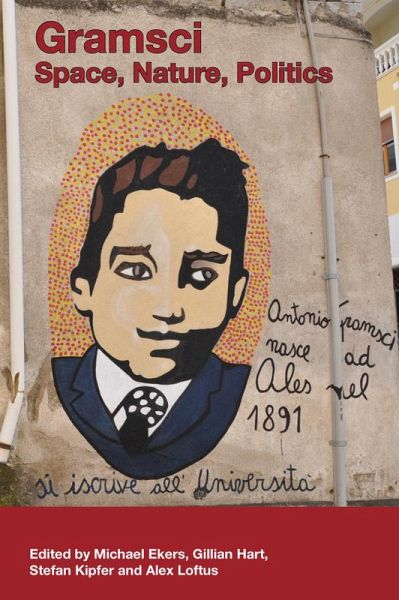
This first volume on Antonio Gramsci's relevance to contemporary concerns with space and nature takes Gramsci scholarship in new directions. It shows how his writings, well known for their historical nuance, also convey a rich spatial sensibility and a distinctive approach to geographical and ecological questions. By linking Gramsci's socially differentiated understanding of politics to his spatial and ecological concerns, the contributors demonstrate his relevance to new audiences. While recognizing his sometimes problematic discussions of sexuality, gender, racism, and (post)colonialism, several contributors discern distinctive elements of his work that bear directly on current debates. The volume presents a substantially different Gramsci from post-Marxist perspectives and recent anarchist and post-anarchist critiques. It retains his revolutionary orientation, and highlights the profound conceptual and political leverage that a spatialized reading of Gramsci enables today. Reorienting his innovative philosophy of praxis, it proposes new approaches within human geography, environmental studies, and development theory.
"As can be inferred from my opening remarks, my briefcomments on the overall purpose of this collection, and my evenbriefer comments on individual chapters, this is an importantcontribution to the urgent critical work of recovering,appropriating and recontextualizing Gramsci's concepts,methods and analyses, and, above all, 'translating'them for the current conjuncture, in which issues of politicalecology as well as political economy are ever more critical tohuman flourishing." (Antipode, 1 November2013)
'This well-crafted volume pushes the boundaries of currentdebates on Gramsci. Highlighting spatial and geographicalrelations, the diverse contributions all share detailed attentionto Gramsci's writings while opening an array of contemporaryissues including struggles in Brazil, Nepal, India and SouthAfrica, discussions of gender, class, race and ecology class, andengagements with theoretical work of Laclau & Mouffe, Lefebvre,David Harvey, Hardt & Negri and Subaltern Studies. Thecontributors have set a hallmark in scholarship that will be veryinfluential across many fields from critical geography andinternational relations to political theory, development studiesand postcolonialism.'--Peter Ives, Department ofPolitics, University of Winnipeg, Canada
'From the backwoods to the frontlines, Gramsci'sgeographical imagination receives here the thoroughgoingexploration it has always deserved. With deep and nuancedattention to Gramsci's spatial historicism, this collectionforegrounds the profoundly geographical nature of Gramsci'scritical consciousness and what it offers for thinking space,nature and politics relationally. As beautifully considered as itscover, this book is alive to the 'earthliness ofthought' and its political possibilities.'--CindiKatz, Earth and Environmental Sciences & EnvironmentalPsychology Programs, The City University of New York
'This well-crafted volume pushes the boundaries of currentdebates on Gramsci. Highlighting spatial and geographicalrelations, the diverse contributions all share detailed attentionto Gramsci's writings while opening an array of contemporaryissues including struggles in Brazil, Nepal, India and SouthAfrica, discussions of gender, class, race and ecology class, andengagements with theoretical work of Laclau & Mouffe, Lefebvre,David Harvey, Hardt & Negri and Subaltern Studies. Thecontributors have set a hallmark in scholarship that will be veryinfluential across many fields from critical geography andinternational relations to political theory, development studiesand postcolonialism.'--Peter Ives, Department ofPolitics, University of Winnipeg, Canada
'From the backwoods to the frontlines, Gramsci'sgeographical imagination receives here the thoroughgoingexploration it has always deserved. With deep and nuancedattention to Gramsci's spatial historicism, this collectionforegrounds the profoundly geographical nature of Gramsci'scritical consciousness and what it offers for thinking space,nature and politics relationally. As beautifully considered as itscover, this book is alive to the 'earthliness ofthought' and its political possibilities.'--CindiKatz, Earth and Environmental Sciences & EnvironmentalPsychology Programs, The City University of New York