
Andere Kunden interessierten sich auch für
 Science in Russia and the Soviet Union36,99 €
 Enlightenment Science in the Romantic Era42,99 €
 An Introduction to the Historiography of Science50,99 €
 Memorials of Sir C. J. F. Bunbury, Bart - Volume 864,99 €
 Mathematical and Physical Papers - Volume 654,99 €
 Memorials of Sir C. J. F. Bunbury, Bart - Volume 164,99 €
 Scientific Papers of Asa Gray55,99 €



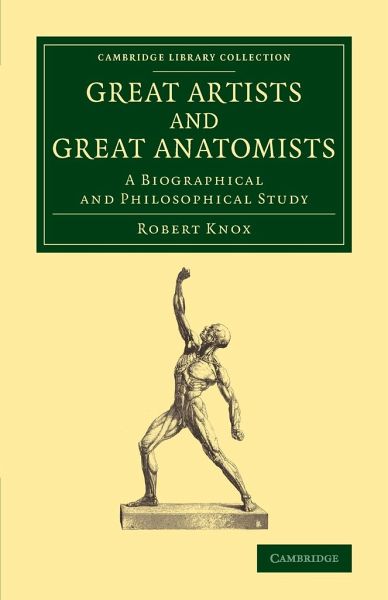
A gifted yet controversial anatomical teacher, Robert Knox (1791-1862) published this remarkable study in 1852. It explores the influence of anatomy on evolutionary theories and fine art respectively. The first part of the work discusses the lives and scientific insights of the eminent French naturalists Georges Cuvier (1769-1832) and Étienne Geoffroy Saint-Hilaire (1772-1844). Rejecting the explanations offered by natural theology, Knox maintains that descriptive anatomy can give answers to questions surrounding the origin and development of life in the natural world. The latter part of the book is concerned with the relation that anatomy bears to fine art, specifically the painting and sculpture of the Italian Renaissance. Entering the debate about the importance of anatomical knowledge in art, Knox focuses on 'the immortal trio' of Leonardo da Vinci, Michelangelo and Raphael. Henry Lonsdale's sympathetic biography of Knox has also been reissued in this series.