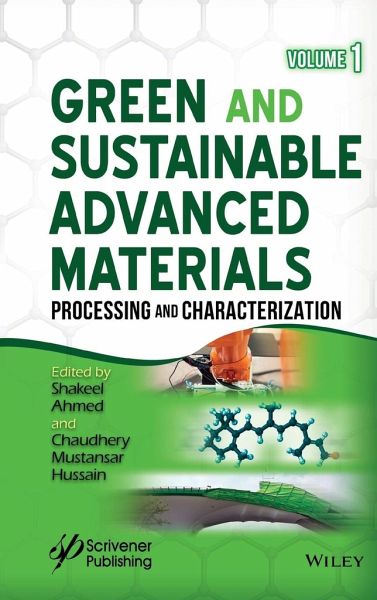
This book is industry-oriented and shows current challenges for scaling up green and sustainable advanced materials design and manufacturing technology. Green and sustainable advanced materials are the newly synthesized material having superior and special properties. These fulfil today's growing demand for equipment, machines and devices with better quality for an extensive range of applications in various sectors such as paper, biomedical, food, construction, textile, and many more. The objective of this two-volume set is to provide an overview of new developments and state-of-the-art for a…mehr
This book is industry-oriented and shows current challenges for scaling up green and sustainable advanced materials design and manufacturing technology. Green and sustainable advanced materials are the newly synthesized material having superior and special properties. These fulfil today's growing demand for equipment, machines and devices with better quality for an extensive range of applications in various sectors such as paper, biomedical, food, construction, textile, and many more. The objective of this two-volume set is to provide an overview of new developments and state-of-the-art for a variety of green and sustainable advanced materials. It incorporates in-depth technical information without compromising the delicate link between factual data and fundamental concepts or between theory and practice. In this first volume, the first chapter presents an overview and characterization of green and sustainable advanced materials. The subsequent chapters encompass details of biopolymers, biocomposite materials and nanomaterials. Subsequent chapters describe biogenic approaches for SiO2 nanostructures nanofabrication, polymer and composite materials, design and processing aspects of polymer and composite materials. The next set of chapters incorporate seaweed-based binder in wood composites, coloration and functional finishing of textile materials using natural resources. The final two chapters discuss advances in bio-nanohybrid materials, selenium nanoparticles and their biotechnological applications. Audience The 2-volume set will be of significant interest to materials scientists, chemists, pharmacists, biologists, biotechnologists and chemical engineers who are involved in the future frontiers of advanced materials, polymer and ceramic sciences & technology. The books will also appeal to advanced undergraduate and graduate students who will find a useful source of knowledge for their studies
Shakeel Ahmed is a Research Fellow at Bio/Polymers Research Laboratory, Department of Chemistry, Jamia Millia Islamia, New Delhi. He obtained his PhD in the area of biopolymers and bionanocomposites. He has published several research publications in the area of green nanomaterials and biopolymers for various applications including biomedical, packaging, sensors, and water treatment. He is an associate member of the Royal Society of Chemistry (RSC), UK and life member of the Asian Polymer Association and Society of Materials Chemistry. Chaudhery Mustansar Hussain, is an Adjunct Professor, an Academic Advisor and Director of Laboratories in the Department of Chemistry & Environmental Sciences at the New Jersey Institute of Technology (NJIT), Newark, New Jersey, USA. Dr. Hussain is the author of numerous papers in peer-reviewed journals as well as a prolific author and editor of several scientific monographs and handbooks in his research areas.
Inhaltsangabe
1. Green and Sustainable Advanced Materials: Overview Tanvir Arfin, Arshiya Tarannum and Kamini Sonawane. 1 1.1. History. 1 1.2. Biomaterials. 2 1.3. CdS. 18 1.4. Carbon Nanotube. 19 1.5. Fe Containing Nanomaterial. 20 1.6. Graphene. 20 1.7. Graphene Oxide. 22 1.8. Inulin. 23 1.9. Pectin. 24 1.10. Metal Oxide. 25 1.11. Polymer. 27 1.12 Bentonite. 29 1.13 Conclusion. 29 References. 30 2. Characterization of Green and Sustainable Advanced Materials. 35 Pintu Pandit and Gayatri T.N. 2.1. Introduction. 36 2.2. Characterization of Advanced Materials. 38 2.3. Physical Characterization of Advanced Materials. 39 2.4. Chemical Characterization of Advanced Materials. 50 2.5. Conclusions. 61 References. 62 3. Green and Sustainable Advanced Biopolymeric and Biocomposite Materials. 67 T.P. Mohan and K. Kanny 3.1. Introduction. 67 3.2. Classification of Green Materials. 68 3.3. Biopolymers. 69 3.4. Natural Fillers. 70 3.5. Natural Fibers. 72 3.6. Biocomposites. 73 3.7. Merits and Demerits of Green Materials. 76 3.8. Recent Progress in Improvement of Material Properties. 78 3.9. Current Applications of Biocomposites and Biopolymers. 79 3.10. Futuristic Applications of Biocomposites and Biopolymers. 83 3.11. Conclusion. 85 References. 86 4. Green and Sustainable Advanced Nanomaterials. 93 Alaa K. H. Al-Khalaf and Falah H. Hussein 4.1. Introduction. 93 4.2. Applications of Natural NanoOrganic Materials. 100 4.3. Conclusion. 104 References. 105 5. Biogenic Approaches for SiO2 Nanostructures: Exploring the Sustainable Platform of Nanofabrication. 107 M. Hariram, P. Vishnukumar and S. Vivekanandhan 5.1. Introduction. 108 5.2. Synthesis of SiO2 Nanostructures. 109 5.3. Bio-Mediated Sustainable Processes for SiO2 Nanostructures. 115 5.4. Biogenic SiO2 based Doped, Functionalized and Composite Nanostructures. 125 5.5. Applications of Bio-fabricated SiO2 Nanoparticles. 129 5.6. Conclusions. 131 Acknowledgements. 132 References. 132 6. Green and Sustainable Advanced Composite Materials. 143 Yahya F. Al-Khafaji and Falah H. Hussein. 6.1. Introduction. 143 6.2. Applications of Polymers. 145 6.3. The Problems of Synthetic Polymers. 145 6.4. Why Biodegradable Polymers. 147 6.5. Biodegradable Polymers. 147 6.6. Copolymers. 147 6.7. Examples of Biodegradable Polymers is Polyesters. 148 6.8. Conclusion. 152 References. 152 7. Design and Processing Aspects of Polymer and Composite Materials. 155 Hafiz M. N. Iqbal, Muhammad Bilal and Tahir Rasheed 7.1. Introduction. 156 7.2. Design and Processing. 158 7.3. Natural Polymers and Their Applied Potentialities. 158 7.4. Synthetic Polymers and Their Applied Potentialities. 169 7.5. Materials-based Biocomposites. 173 7.6. Concluding Remarks and Future Considerations. 179 Conflict of Interest. 180 Acknowledgements. 180 References. 180 8. Seaweed-Based Binder in Wood Composites. 191 Kang Chiang Liew and Nur Syafiqah Nadiah Abdul Ghani 8.1. Introduction. 191 8.2. Methods and Techniques. 193 8.3. Results and Discussion. 195 8.4. Conclusion. 208 References. 209 9. Green and Sustainable Textile Materials Using Natural Resources. 213 Pintu Pandit, Gayatri T.N. and Saptarshi Maiti 9.1. Introduction. 213 9.2. Sustainable Colouration of Textile Materials Using Natural Plant Waste Resources. 216 9.3. Sustainable Antibacterial Finishing of Textile Materials Using Natural Waste Resources. 223 9.4. Sustainable UV Protective Textile Materials Using Waste Natural Resources. 226 9.5. Sustainable Green Flame Retardant Textile Materials Using Natural Resources. 229 9.6. Sustainable Textile Materials Using Clay as Natural Resources. 243 9.7. Sustainable Application of Aroma Finishing in Textile Materials Using Natural Resources. 250 9.8. Sustainable Mosquito Repellent Textile Materials Using Natural Resources. 253 9.9. Conclusion. 256 References. 257 10. Green Engineered Functional Textile Materials. 263 Pravin Chavan, Shahid-ul-Islam, Akbar Ali, Shakeel Ahmed and Javed Sheikh 10.1. Introduction. 263 10.2. Different Finishes Applied onto Textiles: Present Techniques vs. Green Methods. 266 10.3. Methods of Application of Microcapsules on Textiles. 273 10.4. Release Mechanism of Core Material from Microcapsules. 273 10.5. Chemistry of EO. 273 10.6. Evaluation of Mosquito Repellency. 276 10.7. Aroma Finish. 279 10.8. Conclusion. 282 References. 283 11. Advances in Bio-Nanohybrid Materials. 289 Houda Saad, Pedro Luis de Hoyos, Ezzeddine Srasra, Fatima Charrier-El Bouhtoury 11.1. Introduction. 289 11.2. Inorganic/Organic Hybrids. 290 11.3. Bio-nanohybrid Materials Based on Clay and Polyphenols. 297 11.4. Conclusions and Perspectives. 323 References. 324 12. Green and Sustainable Selenium Nanoparticles and Their Biotechnological Applications. 333 MeryamSardar and HammadAlam 12.1. Introduction. 334 12.2. Synthesis of SeNPs. 335 12.3. Biotechnological Applications of SeNPs. 341 12.4. Conclusion. 347 Acknowledgments. 348 References. 348 Index. 000