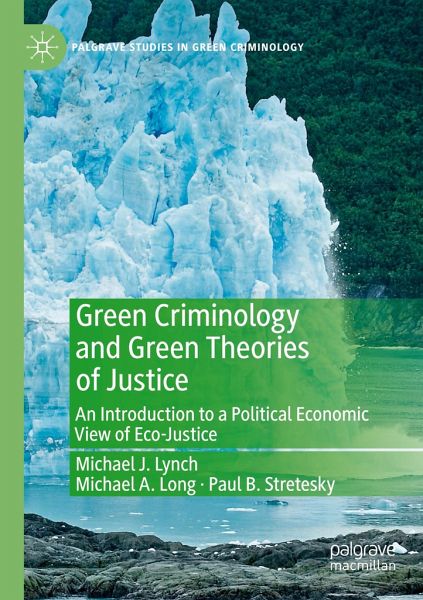
This book offers an alternative analysis of the various theories and dimensions of green and environmental justice which are rooted in political economy. Much green criminological literature sidelines political economic theoretical insights and therefore with this work the authors enrich the field by vigorously exploring such perspectives. It engages with a number of studies relevant to a political economic approach to justice in order to make two key arguments: that capitalism has produced profound ecological injustices and that the concept of ecological justice (human and ecological rights)…mehr
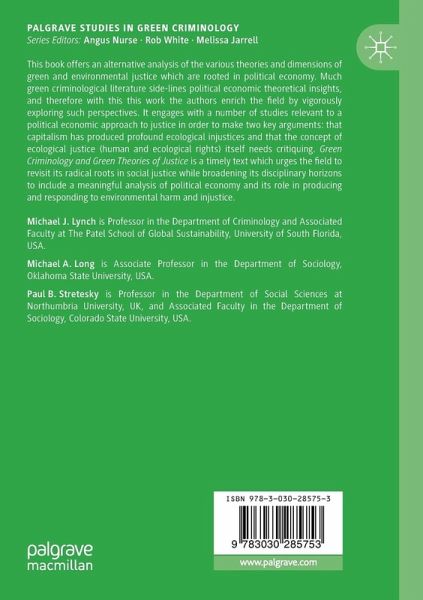
This book offers an alternative analysis of the various theories and dimensions of green and environmental justice which are rooted in political economy. Much green criminological literature sidelines political economic theoretical insights and therefore with this work the authors enrich the field by vigorously exploring such perspectives. It engages with a number of studies relevant to a political economic approach to justice in order to make two key arguments: that capitalism has produced profound ecological injustices and that the concept of ecological justice (human and ecological rights) itself needs critiquing. Green Criminology and Green Theories of Justice is a timely text which urges the field to revisit its radical roots in social justice while broadening its disciplinary horizons to include a meaningful analysis of political economy and its role in producing and responding to environmental harm andinjustice.
Kenneth J. Berry is Professor Emeritus in the Department of Sociology at Colorado State University. He is the author of eight books and over 190 journal articles, primarily in the areas of statistics and quantitative research methods. Janis E. Johnston is employed by the U.S. Government and is an Affiliate Faculty member in the Department of Sociology at Colorado State University. She is the author of six books and over 40 journal articles, primarily in the areas of statistics and quantitative research methods. Michael A. Long is Professor and Director of Graduate Studies in the Department of Sociology at Oklahoma State University. He is the author of six books and over 100 journal articles and book chapters, primarily in the areas of environmental sociology, green criminology, food insecurity and quantitative methodology. Paul B. Stretesky is Professor of Sociology in the Department of Social Sciences at Northumbria University, UK. He is author of eight books and over 100 journal articles, primarily in the areas of environmental justice, green criminology and food insecurity. Michael J. Lynch is Professor and Director of the Graduate Program in the Department of Criminology at University of South Florida. He is author/editor of over 25 books and over 120 journal articles, primarily in the areas of green criminology, radical criminology, and environmental sociology.
Inhaltsangabe
1: Introduction: Green Theories Of Justice And Political Economy.- 2. Connecting Ecological Decline And Eco-Justice.- 3. Eco-Justice And An Orientation Toward The Ecosystem.- 4. Human Social & Ecological Justice In The Global World: Capitalist System And The Treadmill Of Production.- 5. Unsustainable Economic Development And Nonhuman Ecological Justice.- 6. Gaia And A Green Theory Of Justice.- 7. Metabolic Rift And Eco-Justice.- 8.Political Economy, Food And Eco-Justice.- 9. Conclusion.
1: Introduction: Green Theories Of Justice And Political Economy.- 2. Connecting Ecological Decline And Eco-Justice.- 3. Eco-Justice And An Orientation Toward The Ecosystem.- 4. Human Social & Ecological Justice In The Global World: Capitalist System And The Treadmill Of Production.- 5. Unsustainable Economic Development And Nonhuman Ecological Justice.- 6. Gaia And A Green Theory Of Justice.- 7. Metabolic Rift And Eco-Justice.- 8.Political Economy, Food And Eco-Justice.- 9. Conclusion.
Rezensionen
"Green Criminology and Green Theories of Justice is an especially useful addition to the growing literature on green criminology. ... Summing Up: Highly recommended. Upper-division undergraduates through faculty." (P. Beirne, Choice, Vol. 57 (11), 2020)
Es gelten unsere Allgemeinen Geschäftsbedingungen: www.buecher.de/agb
Impressum
www.buecher.de ist ein Internetauftritt der buecher.de internetstores GmbH
Geschäftsführung: Monica Sawhney | Roland Kölbl | Günter Hilger
Sitz der Gesellschaft: Batheyer Straße 115 - 117, 58099 Hagen
Postanschrift: Bürgermeister-Wegele-Str. 12, 86167 Augsburg
Amtsgericht Hagen HRB 13257
Steuernummer: 321/5800/1497
USt-IdNr: DE450055826