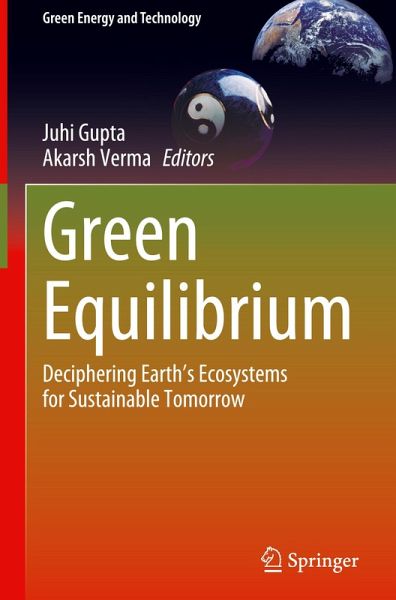
This book offers a profound exploration into our planet's intricate ecosystems, highlighting the urgent need for sustainable practices. Through insightful analysis and compelling narratives, this book unveils the delicate balance of nature and our role in preserving it for future generations. This book is a must-read for those committed to understanding and protecting our Earth's environmental harmony. Join the journey toward a sustainable tomorrow.
This book offers a profound exploration into our planet's intricate ecosystems, highlighting the urgent need for sustainable practices. Through insightful analysis and compelling narratives, this book unveils the delicate balance of nature and our role in preserving it for future generations. This book is a must-read for those committed to understanding and protecting our Earth's environmental harmony. Join the journey toward a sustainable tomorrow.
Dr. Juhi Gupta, Assistant Professor at Amity University in Noida, India, brings a wealth of knowledge to the academic world. She holds a Ph.D. from Jawaharlal Nehru University, New Delhi, and specializes in environmental microbiology, ecosystem sustainability and resource management. Her skill set also includes advanced techniques like next-generation sequencing and climate change monitoring. Dr. Gupta's academic achievements are numerous and distinguished, highlighted by her receipt of the J. William Fulbright Research Scholarship in the USA and the Swachh Sarthi Fellowship from the Government of India. Her exemplary performance in India's National Eligibility Test (NET) and the Doctoral Research Scholarship awarded by the Department of Science and Technology (DST), India, are testaments to her scholarly prowess. Additionally, she actively contributes to the scientific community by reviewing for various prominent Elsevier Publications journals. Dr. Gupta's deep commitment and vast expertise in environmental sciences distinguish her as a prominent figure in her field. Prof. (Dr.) Akarsh Verma is currently working as an Assistant Professor at UPES (University of Petroleum and Energy Studies), India. Earlier, he was a Japan Society for the Promotion of Science (JSPS) International Research Fellow at Osaka University, Japan. He obtained a Ph.D. in Mechanical Engineering from the Indian Institute of Technology Roorkee, India, and did his postdoctoral research work at the Brigham Young University, USA. He serves the research community by acting as a reviewer for various international journals (Nature, Springer, Elsevier, Sage, Taylor & Francis, Wiley, IOP, etc.). In addition, he has published research articles in high-quality international peer-reviewed journals, books and book chapters, and presented many research papers at various international/national conferences. His area of interest is computational mechanics, atomistic-scale modelling, computational chemistry, etc. He has also been recognized by Stanford University’s list of the world’s top 2% of the Most-Cited Scientists in Single Year Citation Impact (2023, 2022, 2021 and 2020).
Inhaltsangabe
Chapter 1. Ecological Equilibria: Understanding Keystone Species and Trophic Cascades.- Chapter 2. Analysing the Impacts of Invasive Species for Ecosystems Under Stress.- Chapter 3. Conservation Strategies for Endangered Species and Habitats.- Chapter 4. Carbon Cycling and Climate Feedbacks in Terrestrial Ecosystems.- Chapter 5. Microbial Ecosystems and Biogeochemical Cycles.- Chapter 6. Phytoplankton Dynamics and Ocean Ecosystem Health.- Chapter 7. Marine Ecosystem Dynamics: Coral Reefs and Ocean Acidification.- Chapter 8. Ocean Warming and Marine Migratory Patterns.- Chapter 9. Urban Ecosystems: Biodiversity in Human-Dominated Landscapes.- Chapter 10. Agricultural Ecosystems and Sustainable Food Production.- Chapter 11. Pollinators in Crisis: The Decline of Bees and Its Impacts.- Chapter 12. Ecohydrology: Water Management in Changing Environments.- Chapter 13. Climate Change Adaptation Strategies for Coastal Communities.- Chapter 14. Remote Sensing and GIS in Ecosystem Monitoring.- Chapter 15. Restoration Ecology: Principles and Practices for Degraded Ecosystems.- Chapter 16. Advances in Climate Modeling and Ecosystem Prediction.- Chapter 17. Renewable Energy and Ecosystem Conservation.- Chapter 18. Conservation Genomics: A New Frontier in Ecosystem Management.- Chapter 19. Environmental Justice and Ecosystem Management.- Chapter 20. Ecosystem Services Valuation and Environmental Economics.
Chapter 1. Ecological Equilibria: Understanding Keystone Species and Trophic Cascades.- Chapter 2. Analysing the Impacts of Invasive Species for Ecosystems Under Stress.- Chapter 3. Conservation Strategies for Endangered Species and Habitats.- Chapter 4. Carbon Cycling and Climate Feedbacks in Terrestrial Ecosystems.- Chapter 5. Microbial Ecosystems and Biogeochemical Cycles.- Chapter 6. Phytoplankton Dynamics and Ocean Ecosystem Health.- Chapter 7. Marine Ecosystem Dynamics: Coral Reefs and Ocean Acidification.- Chapter 8. Ocean Warming and Marine Migratory Patterns.- Chapter 9. Urban Ecosystems: Biodiversity in Human-Dominated Landscapes.- Chapter 10. Agricultural Ecosystems and Sustainable Food Production.- Chapter 11. Pollinators in Crisis: The Decline of Bees and Its Impacts.- Chapter 12. Ecohydrology: Water Management in Changing Environments.- Chapter 13. Climate Change Adaptation Strategies for Coastal Communities.- Chapter 14. Remote Sensing and GIS in Ecosystem Monitoring.- Chapter 15. Restoration Ecology: Principles and Practices for Degraded Ecosystems.- Chapter 16. Advances in Climate Modeling and Ecosystem Prediction.- Chapter 17. Renewable Energy and Ecosystem Conservation.- Chapter 18. Conservation Genomics: A New Frontier in Ecosystem Management.- Chapter 19. Environmental Justice and Ecosystem Management.- Chapter 20. Ecosystem Services Valuation and Environmental Economics.
Es gelten unsere Allgemeinen Geschäftsbedingungen: www.buecher.de/agb
Impressum
www.buecher.de ist ein Internetauftritt der buecher.de internetstores GmbH
Geschäftsführung: Monica Sawhney | Roland Kölbl | Günter Hilger
Sitz der Gesellschaft: Batheyer Straße 115 - 117, 58099 Hagen
Postanschrift: Bürgermeister-Wegele-Str. 12, 86167 Augsburg
Amtsgericht Hagen HRB 13257
Steuernummer: 321/5800/1497
USt-IdNr: DE450055826