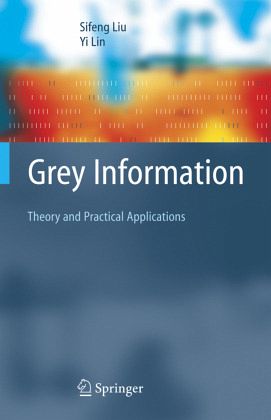
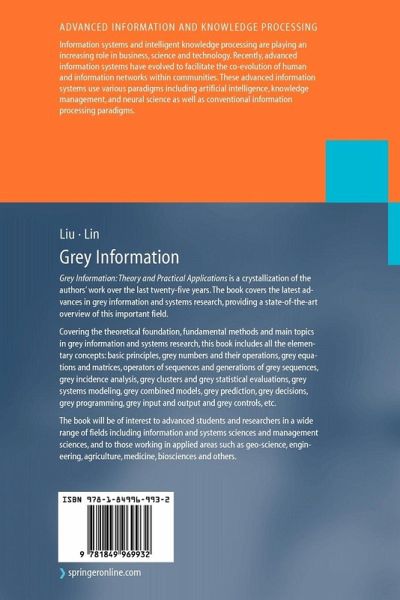
Rapid formation and development of new theories of systems science have become an important part of modern science and technology. For - ample, since the 1940s, there have appeared systems theory, information theory, fuzzy mathematics, cybernetics, dissipative structures, synergetics, catastrophe theory, chaos theory, bifurcations, ultra circulations, dynamics, and many other systems theories. Grey systems theory is also one of such systems theories that appeared initially in the 1980s. When the research of systems science and the method and technology of systems engineering are applied in…mehr
Rapid formation and development of new theories of systems science have become an important part of modern science and technology. For - ample, since the 1940s, there have appeared systems theory, information theory, fuzzy mathematics, cybernetics, dissipative structures, synergetics, catastrophe theory, chaos theory, bifurcations, ultra circulations, dynamics, and many other systems theories. Grey systems theory is also one of such systems theories that appeared initially in the 1980s. When the research of systems science and the method and technology of systems engineering are applied in various traditional disciplines, such as management science, decision science, and various scienti?c disciplines, a whole new group of new results and breakthroughs are obtained. Such a historical background has provided the environment and soil for grey systems theory to form and to develop rapidly in the past 20-plus years. More speci?cally, in 1982, Professor Deng Ju-Long published the ?rst research paper in the area of grey systems in the international journal entitled Systems and Control Letters, published by North-Holland Co. His paper was titled "Control Problems of Grey Systems. " The publication of this paper signalled the birth of grey systems theory after many years of e ective research of the founding father. This new theory soon caught the attention of the international academic community and practitioners of science. Many well-known scholars, such as Chinese academicians Qian Xueshen, Song Jian, and Zhang Zhongjun. Professor Roger W.
Professor Sifeng Liu, Ph.D., a distinguished professor at Northwestern Polytechnical University. He was a professor at NUAA, DMU and HAU respectively. Dr Liu has selected into the long-term project of national major talent programs of China, honorary fellow of WOSC, and senior fellowship of Marie Sk¿odowska-Curie actions of the EU. He is serving as the founding director of CGSS at NPU, the founding president of IAGSUA, the founding editor of GS, and the editor-in-chief of JGS and two book series on Grey Systems one in English (Springer-Nature) and the other one in Chinese (Science Press). He was the founding director of IGSS at NUAA and the founding president of GSSC. His publications has been cited 51631 times with an H-Index of 95 in Huezhi Scholar and ranking first in the list of the highly cited authors in the field of system science by Baidu Scholar. He has listed in top 2% scientists of the world by Stanford University. On the 7th of September, 2019, then German Chancellor Merkel praised Prof. Liu's work as "profoundly influencing the world". In 2023, Prof. Liu won the Global Excellence Award by GSSP. In 2024, he was selected as one of the top 0.05% Highly Ranked Scholar-Lifetime of the world by Scholar GPS.
Inhaltsangabe
Grey Numbers and Their Operations.- Grey Equations and Grey Matrices.- Generation of Grey Sequences.- Grey Incidence Analysis.- Grey Clusters and Grey Statistical Evaluations.- Grey Systems Modeling.- Grey Combined Models.- Grey Prediction.- Grey Decisions.- Grey Programming.- Grey Input and Output.- Grey Control.
Grey Numbers and Their Operations.- Grey Equations and Grey Matrices.- Generation of Grey Sequences.- Grey Incidence Analysis.- Grey Clusters and Grey Statistical Evaluations.- Grey Systems Modeling.- Grey Combined Models.- Grey Prediction.- Grey Decisions.- Grey Programming.- Grey Input and Output.- Grey Control.
Rezensionen
From the reviews: "I am much interested and impressed by Dr. Sifeng Liu and Dr. Yi Lin's recently published monograph on grey information, dealing with the theory and practical applications. ... It is a comprehensive, all-in-one exposition, detailing not only with the theoretical foundation but also real-life applications. Because of this characteristic of quality and usefulness, Liu and Lin's book possesses the value of the widest possible range of reference by the workers and practitioners from all concerns of natural and social sciences and technology." (Robert Vallée, Kybernetes, Vol. 37 (1), 2008)
Es gelten unsere Allgemeinen Geschäftsbedingungen: www.buecher.de/agb
Impressum
www.buecher.de ist ein Internetauftritt der buecher.de internetstores GmbH
Geschäftsführung: Monica Sawhney | Roland Kölbl | Günter Hilger
Sitz der Gesellschaft: Batheyer Straße 115 - 117, 58099 Hagen
Postanschrift: Bürgermeister-Wegele-Str. 12, 86167 Augsburg
Amtsgericht Hagen HRB 13257
Steuernummer: 321/5800/1497
USt-IdNr: DE450055826