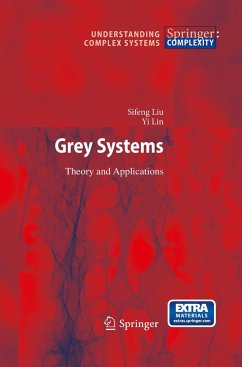
Due to inherent limitations in human sensing organs, most data collected for various purposes contain uncertainties. Even at the rare occasions when accurate data are available, the truthful predictions derived on the data tend to create chaotic consequences. So, to effectively process and make sense out of available data, we need methods to deal with uncertainty inherently existing inside the data. The intent of this monograph is to explore the fundamental theory, methods, and techniques of practical application of grey systems theory, initiated by Professor Deng Julong in 1982. This volume…mehr
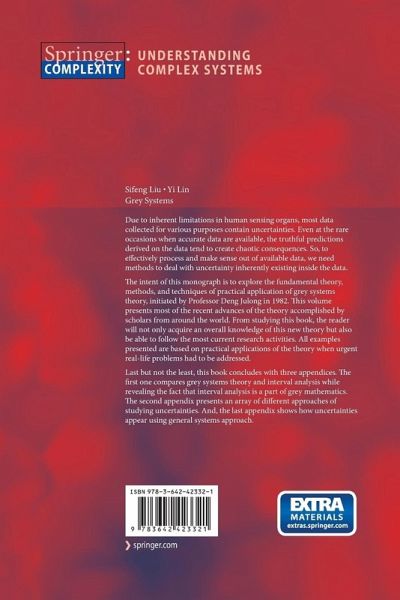
Due to inherent limitations in human sensing organs, most data collected for various purposes contain uncertainties. Even at the rare occasions when accurate data are available, the truthful predictions derived on the data tend to create chaotic consequences. So, to effectively process and make sense out of available data, we need methods to deal with uncertainty inherently existing inside the data. The intent of this monograph is to explore the fundamental theory, methods, and techniques of practical application of grey systems theory, initiated by Professor Deng Julong in 1982. This volume presents most of the recent advances of the theory accomplished by scholars from around the world. From studying this book, the reader will not only acquire an overall knowledge of this new theory but also be able to follow the most current research activities. All examples presented are based on practical applications of the theory when urgent real-life problems had to be addressed. Last butnot the least, this book concludes with three appendices. The first one compares grey systems theory and interval analysis while revealing the fact that interval analysis is a part of grey mathematics. The second appendix presents an array of different approaches of studying uncertainties. And, the last appendix shows how uncertainties appear using general systems approach.
Professor Sifeng Liu, Ph.D., a distinguished professor at Northwestern Polytechnical University. He was a professor at NUAA, DMU and HAU respectively. Dr Liu has selected into the long-term project of national major talent programs of China, honorary fellow of WOSC, and senior fellowship of Marie Sk¿odowska-Curie actions of the EU. He is serving as the founding director of CGSS at NPU, the founding president of IAGSUA, the founding editor of GS, and the editor-in-chief of JGS and two book series on Grey Systems one in English (Springer-Nature) and the other one in Chinese (Science Press). He was the founding director of IGSS at NUAA and the founding president of GSSC. His publications has been cited 51631 times with an H-Index of 95 in Huezhi Scholar and ranking first in the list of the highly cited authors in the field of system science by Baidu Scholar. He has listed in top 2% scientists of the world by Stanford University. On the 7th of September, 2019, then German Chancellor Merkel praised Prof. Liu's work as "profoundly influencing the world". In 2023, Prof. Liu won the Global Excellence Award by GSSP. In 2024, he was selected as one of the top 0.05% Highly Ranked Scholar-Lifetime of the world by Scholar GPS.
Inhaltsangabe
Introduction to Grey Systems Theory.- Basic Building Blocks.- Grey Incidence and Evaluations.- Grey Systems Modeling.- Discrete Grey Prediction Models.- Combined Grey Models.- Grey Models for Decision Making.- Grey Game Models.- Grey Control Systems.- Introduction to the Software of Grey Systems Modeling.- Appendix A: Interval Analysis and Grey Systems Theory.- Appendix B: Approaches of Uncertainty.- Appendix C: How Uncertainties Appear: A General Systems Approach.
Introduction to Grey Systems Theory.- Basic Building Blocks.- Grey Incidence and Evaluations.- Grey Systems Modeling.- Discrete Grey Prediction Models.- Combined Grey Models.- Grey Models for Decision Making.- Grey Game Models.- Grey Control Systems.- Introduction to the Software of Grey Systems Modeling.- Appendix A: Interval Analysis and Grey Systems Theory.- Appendix B: Approaches of Uncertainty.- Appendix C: How Uncertainties Appear: A General Systems Approach.
Rezensionen
From the reviews: "The purpose of this monograph is to collect the most recent advances accomplished by scientists from around the world ... . This meticulous work is based on an extensive bibliography that is converted into a very valuable reference book by a careful topic selection and by the significance of applications and examples. The book is highly recommended to graduate students or high-level undergraduate students and to any other scientists or professionals in areas of science, technology, agriculture, medicine, astronomy, earth science, economics, and management." (Mihail Voicu, Zentralblatt MATH, Vol. 1222, 2011)
Es gelten unsere Allgemeinen Geschäftsbedingungen: www.buecher.de/agb
Impressum
www.buecher.de ist ein Internetauftritt der buecher.de internetstores GmbH
Geschäftsführung: Monica Sawhney | Roland Kölbl | Günter Hilger
Sitz der Gesellschaft: Batheyer Straße 115 - 117, 58099 Hagen
Postanschrift: Bürgermeister-Wegele-Str. 12, 86167 Augsburg
Amtsgericht Hagen HRB 13257
Steuernummer: 321/5800/1497
USt-IdNr: DE450055826