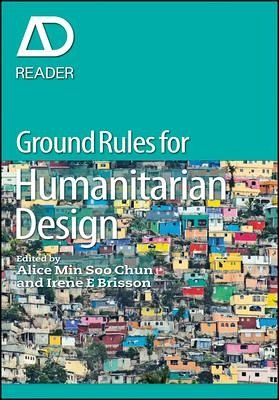
Today, the ambition to provide humanitarian architecture for areas in acute need - whether afflicted by disease, poverty, conflict or ecological disaster - is driving design innovation worldwide among practitioners and educators. While still at college, many North American and European students are being given the opportunity to participate directly in programmes that provide vital facilities for communities abroad. Ground Rules for Humanitarian Design seeks to provide parameters for engagement at a time when these international initiatives remain largely ad hoc. Through the publication of…mehr
Today, the ambition to provide humanitarian architecture for areas in acute need - whether afflicted by disease, poverty, conflict or ecological disaster - is driving design innovation worldwide among practitioners and educators. While still at college, many North American and European students are being given the opportunity to participate directly in programmes that provide vital facilities for communities abroad. Ground Rules for Humanitarian Design seeks to provide parameters for engagement at a time when these international initiatives remain largely ad hoc. Through the publication of technical and theoretical writings on the subject, this anthology establishes foundations for thinking about design and its role in development for global change. Ground Rules for Humanitarian Design provides an indispensable resource for designers, academics, and humanitarian organisations faced with building after disaster and engaged in the search for the sustainable inclusion of cultural code and compassion as a technology for design innovation. The integration of culture, art, architecture, economy, ecology, health and education, are absolute necessities for design and architecture. The book is organised into distinct sections, with contributions from experts on the topics of land, health, water, ecology, local materials and skills, housing, education and planning. Richly illustrated, this publication combines graphic documentation of projects, maps and data-tracking developments in the Americas, Asia and Africa. The content is underpinned by an opening section that defines humanitarian design even as this term evolves in practice.
Alice Min Soo Chun is assistant professor of design and material culture at Parsons The New School for Design, with a focus on material technology and renewable energy. She is CEO and president of FAARM, a non-profit organisation, dedicated to humanitarian design efforts worldwide and co-founder of Solight Design, a design startup in New York City. She has taught architecture at Columbia University, the University of Pennsylvania and the University of Arizona, and has been building award-winning community outreach projects. Her work has been published in the New York Times, Architectural Record, Dwell and the Journal of Architectural Education, the Herald Tribune and the New York Observer. Irene Brisson is a designer and educator interested in the development and implementation of equitable design processes. As vice-president of FAARM she has led design and research projects in southern Haiti since 2010. An alumna of Columbia University and the Massachusetts Institute of Technology, she has taught at Parsons the New School for Design and Bowling Green State University and is a doctoral student in the Taubman College of Architecture and Urban Planning at the University of Michigan.
Inhaltsangabe
8 Introduction Ground Rules for Humanitarian Design 18 Part 1 - Histories of Humanitarian Design and Aid 20 Humanitarian Design Notes for a Definition Christian Hubert and Ioanna Theocharopoulou 36 Fifty Years of the Community-Led Incremental Development Paradigm for Urban Housing and Place-Making John FC Turner and Patrick Wakely 56 Part 2 - Land 58 Real Estate and Property Rights in Humanitarian Design Jesse M Keenan 70 Remediating Ecocide Alice Min Soo Chun 86 Part 3 - Crisis in Health and Culture 88 Crisis Architecture Conflict, Cultures of Displacement and Crisis-forms J Yolande Daniels 98 Emergency Medical Structures Sabrina Plum 110 Part 4 - Water and Sanitation 112 Fluid Matters On Water and Design Elizabeth Parker 124 Water, Sanitation and Hygiene Interventions Household Water Treatment and Safe Storage to Reduce the Burden of Diarrhoeal Disease in Developing Countries Daniele Lantagne 134 Part 5 - Ecology and Humanitarian Design 136 Architectures of Eco-Literacy Eric Höweler and J Meejin Yoon 142 Circling Research with Design NLÉ's African Water Cities Project and Prototype Floating School for Makoko Kunlé Adeyemi 148 Part 6 - Local Materials and Local Skills 150 Intelligent Materials and Technology Alice Min Soo Chun 168 One City Merritt Bulcholz 176 Part 7 - Shelter and Housing 178 Missing Scales Deborah Gans 192 reCOVER Emergency Shelter Interventions Anselmo G Canfora 210 Part 8 - Education and Practice 212 Humanitarian Architecture Is Hip. Now What? Eric Cesal 218 Reading Codes Is a Whole New World Grainne Hassett 238 Part 9 - Architecture, Planning and Politics 240 Delmas 32 A Post-Disaster Planning Experience in Haiti Sabine Malebranche 250 Building On, Over, With Postcolonialism and Humanitarian Design Irene E Brisson 258 Select Bibliography 259 Index
Es gelten unsere Allgemeinen Geschäftsbedingungen: www.buecher.de/agb
Impressum
www.buecher.de ist ein Internetauftritt der buecher.de internetstores GmbH
Geschäftsführung: Monica Sawhney | Roland Kölbl | Günter Hilger
Sitz der Gesellschaft: Batheyer Straße 115 - 117, 58099 Hagen
Postanschrift: Bürgermeister-Wegele-Str. 12, 86167 Augsburg
Amtsgericht Hagen HRB 13257
Steuernummer: 321/5800/1497
USt-IdNr: DE450055826