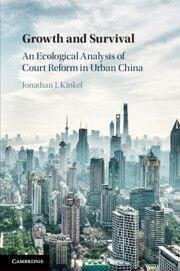
34,99 €
inkl. MwSt.
Versandkostenfrei*Erscheint vorauss. 19. Februar 2026
Melden Sie sich
hier
hier
für den Produktalarm an, um über die Verfügbarkeit des Produkts informiert zu werden.
oder sofort lesen als eBook

17 °P sammeln
Andere Kunden interessierten sich auch für
 How Do Separatist Insurgents Use Negotiations for Their Growth and Survival?17,99 €
 Votes for Survival38,99 €
 The Costs of Regime Survival43,99 €
 Labour Unions, Public Policy and Economic Growth40,99 €
 The Economics of Saving and Growth51,99 €
 See You in Court17,99 €
 William Pitt, Earl Of Chatham; And The Growth And Division Of The British Empire, 1708-177826,99 €



Bridging disparate literatures on courts and the legal profession in China, Jonathan J. Kinkel introduces an innovative cross-disciplinary framework to understand the reality of Chinese politics and society. Fusing a variety of perspectives from social ecology, historical institutionalism, and empirical legal studies, Kinkel contextualises patterns of court reform within China's rapid economic and social transformations. This book's extensive case studies emphasise the dynamic expansion of the legal system in the post-Mao reform period and demonstrate that law firm growth in large cities, especially in the early twenty-first century, pressured courts at the local and national levels to enhance judicial autonomy. Advancing debates on the multiplicity of political-legal regimes, this book offers a comprehensive, empirical account of how reforms in both the public and private arenas can interact and operate alongside one another.