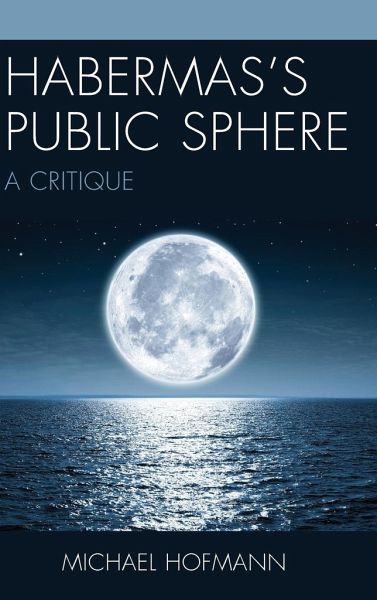
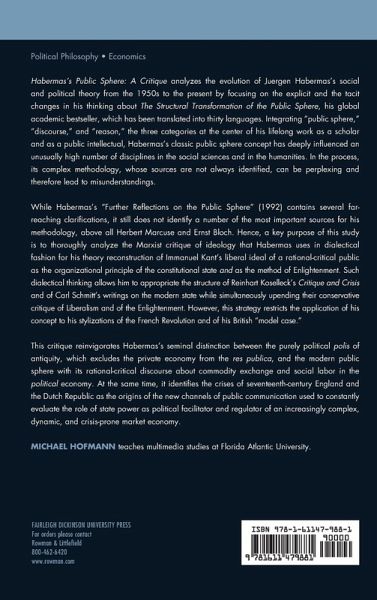
Habermas’s Public Sphere: A Critique systematically analyzes the strengths and weaknesses of Habermas’s classic public sphere concept to reinvigorate it for evaluating the liberal promises and realities of modern societies.
Habermas’s Public Sphere: A Critique systematically analyzes the strengths and weaknesses of Habermas’s classic public sphere concept to reinvigorate it for evaluating the liberal promises and realities of modern societies.
Michael Hofmann is professor of Communication and Multimedia Studies at Florida Atlantic University.
Inhaltsangabe
Preface 1Introduction: Reassessing Habermas's Public Sphere Concept 1.1. After Fifty Years: The Public Sphere, Reason, and Democracy 1.2. The Concept's Lasting Contribution to Critical Theory and Practice 1.3. The Concept's Key Challenge 1.4. The Concept's Contradictory Sources 1.5. The Concept's Interdisciplinary Structure 2Public Reason and Popular Sovereignty: Habermas's Stylization of the French Revolution 2.1. Revolutionary Dialectic: Synthesizing Rousseau and the Physiocrats? 2.2. Revolutionary Philosophy: Uncoerced or Predetermined Opinion Publique? 2.3. Revolutionary Mythology: Conservative / Liberal Uses of de Tocqueville's Ambivalence as an "Aristocratic Liberal" in The Old Regime and the Revolution 2.4. Revolutionary Romantic: From Moral Theater to Aesthetic Utopia (Schiller) 3The Third Estate, the Two Nations, and the Sovereignty of Reason: Kant's Public & Say's Law After the French Revolution 3.1. Establishing the Third Estate as the Nation in England in 1832: Transcending History through a Unique Critique of Ideology? 3.2. The English Century: One Nation under Say's Law and a Vast Secular Boom? 3.3. Early Challenges to the Bourgeois Public: Hegel on Class Antagonism, Ricardo on Victims of Machinery, and Carlyle on the Callous "Cash Nexus" 3.4. Property and Reform in Parliament: The Dialectics of Corn & Factory Legislation 4From the Dutch Republic to the Fiscal-Military State of the Modern Whigs: Bourgeois Morality and Moral Censure of the Political Public Sphere Before the French Revolution 4. 1. Crisis and Critique: The Origins of Political Economy in the Political Public Sphere of the Seventeenth Century 4.2. The Fiscal-Military State of the Modern Whigs and its Critique in the Political Public Sphere 4.3. The Moral Public Sphere and the Rise of Civilized Barbarism 4.4. Moral Censure of the Political Public Sphere in the Eighteenth Century Conclusion Selected Bibliography Index About the Author
Preface 1Introduction: Reassessing Habermas's Public Sphere Concept 1.1. After Fifty Years: The Public Sphere, Reason, and Democracy 1.2. The Concept's Lasting Contribution to Critical Theory and Practice 1.3. The Concept's Key Challenge 1.4. The Concept's Contradictory Sources 1.5. The Concept's Interdisciplinary Structure 2Public Reason and Popular Sovereignty: Habermas's Stylization of the French Revolution 2.1. Revolutionary Dialectic: Synthesizing Rousseau and the Physiocrats? 2.2. Revolutionary Philosophy: Uncoerced or Predetermined Opinion Publique? 2.3. Revolutionary Mythology: Conservative / Liberal Uses of de Tocqueville's Ambivalence as an "Aristocratic Liberal" in The Old Regime and the Revolution 2.4. Revolutionary Romantic: From Moral Theater to Aesthetic Utopia (Schiller) 3The Third Estate, the Two Nations, and the Sovereignty of Reason: Kant's Public & Say's Law After the French Revolution 3.1. Establishing the Third Estate as the Nation in England in 1832: Transcending History through a Unique Critique of Ideology? 3.2. The English Century: One Nation under Say's Law and a Vast Secular Boom? 3.3. Early Challenges to the Bourgeois Public: Hegel on Class Antagonism, Ricardo on Victims of Machinery, and Carlyle on the Callous "Cash Nexus" 3.4. Property and Reform in Parliament: The Dialectics of Corn & Factory Legislation 4From the Dutch Republic to the Fiscal-Military State of the Modern Whigs: Bourgeois Morality and Moral Censure of the Political Public Sphere Before the French Revolution 4. 1. Crisis and Critique: The Origins of Political Economy in the Political Public Sphere of the Seventeenth Century 4.2. The Fiscal-Military State of the Modern Whigs and its Critique in the Political Public Sphere 4.3. The Moral Public Sphere and the Rise of Civilized Barbarism 4.4. Moral Censure of the Political Public Sphere in the Eighteenth Century Conclusion Selected Bibliography Index About the Author
Es gelten unsere Allgemeinen Geschäftsbedingungen: www.buecher.de/agb
Impressum
www.buecher.de ist ein Internetauftritt der buecher.de internetstores GmbH
Geschäftsführung: Monica Sawhney | Roland Kölbl | Günter Hilger
Sitz der Gesellschaft: Batheyer Straße 115 - 117, 58099 Hagen
Postanschrift: Bürgermeister-Wegele-Str. 12, 86167 Augsburg
Amtsgericht Hagen HRB 13257
Steuernummer: 321/5800/1497
USt-IdNr: DE450055826