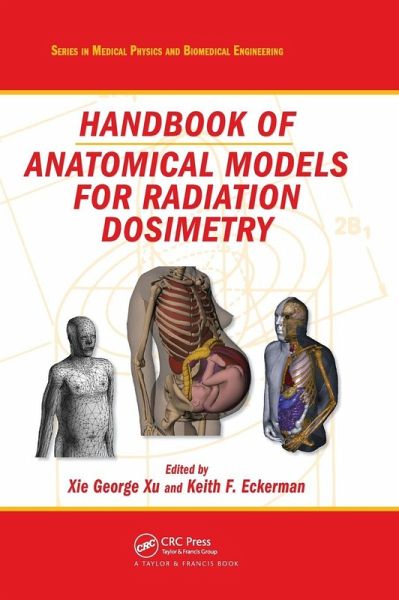
This pioneering work brings together recommendations sanctioned by the International Commission on Radiological Protection (ICRP) and documents 40 years of cutting-edge work with Monte Carlo Codes and radiation protection dosimetry. Assembling the work of nearly all major phantom (computational model) developers around the world, it examines detailed accounts for each well-known phantom, including those for applications for radiation protection dosimetry involving environmental, nuclear power plant, and internal contamination exposures, as well as a host of medical applications. Related datasets can be downloaded from the authors' website. ¿…mehr
This pioneering work brings together recommendations sanctioned by the International Commission on Radiological Protection (ICRP) and documents 40 years of cutting-edge work with Monte Carlo Codes and radiation protection dosimetry. Assembling the work of nearly all major phantom (computational model) developers around the world, it examines detailed accounts for each well-known phantom, including those for applications for radiation protection dosimetry involving environmental, nuclear power plant, and internal contamination exposures, as well as a host of medical applications. Related datasets can be downloaded from the authors' website. ¿
Dr. X. George Xu is a professor of nuclear engineering and biomedical engineering at Rensselaer Polytechnic Institute (RPI), Troy, New York. Dr. Keith F. Eckerman is the leader of the Dosimetry Research Team in the Environmental Science Division at the Oak Ridge National Laboratory (ORNL).
Inhaltsangabe
Part I. Computational Phantoms for Radiation Dosimetry: A 40 Year History of Evolution. Stylized Computational Phantoms Developed at ORNL and Elsewhere. The GSF Voxel Computational Phantom Family. The ADELAIDE Teenage Female Voxel Computational Phantom. The MCAT, NCAT, XCAT, and MOBY Computational Human and Mouse Phantoms. The 3D and 4D VIP-Man Computational Phantoms. The FAX06 and the MAX06 Computational Voxel Phantoms. The University of Florida Pediatric Phantom Series. Japanese Computational Phantoms: Otoko, Onago, JM, JM2, JF, TARO, HANAKO, Pregnant Woman, and Deformable Child. Korean Computational Phantoms: KMIRD, KORMAN, KORWOMAN, KTMAN-1, KTMAN-2, and HDRK-Man. Chinese Voxel Computational Phantoms: CNMAN, VCH, and CVP. Pregnant Female/Fetus Computational Phantoms and the Latest RPI-P Series Representing 3, 6, and 9 Months Gestational Periods. The Vanderbilt University Reference Adult and Pediatric Phantom Series. Mesh-Based and Anatomically Adjustable Adult Phantoms and a Case Study in Virtual Calibration of Lung Counter for Female Workers. The ICRP Reference Computational Phantoms. Physical Phantoms for Experimental Radiation Dosimetry. Part II. Applications to Environmental Exposures. Applications to External Radiation Exposures in Nuclear Power Plants. Applications to Bioassay for Internal Radiation Contamination. Applications to Nuclear Medicine. Applications to Computed Tomography for Pediatric Patients. Applications to Computed Tomography for Adult Patients. Applications to Optimization of X-Ray Radiographic Imaging. Applications to Nuclear Medicine Imaging and Dosimetry Involving MCAT, NCAT, and MOBY Phantoms. Applications to Secondary Radiation Dosimetry in External Beam Radiation Therapy. Applications to Image-Guided Radiation Treatment Planning. Dose Calculations in Radiation Therapy Based on Patient Models Using the Geant4 Monte Carlo Code. Applications to Patient-Specific Voxel Computational Phantoms in EGS Monte Carlo Codes for Radiation Treatment Involving Photons and Electrons. Applications to Nonionizing Radiation Protection. Summary and Future Needs Related to Computational Phantoms. About the Contributors. Index
Part I. Computational Phantoms for Radiation Dosimetry: A 40 Year History of Evolution. Stylized Computational Phantoms Developed at ORNL and Elsewhere. The GSF Voxel Computational Phantom Family. The ADELAIDE Teenage Female Voxel Computational Phantom. The MCAT, NCAT, XCAT, and MOBY Computational Human and Mouse Phantoms. The 3D and 4D VIP-Man Computational Phantoms. The FAX06 and the MAX06 Computational Voxel Phantoms. The University of Florida Pediatric Phantom Series. Japanese Computational Phantoms: Otoko, Onago, JM, JM2, JF, TARO, HANAKO, Pregnant Woman, and Deformable Child. Korean Computational Phantoms: KMIRD, KORMAN, KORWOMAN, KTMAN-1, KTMAN-2, and HDRK-Man. Chinese Voxel Computational Phantoms: CNMAN, VCH, and CVP. Pregnant Female/Fetus Computational Phantoms and the Latest RPI-P Series Representing 3, 6, and 9 Months Gestational Periods. The Vanderbilt University Reference Adult and Pediatric Phantom Series. Mesh-Based and Anatomically Adjustable Adult Phantoms and a Case Study in Virtual Calibration of Lung Counter for Female Workers. The ICRP Reference Computational Phantoms. Physical Phantoms for Experimental Radiation Dosimetry. Part II. Applications to Environmental Exposures. Applications to External Radiation Exposures in Nuclear Power Plants. Applications to Bioassay for Internal Radiation Contamination. Applications to Nuclear Medicine. Applications to Computed Tomography for Pediatric Patients. Applications to Computed Tomography for Adult Patients. Applications to Optimization of X-Ray Radiographic Imaging. Applications to Nuclear Medicine Imaging and Dosimetry Involving MCAT, NCAT, and MOBY Phantoms. Applications to Secondary Radiation Dosimetry in External Beam Radiation Therapy. Applications to Image-Guided Radiation Treatment Planning. Dose Calculations in Radiation Therapy Based on Patient Models Using the Geant4 Monte Carlo Code. Applications to Patient-Specific Voxel Computational Phantoms in EGS Monte Carlo Codes for Radiation Treatment Involving Photons and Electrons. Applications to Nonionizing Radiation Protection. Summary and Future Needs Related to Computational Phantoms. About the Contributors. Index
Es gelten unsere Allgemeinen Geschäftsbedingungen: www.buecher.de/agb
Impressum
www.buecher.de ist ein Internetauftritt der buecher.de internetstores GmbH
Geschäftsführung: Monica Sawhney | Roland Kölbl | Günter Hilger
Sitz der Gesellschaft: Batheyer Straße 115 - 117, 58099 Hagen
Postanschrift: Bürgermeister-Wegele-Str. 12, 86167 Augsburg
Amtsgericht Hagen HRB 13257
Steuernummer: 321/5800/1497
USt-IdNr: DE450055826