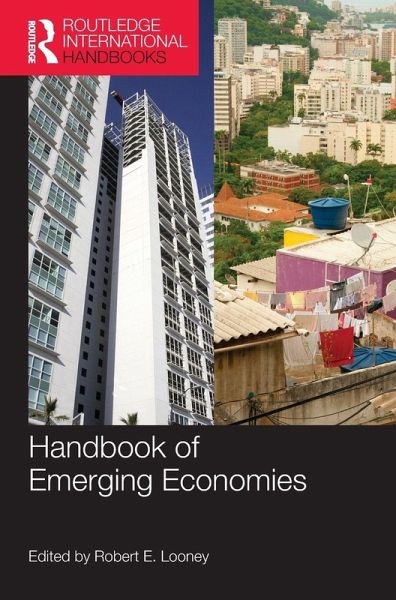
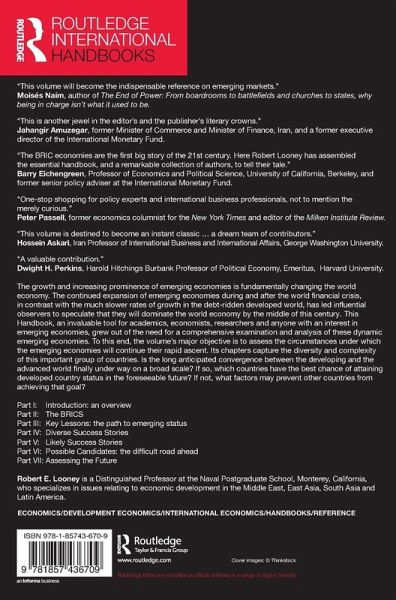
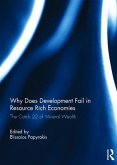
A new volume in the Routledge International Handbooks series analysing emerging and newly emerged economies, including the BRIC countries and other candidates for emerging economy status, offering an overview of issues in development economics.
A new volume in the Routledge International Handbooks series analysing emerging and newly emerged economies, including the BRIC countries and other candidates for emerging economy status, offering an overview of issues in development economics.
Professor Robert E. Looney is a Distinguished Professor at the Naval Postgraduate School, Monterey, California, who specializes in issues relating to economic development in the Middle East, East Asia, South Asia and Latin America. He has published 22 books and more than 250 articles in professional journals. As an international consultant, Dr Looney has provided advice and assistance to various governments and international organizations.
Inhaltsangabe
Foreword Part 1: Introduction-Overview 1.1. Introduction 1.2. Key Trends in the World Economy Part 2: The BRICSs 2.1. Brazil 2.2. Russia 2.3. India 2.4. China 2.5 South Africa Part 3: Key Lessons: The Transition to Emerging Status 3.1. Modern Stage Theories and their Relevance for Emerging Economies 3.2. Beijing Consensus versus Washington Consensus Part 4: Diverse Success Stories 4.1. Israel 4.2. Singapore's Success: After the Miracle 4.3. The Original Sin in Chile's Successful History of Development Part 5: Likely Success Stories 5.1. Turkey 5.2. Indonesia's Ways to Sustainable Economic Growth and Development 5.3. Mexico: Emerging Economy Kept on a Leash by Mismatched Monopolies 5.4. Middle Income Trap of Malaysian Economy: A Political Economy Analysis Part 6: Possible Candidates: The Difficult Road Ahead 6.1. Argentina's Present and its Intriguing Economic History 6.2. Vietnam 6.3. The Philippines: Road to Begin an Emerging Economy 6.5. Pakistan: An Economy in Extreme Distress that could be Revived 6.6. Egypt: Too `Big' to Succeed? 6.7. Thailand: Economic Progress and the Move to Populism 6.9. Iran at a Crossroad 6.10. Colombia: Seeking Prosperity through Peace 6.11. The Saudi Arabian Model Part 7: Assessing the Future 7.1. The Emerging Powers and Global Governance: Why the BRICS Matter 7.2. Challenges of Managing Emerging Economies 7.3. Korea: An Unexpected Journey from Rags to Riches, from Crisis to Recovery 7.4. China and India, 2025: A Macroeconomic Assessment
Foreword Part 1: Introduction-Overview 1.1. Introduction 1.2. Key Trends in the World Economy Part 2: The BRICSs 2.1. Brazil 2.2. Russia 2.3. India 2.4. China 2.5 South Africa Part 3: Key Lessons: The Transition to Emerging Status 3.1. Modern Stage Theories and their Relevance for Emerging Economies 3.2. Beijing Consensus versus Washington Consensus Part 4: Diverse Success Stories 4.1. Israel 4.2. Singapore's Success: After the Miracle 4.3. The Original Sin in Chile's Successful History of Development Part 5: Likely Success Stories 5.1. Turkey 5.2. Indonesia's Ways to Sustainable Economic Growth and Development 5.3. Mexico: Emerging Economy Kept on a Leash by Mismatched Monopolies 5.4. Middle Income Trap of Malaysian Economy: A Political Economy Analysis Part 6: Possible Candidates: The Difficult Road Ahead 6.1. Argentina's Present and its Intriguing Economic History 6.2. Vietnam 6.3. The Philippines: Road to Begin an Emerging Economy 6.5. Pakistan: An Economy in Extreme Distress that could be Revived 6.6. Egypt: Too `Big' to Succeed? 6.7. Thailand: Economic Progress and the Move to Populism 6.9. Iran at a Crossroad 6.10. Colombia: Seeking Prosperity through Peace 6.11. The Saudi Arabian Model Part 7: Assessing the Future 7.1. The Emerging Powers and Global Governance: Why the BRICS Matter 7.2. Challenges of Managing Emerging Economies 7.3. Korea: An Unexpected Journey from Rags to Riches, from Crisis to Recovery 7.4. China and India, 2025: A Macroeconomic Assessment
Es gelten unsere Allgemeinen Geschäftsbedingungen: www.buecher.de/agb
Impressum
www.buecher.de ist ein Internetauftritt der buecher.de internetstores GmbH
Geschäftsführung: Monica Sawhney | Roland Kölbl | Günter Hilger
Sitz der Gesellschaft: Batheyer Straße 115 - 117, 58099 Hagen
Postanschrift: Bürgermeister-Wegele-Str. 12, 86167 Augsburg
Amtsgericht Hagen HRB 13257
Steuernummer: 321/5800/1497
USt-IdNr: DE450055826