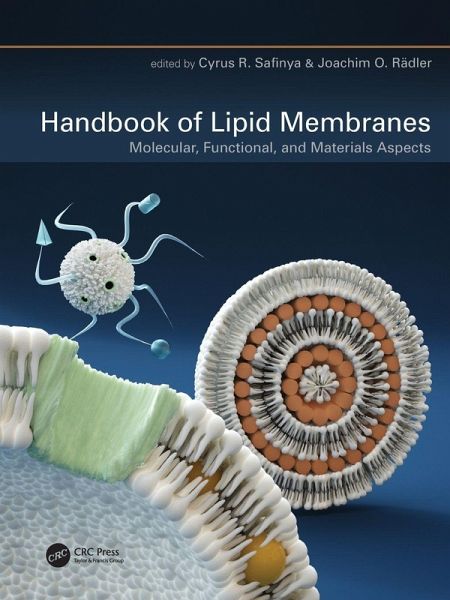
This Handbook provides a comprehensive overview of lipid membrane fundamentals and applications. It gives the fundamental physical and biochemical aspects of membrane-related processes in living cells, and then relates them to how scientists are building bioinspired, artifical membrane-based systems.
This Handbook provides a comprehensive overview of lipid membrane fundamentals and applications. It gives the fundamental physical and biochemical aspects of membrane-related processes in living cells, and then relates them to how scientists are building bioinspired, artifical membrane-based systems.
Cyrus R. Safinya is professor of physics at the University of California, Santa Barbara, USA. Joachim O. Rädler is professor of experimental physics at Ludwig-Maximilians-Universität München, Germany.
Inhaltsangabe
Preface. Editors. Contributors. Chapter 1 A Short History of Membrane Physics. Chapter 2 Structures and Interactions in Freely Suspended Multilayer Membranes and Dilute Lamellar Fluid Membranes from Synchrotron X-Ray Scattering. Chapter 3 Structures of Lipid Membranes: Cubic and Inverse Hexagonal Phases. Chapter 4 Structure of Lipid Membranes by Advanced X-Ray Scattering and Imaging. Chapter 5 Adhesion Protein Architecture and Intermembrane Potentials: Force Measurements and Biological Significance. Chapter 6 Charged Membranes: Poisson¿Boltzmann Theory, the DLVO Paradigm, and Beyond. Chapter 7 Membrane Shape Evolution In Vitro. Chapter 8 Mechanisms of Membrane Curvature Generation by Peptides and Proteins: A Unified Perspective on Antimicrobial Peptides. Chapter 9 Lipid Membrane Shape Evolution and the Actin Cytoskeleton. Chapter 10 Effects of Osmotic Stress on Topologically Closed Membrane Compartments. Chapter 11 Cationic Liposomes as Spatial Organizers of Nucleic Acids in One, Two, and Three Dimensions: Liquid Crystal Phases with Applications in Delivery and Bionanotechnology. Chapter 12 Lipids in DNA, RNA, and Peptide Delivery for In Vivo Therapeutic Applications. Chapter 13 Electrostatics of Lipid Membranes Interacting with Oppositely Charged Macromolecules. Chapter 14 Lipid-Based Bioanalytical Sensors. Chapter 15 Lipids in Dermal Applications: Cosmetics and Pharmaceutics. Chapter 16 Supported Lipid Bilayers. Chapter 17 Artificial Membranes Composed of Synthetic Copolypeptides. Chapter 18 Synthetic Membranes from Block Copolymers, Recombinant Proteins, and Dendrimers. Chapter 19 Amphiphilic Self-Assembly and the Origin of Life in Hydrothermal Conditions. Index.
Preface. Editors. Contributors. Chapter 1 A Short History of Membrane Physics. Chapter 2 Structures and Interactions in Freely Suspended Multilayer Membranes and Dilute Lamellar Fluid Membranes from Synchrotron X-Ray Scattering. Chapter 3 Structures of Lipid Membranes: Cubic and Inverse Hexagonal Phases. Chapter 4 Structure of Lipid Membranes by Advanced X-Ray Scattering and Imaging. Chapter 5 Adhesion Protein Architecture and Intermembrane Potentials: Force Measurements and Biological Significance. Chapter 6 Charged Membranes: Poisson¿Boltzmann Theory, the DLVO Paradigm, and Beyond. Chapter 7 Membrane Shape Evolution In Vitro. Chapter 8 Mechanisms of Membrane Curvature Generation by Peptides and Proteins: A Unified Perspective on Antimicrobial Peptides. Chapter 9 Lipid Membrane Shape Evolution and the Actin Cytoskeleton. Chapter 10 Effects of Osmotic Stress on Topologically Closed Membrane Compartments. Chapter 11 Cationic Liposomes as Spatial Organizers of Nucleic Acids in One, Two, and Three Dimensions: Liquid Crystal Phases with Applications in Delivery and Bionanotechnology. Chapter 12 Lipids in DNA, RNA, and Peptide Delivery for In Vivo Therapeutic Applications. Chapter 13 Electrostatics of Lipid Membranes Interacting with Oppositely Charged Macromolecules. Chapter 14 Lipid-Based Bioanalytical Sensors. Chapter 15 Lipids in Dermal Applications: Cosmetics and Pharmaceutics. Chapter 16 Supported Lipid Bilayers. Chapter 17 Artificial Membranes Composed of Synthetic Copolypeptides. Chapter 18 Synthetic Membranes from Block Copolymers, Recombinant Proteins, and Dendrimers. Chapter 19 Amphiphilic Self-Assembly and the Origin of Life in Hydrothermal Conditions. Index.
Es gelten unsere Allgemeinen Geschäftsbedingungen: www.buecher.de/agb
Impressum
www.buecher.de ist ein Internetauftritt der buecher.de internetstores GmbH
Geschäftsführung: Monica Sawhney | Roland Kölbl | Günter Hilger
Sitz der Gesellschaft: Batheyer Straße 115 - 117, 58099 Hagen
Postanschrift: Bürgermeister-Wegele-Str. 12, 86167 Augsburg
Amtsgericht Hagen HRB 13257
Steuernummer: 321/5800/1497
USt-IdNr: DE450055826