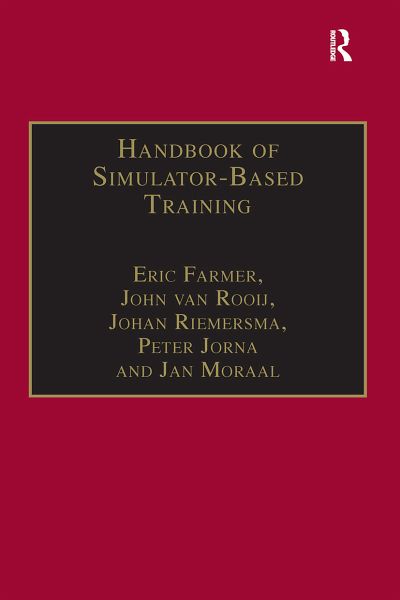
Advances in simulation technology have enabled an interesting amount of training and instruction to be conducted on training simulators instead of on real systems. However, experiences with the procurement and use of training simulators has not always been as successful, often owing to a lack of knowledge of didactics and of training programme development, and also to inadequate simulator specifications. The Handbook of Simulator-based Training represents the first comprehensive overview of the European state of the art in simulator-based training. It also comprises a well-founded and…mehr
Advances in simulation technology have enabled an interesting amount of training and instruction to be conducted on training simulators instead of on real systems. However, experiences with the procurement and use of training simulators has not always been as successful, often owing to a lack of knowledge of didactics and of training programme development, and also to inadequate simulator specifications. The Handbook of Simulator-based Training represents the first comprehensive overview of the European state of the art in simulator-based training. It also comprises a well-founded and systematic approach to simulator-based training and the specification of simulator requirements. The multi-disciplinary research project described in this book combines the expertise of specialists in human factors, information systems, system design and engineering from 23 research and industrial organizations from five countries - France, Germany, the Netherlands, Spain, the UK. The authors have synthesized and documented the project results to ensure that this handbook provides not only many valuable guidelines, but more importantly a common frame of reference. It will be a key resource for the many specialists who are concerned with simulator-based training: researchers, engineers, and users; military training institutes and training system development departments; military staff responsible for the procurement of training devices and simulators; the simulator industry; the training research community; and the human factors and ergonomics community.
Eric W. Farmer is Technical Manager at the Centre for Human Sciences, Defence Evaluation and Research Agency (DERA), Farnborough. UK. John van Rooij, Research Psychologist at the TNO Human Factors Research Institute, Soesterberg, The Netherlands. Johan Riemersma are Research Psychologist at the TNO Human Factors Research Institute, Soesterberg, The Netherlands. Peter Jorna is Head of the Flight Division at the National Aeronautics Laboratory, NLR, Amsterdam, The Netherlands. Jan Moraal is Project Manager at TNO Human Factors Research Institute, Soesterberg, The Netherlands.
Inhaltsangabe
Contents: Introduction Training Needs Analysis: Introduction Mission analysis Task Analysis Trainee analysis Training analysis Discussion and conclusions. Training Programme Design: Introduction Current practices Principles of training and instruction Sequencing of training objectives Specification of training activities and scenarios Design of instruction Methodology for training programme design Optimisation of training programmes Discussion and conclusions. Training Media Specification: Introduction to training media specification Databases and models Human-simulator interfaces Visual cueing and image systems Haptic, kinesthetic and vestibular cueing Methodology for training media specification Discussion and conclusions. Training Evaluation: Performance measurement Workload measurement Team performance Applications Discussion and conclusions Epilogue References Glossary Index.
Contents: Introduction Training Needs Analysis: Introduction Mission analysis Task Analysis Trainee analysis Training analysis Discussion and conclusions. Training Programme Design: Introduction Current practices Principles of training and instruction Sequencing of training objectives Specification of training activities and scenarios Design of instruction Methodology for training programme design Optimisation of training programmes Discussion and conclusions. Training Media Specification: Introduction to training media specification Databases and models Human-simulator interfaces Visual cueing and image systems Haptic, kinesthetic and vestibular cueing Methodology for training media specification Discussion and conclusions. Training Evaluation: Performance measurement Workload measurement Team performance Applications Discussion and conclusions Epilogue References Glossary Index.
Rezensionen
'...a formidable source-book for both military and civil research and design in training programmes and the use of simulator devices.' The Aerospace Professional 'An interesting collection of research which could provide real, demonstrable benefits in the future.' M2 Best Books
Es gelten unsere Allgemeinen Geschäftsbedingungen: www.buecher.de/agb
Impressum
www.buecher.de ist ein Internetauftritt der buecher.de internetstores GmbH
Geschäftsführung: Monica Sawhney | Roland Kölbl | Günter Hilger
Sitz der Gesellschaft: Batheyer Straße 115 - 117, 58099 Hagen
Postanschrift: Bürgermeister-Wegele-Str. 12, 86167 Augsburg
Amtsgericht Hagen HRB 13257
Steuernummer: 321/5800/1497
USt-IdNr: DE450055826