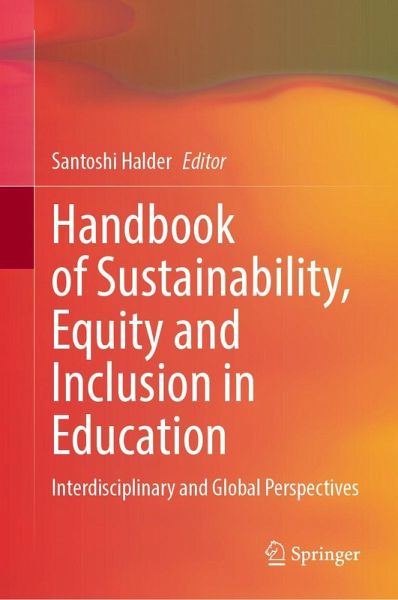
The handbook explores essential aspects of building a more equitable and inclusive society, ensuring every individual's right to a dignified, self-determined life without discrimination based on caste, creed, gender, culture, or nationality. It advocates for innovative pedagogical methods and evidence-based techniques in inclusive education. Each chapter emphasizes critical consciousness, reflection, sustainability, and humanitarianism as emerging paradigms, fostering a culture of free learning. This transformative approach empowers learners from passive recipients to active co-creators of…mehr
The handbook explores essential aspects of building a more equitable and inclusive society, ensuring every individual's right to a dignified, self-determined life without discrimination based on caste, creed, gender, culture, or nationality. It advocates for innovative pedagogical methods and evidence-based techniques in inclusive education. Each chapter emphasizes critical consciousness, reflection, sustainability, and humanitarianism as emerging paradigms, fostering a culture of free learning. This transformative approach empowers learners from passive recipients to active co-creators of knowledge and agents of change. Through diverse perspectives and insights from global experts, teacher educators, and researchers across countries like India, South Africa, Greece, Hungary, the USA, Canada, Bangladesh, Japan, and Germany, the book addresses disabilities, historically marginalized communities, socio-cultural minorities, socioeconomically disadvantaged groups, indigenous peoples, sexual and gender minorities, religious minorities, and other marginalized populations. It presents their challenges, needs, and future directions through a cross-cultural lens. The book's primary objective is to promote understanding and acceptance of diversity and inclusion globally, bridging gaps between countries and cultures. The book is designed to be of use to a wide range of professionals, researchers, teacher educators specializing in education, sociology, anthropology, and related fields. It is also intended for policy makers and practitioners involved in educational policy and curriculum development, as well as undergraduate and graduate students studying diversity, inclusion, and social justice.
Artikelnr. des Verlages: 89521967, 978-981-95-1027-6
Seitenzahl: 868
Erscheinungstermin: 4. Januar 2026
Englisch
Abmessung: 235mm x 155mm
ISBN-13: 9789819510276
ISBN-10: 9819510279
Artikelnr.: 74820164
Herstellerkennzeichnung
Libri GmbH
Europaallee 1
36244 Bad Hersfeld
gpsr@libri.de
Autorenporträt
Santoshi Halder, Ph.D., is a Professor at the Department of Education, University of Calcutta, India. She has a Post-graduation in Education and a Ph.D. in Applied Psychology. She is a Board-Certified Behaviour Analyst (BACB, USA) and has a Special Educator license (Rehabilitation Council of India, RCI). She is awarded the prestigious ‘Extraordinary Professorship’ by the University of Pretoria, South Africa (2023). She has been actively involved internationally and nationally in multifarious ways for the inclusion of people with diversities primarily through various academic and research endeavors since 2000. She has been an international fellow and recipient of various prestigious competitive International awards; Fulbright Scholar-in-Residence (S-I-R), USA (2024-2025), Hungarian International Credit Mobility Cooperation Erasmus, Hungary (2022-2025), Hungarian State bilateral Awardee (2022-23), Shastri-Indo-Canadian Fellow (2020-22), Fulbright Academic and Professional Excellence fellow, USA (2020), Rockefeller Fellow, Italy (2019), Japan Society for Promotion of Science/ JSPS fellow, (2019), Endeavour Australia-India Education Council Research Fellow and Honorary Visiting Fellow at Olga Tennison Autism Research Centre (OTARC), La Trobe University, Australia (2015-2016), Endeavour Awards Ambassador (2018) and Fulbright Nehru Senior Research Fellow, USA (2011–2012). She received the Governor’s Medal (West Bengal, India) in 2001 for her contribution to the community as a National Cadet Corps (N.C.C). Thirteen Ph.D. and eighteen M. Phil Dissertations have been successfully completed/ awarded under her supervision. She is passionate about the inclusion of people with diverse needs. She has edited international books on inclusion/ inclusive pedagogy/ Diversity, Equity & Culture (Springer International, Palgrave Macmillan pub. and Routledge) and authored a book on Education Technology (Routledge pub.). Prof. Halder is Associate Editor for the Journal of Disability and Impairment, an international peer-reviewed Journal-Fulbright Chronicle, Indonesian Journal of Disability Studies, and Asian Journal of Inclusive Education. She is currently working on two international projects exploring the 'Wellbeing of Children & Adults with Disabilities through Digitalization' with University of South Africa, (UNISA) and on 'Gendered Impact of Human-wild life Conflict in Largest Mangrove Forest-the Sundarbans' with McGill University, Canada as the project lead from India. Her overall goal is to identify the secluded and marginalized communities from various corners of the world and constructively develop and implement intervention plans for their inclusive growth through effective pathways.
Inhaltsangabe
Diversity, Equity Inclusion (DEI) and Sustainability; The Interconnectedness.- Disability Rights Jurisprudence and Reasonable Accommodation (Vikash Kumar v. UPSC): Must They Remain on the Front Porch.- Gender, Politics, and Education Policy.- Disability, Religion, Culture and Personal Narratives: Intersectionality And Reflections.- Coalitions, Corporations, and Compromise: Shaping Inclusive Education in India.- Empowering Music Becoming and belonging narratives in the context of blind people s music education.
Diversity, Equity Inclusion (DEI) and Sustainability; The Interconnectedness.- Disability Rights Jurisprudence and Reasonable Accommodation (Vikash Kumar v. UPSC): Must They Remain on the Front Porch.- Gender, Politics, and Education Policy.- Disability, Religion, Culture and Personal Narratives: Intersectionality And Reflections.- Coalitions, Corporations, and Compromise: Shaping Inclusive Education in India.- Empowering Music Becoming and belonging narratives in the context of blind people s music education.
Es gelten unsere Allgemeinen Geschäftsbedingungen: www.buecher.de/agb
Impressum
www.buecher.de ist ein Internetauftritt der buecher.de internetstores GmbH
Geschäftsführung: Monica Sawhney | Roland Kölbl | Günter Hilger
Sitz der Gesellschaft: Batheyer Straße 115 - 117, 58099 Hagen
Postanschrift: Bürgermeister-Wegele-Str. 12, 86167 Augsburg
Amtsgericht Hagen HRB 13257
Steuernummer: 321/5800/1497
USt-IdNr: DE450055826