
Andere Kunden interessierten sich auch für
 Labster Virtual Lab Experiments: Basic Biochemistry33,43 €
 Synthetic Promoters97,99 €
 Recent Advances in Oxidative Stress Associated Chronic Diseases Volume 2189,99 €
 Bioanalytik119,99 €
 Bioorthogonal Reactions249,99 €
 Synthetic Biology190,99 €
 Vitamin D Function112,99 €




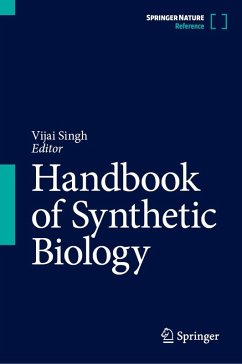
This reference work presents a comprehensive and authoritative overview of the rapidly evolving field of synthetic biology. It brings together the foundational concepts, technological innovations, and wide-ranging applications that define this discipline. By applying engineering principles to biological systems, synthetic biology enables the design of novel biological parts, systems, and functions. The handbook explores recent breakthroughs ranging from synthetic circuits for diagnostics and therapeutics to engineered biomaterials and biomolecules, positioning itself as a valuable, one-stop reference for this interdisciplinary science.
Synthetic biology is an exponentially growing field that employs the application of engineering principles to biology. It is transformative field at the intersection of biology, engineering, and computation. It allows precise control and design of biological systems through synthetic promoters, ribosome binding sites, genetic circuits, and other engineered components. These capabilities are driving innovations in health, environment, and energy.
The handbook is organized into five sections. Section I: highlights the fundamentals of synthetic biology, section II: Advances in synthetic biology, section III: Applications of synthetic biology, section IV: synthetic biology for human disease and section V: synthetic biology ethics and regulations. Each section is consistently organized, so that the handbook introduces synthetic biology - from historical backgrounds and the fundamentals, over the description of the methods and technology, to their applications. Each chapter provides accessible, well-structured insights for readers across disciplines.
This handbook is designed for a diverse audience including researchers, students, clinicians, industry experts, and policymakers. It serves as both an introductory guide and a detailed reference, offering rich, easy-to-understand content enhanced by clarity,depth, and broad coverage. This is a foundational resource for anyone looking to engage with the future of synthetic biology.
Synthetic biology is an exponentially growing field that employs the application of engineering principles to biology. It is transformative field at the intersection of biology, engineering, and computation. It allows precise control and design of biological systems through synthetic promoters, ribosome binding sites, genetic circuits, and other engineered components. These capabilities are driving innovations in health, environment, and energy.
The handbook is organized into five sections. Section I: highlights the fundamentals of synthetic biology, section II: Advances in synthetic biology, section III: Applications of synthetic biology, section IV: synthetic biology for human disease and section V: synthetic biology ethics and regulations. Each section is consistently organized, so that the handbook introduces synthetic biology - from historical backgrounds and the fundamentals, over the description of the methods and technology, to their applications. Each chapter provides accessible, well-structured insights for readers across disciplines.
This handbook is designed for a diverse audience including researchers, students, clinicians, industry experts, and policymakers. It serves as both an introductory guide and a detailed reference, offering rich, easy-to-understand content enhanced by clarity,depth, and broad coverage. This is a foundational resource for anyone looking to engage with the future of synthetic biology.