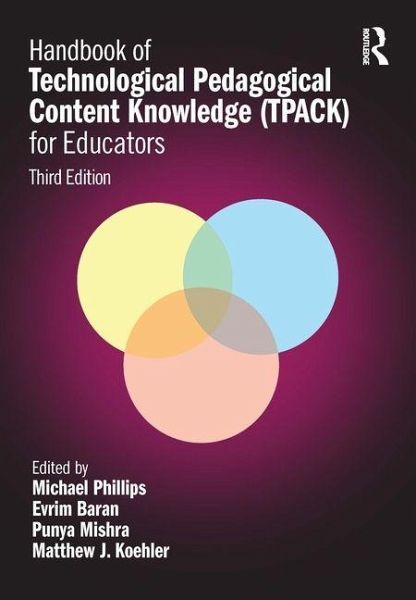
The third edition of the Handbook of Technological Pedagogical Content Knowledge (TPACK) for Educators addresses the concept and implementation of technological pedagogical content knowledge.
The third edition of the Handbook of Technological Pedagogical Content Knowledge (TPACK) for Educators addresses the concept and implementation of technological pedagogical content knowledge.
Michael Phillips is Professor of Digital Transformation in the Faculty of Education at Monash University, Australia. Evrim Baran is Professor of Educational Technology and Human-Computer Education at Iowa State University, USA. Punya Mishra is Director of Innovative Learning Futures at the Learning Engineering Institute and Professor at the Mary Lou Fulton College of Teaching and Learning Innovation at Arizona State University, USA. Matthew J. Koehler is Professor of Educational Psychology and Educational Technology at Michigan State University, USA.
Inhaltsangabe
Introduction Section I: TPACK and Context 1. Enacting Technological Pedagogical Content Knowledge in the COVID-19 Era: Advancements in Understanding Contextual Factors 2. TPACK's Contextual Knowledge: Exploring EFL Teachers' Technological Pedagogical Practices in Iran, Libya, Syria, Tunisia, and Yemen 3. Reimagining TPACK in the Landscape of Early Childhood Education 4. Developing Teachers' Contextual Knowledge and TPACK in a Pedagogical Change Laboratory Section II: TPACK Framework and Theory 5. TP(A)CK's Many Derivatives: Accretion or Evolution? 6. Introducing FULL TPACK: Expanding the TPACK Framework to Include a Comprehensive View of Contextual Knowledge (XK) 7. TPACK as a Resource for Teaching Professional Ethical Knowledge in the Training of Social Sciences Teachers 8. ConteXt Is Key: UDL and TPACK = Universal Access to Learning Section III: TPACK in Practice 9. Applying the TPACK Framework: Guiding Faculty Development for Generative Artificial Intelligence Literacy 10. TPACK Development in Teacher Education: A Simulation-Based Learning Approach 11. Implications of the TPACK Framework for Developing Computationally Literate Preservice Teachers 12. Linking TPACK and Equity-Based Mathematics Teaching 13. Challenges and Opportunities: The Influence of Artificial Intelligence Powered Tools on Developing Teachers' TPACK Section IV: TPACK Research and Approaches 14. How Is TPACK Used in PK-12 Technology Integration Professional Development Models?: A Systematic Literature Review 15. Examining Dimensions of Preservice Teachers' TPACK for Elementary Mathematics 16. Measuring TPACK Learning: A Modern Measurement Approach for TPACK 17. Gathering Evidence of Teachers' TPACK through Discourse Analysis of Their Coursework in an Online Professional Development Course: A Case Study
Introduction Section I: TPACK and Context 1. Enacting Technological Pedagogical Content Knowledge in the COVID-19 Era: Advancements in Understanding Contextual Factors 2. TPACK's Contextual Knowledge: Exploring EFL Teachers' Technological Pedagogical Practices in Iran, Libya, Syria, Tunisia, and Yemen 3. Reimagining TPACK in the Landscape of Early Childhood Education 4. Developing Teachers' Contextual Knowledge and TPACK in a Pedagogical Change Laboratory Section II: TPACK Framework and Theory 5. TP(A)CK's Many Derivatives: Accretion or Evolution? 6. Introducing FULL TPACK: Expanding the TPACK Framework to Include a Comprehensive View of Contextual Knowledge (XK) 7. TPACK as a Resource for Teaching Professional Ethical Knowledge in the Training of Social Sciences Teachers 8. ConteXt Is Key: UDL and TPACK = Universal Access to Learning Section III: TPACK in Practice 9. Applying the TPACK Framework: Guiding Faculty Development for Generative Artificial Intelligence Literacy 10. TPACK Development in Teacher Education: A Simulation-Based Learning Approach 11. Implications of the TPACK Framework for Developing Computationally Literate Preservice Teachers 12. Linking TPACK and Equity-Based Mathematics Teaching 13. Challenges and Opportunities: The Influence of Artificial Intelligence Powered Tools on Developing Teachers' TPACK Section IV: TPACK Research and Approaches 14. How Is TPACK Used in PK-12 Technology Integration Professional Development Models?: A Systematic Literature Review 15. Examining Dimensions of Preservice Teachers' TPACK for Elementary Mathematics 16. Measuring TPACK Learning: A Modern Measurement Approach for TPACK 17. Gathering Evidence of Teachers' TPACK through Discourse Analysis of Their Coursework in an Online Professional Development Course: A Case Study
Es gelten unsere Allgemeinen Geschäftsbedingungen: www.buecher.de/agb
Impressum
www.buecher.de ist ein Internetauftritt der buecher.de internetstores GmbH
Geschäftsführung: Monica Sawhney | Roland Kölbl | Günter Hilger
Sitz der Gesellschaft: Batheyer Straße 115 - 117, 58099 Hagen
Postanschrift: Bürgermeister-Wegele-Str. 12, 86167 Augsburg
Amtsgericht Hagen HRB 13257
Steuernummer: 321/5800/1497
USt-IdNr: DE450055826