
Andere Kunden interessierten sich auch für
 Repertorium Des Teutschen Staats- Und Lehnrechts42,99 €
 GrundzÃ1/4ge Eines Systems Des Teutschen Privatrechts Mit Einschluß Des Lehnrechts38,99 €
 Lehrbuch Des Teutschen Privatrechts34,99 €
 Zivilrecht Der HerzogthÃ1/4mer Mecklenburg40,99 €
 Marriage And Divorce27,99 €
 Marriage and Divorce Laws of the World30,99 €
 The Law of Infancy and Coverture36,99 €


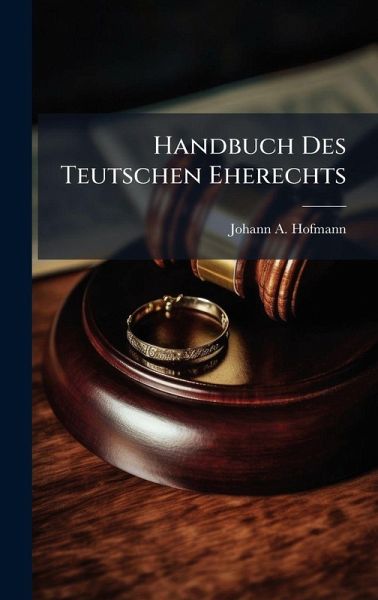
"Handbuch Des Teutschen Eherechts" (Handbook of German Marriage Law) by Johann A. Hofmann is a comprehensive historical treatise on the laws and customs surrounding marriage in Germany. This meticulously detailed handbook provides insights into the legal framework that governed marital unions, covering aspects such as betrothal, the rights and responsibilities of spouses, and the dissolution of marriage. Examining the nuances of Teutschen Eherechts, the handbook offers a valuable resource for legal historians, genealogists, and anyone interested in understanding the social and legal history of marriage in Germany. It presents a structured analysis of legal principles and practices, reflecting the societal norms and values of the period. This book stands as an important reference work for exploring the historical context of family law within the German legal system. This work has been selected by scholars as being culturally important, and is part of the knowledge base of civilization as we know it. This work was reproduced from the original artifact, and remains as true to the original work as possible. Therefore, you will see the original copyright references, library stamps (as most of these works have been housed in our most important libraries around the world), and other notations in the work. This work is in the public domain in the United States of America, and possibly other nations. Within the United States, you may freely copy and distribute this work, as no entity (individual or corporate) has a copyright on the body of the work. As a reproduction of a historical artifact, this work may contain missing or blurred pages, poor pictures, errant marks, etc. Scholars believe, and we concur, that this work is important enough to be preserved, reproduced, and made generally available to the public. We appreciate your support of the preservation process, and thank you for being an important part of keeping this knowledge alive and relevant.