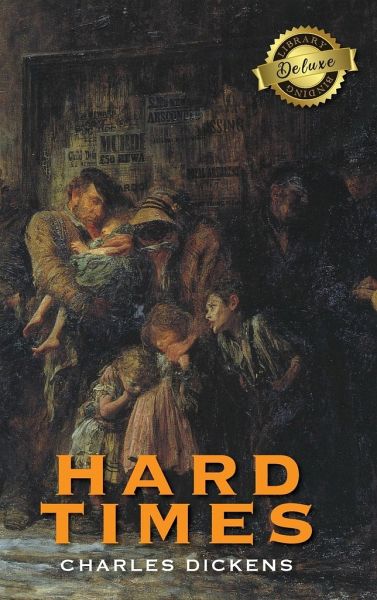
Hard Times is set in the imaginary industrial town of Coketown, the soulless domain of the strict Gradgind and the heartless factory owner Bounderby. The eminently practical Mr. Gradgrind, teaches nothing but facts, eradicating any imaginative or aesthetic subjects from the curriculum, while analysis, deduction and mathematics are emphasised. Mr. Bounderby himself superintends through calculating tabular statements and statistics, and is always secretly rebuking the people of Coketown for indulging in conceitful activities. Human joy is seen as the open-hearted and affectionate people act as…mehr
Hard Times is set in the imaginary industrial town of Coketown, the soulless domain of the strict Gradgind and the heartless factory owner Bounderby. The eminently practical Mr. Gradgrind, teaches nothing but facts, eradicating any imaginative or aesthetic subjects from the curriculum, while analysis, deduction and mathematics are emphasised. Mr. Bounderby himself superintends through calculating tabular statements and statistics, and is always secretly rebuking the people of Coketown for indulging in conceitful activities. Human joy is seen as the open-hearted and affectionate people act as an antidote to the ruthless behaviour Dickens presents. Hard Times appraises English society and highlights the social and economic pressures of the times. Dickens wished to confront the assumption that prosperity runs parallel to morality, a notion which is systematically deconstructed in this novel through his portrayal of the moral monsters, Mr. Bounderby and James Harthouse. Dickens was also campaigning for the importance of imagination in life, and for people's lives to not be reduced to a collection of material facts and statistical analyses.
Charles Dickens (1812-1870) Charles Dickens was born on February 7, 1812, in Portsea, England. His parents were middle-class and suffered financially. When Dickens was twelve years old, his family faced financial crisis, which forced him to quit school and work in a shoe polish manufacturing factory. Dickens's mother and siblings eventually joined him. Dickens continued to work at the factory for several months. In the factory the horrific conditions haunted him throughout his life. Dickens never forgot the day when a senior boy in the warehouse took it upon himself to instruct Dickens how to do his work more efficiently. As a young adult, Dickens worked as a law clerk and later as a journalist. He perceived the darker social conditions of the Industrial Revolution. A collection of semi-fictional sketches entitled Sketches by Boz earned him recognition as a writer. Dickens began to make money from his writing when he published his first novel, The Pickwick Papers in 1836. The Pickwick Papers was hugely popular and Dickens became a literary celebrity at the age of twenty-five. Dickens's themes included wealth and poverty, love and rejection, and the eventual triumph of good over evil. In 1836, Dickens married Catherine Hogarth, but after twenty years of marriage and their ten children, he fell in love with Ellen Ternan, an actress many years his junior. Soon after, Dickens and his wife separated. Dickens remained a prolific writer to the end of his life, and his novels - Great Expectations, A Tale of Two Cities, A Christmas Carol, David Copperfield, and Bleak House - continued to earn critical and popular acclaim. He died of a stroke in 1870, at the age of 58.
Es gelten unsere Allgemeinen Geschäftsbedingungen: www.buecher.de/agb
Impressum
www.buecher.de ist ein Internetauftritt der buecher.de internetstores GmbH
Geschäftsführung: Monica Sawhney | Roland Kölbl | Günter Hilger
Sitz der Gesellschaft: Batheyer Straße 115 - 117, 58099 Hagen
Postanschrift: Bürgermeister-Wegele-Str. 12, 86167 Augsburg
Amtsgericht Hagen HRB 13257
Steuernummer: 321/5800/1497
USt-IdNr: DE450055826