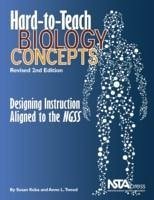
"This book does not contain a recipe to follow as you plan and deliver lessons. Nor is it a set of predesigned lessons for use in biology classrooms. Instead, it features both an instructional framework you can use as you plan and sets of research-based strategies and resources you can select from to help your students learn." -from the Introduction to Hard-to-Teach Biology Concepts, Revised 2nd Edition You know it's tough to convey some foundational biology concepts-and it's even tougher when you're adjusting to the Next Generation Science Standards. This thoroughly revised book is designed…mehr
"This book does not contain a recipe to follow as you plan and deliver lessons. Nor is it a set of predesigned lessons for use in biology classrooms. Instead, it features both an instructional framework you can use as you plan and sets of research-based strategies and resources you can select from to help your students learn." -from the Introduction to Hard-to-Teach Biology Concepts, Revised 2nd Edition You know it's tough to convey some foundational biology concepts-and it's even tougher when you're adjusting to the Next Generation Science Standards. This thoroughly revised book is designed to support you as you plan and implement NGSS-aligned lessons that will engage students with biology concepts that many find especially challenging. The book is organized into two parts that feature an instructional framework and resources that support framework implementation and is designed for both veteran teachers and newcomers to the classroom. Part I, The Toolbox, introduces a research-based Instructional Planning Framework that helps you to understand the learning needs your students bring to class, incorporate appropriate teaching strategies, and interpret the framework and teaching tools through the lens of NGSS. Part II, Toolbox Implementation, models use of the framework with four hard-to-teach topics, all different from the ones in the book's first edition. Contributing authors show you how the framework helps teach the NGSS's four disciplinary core ideas: growth and development of organisms, ecosystems, heredity, and biological evolution. As the contributing authors make clear, the teaching models are specific and help to make student thinking visible, but they don't presume to dictate what's right for you. Rather, the book will open your mind to fresh, effective ways to help biology students deepen their conceptual understanding based on what works best for them and you in today's classrooms.
Susan Koba, a science education consultant, works primarily with the National Science Teachers Association (NSTA) on its professional development website, The NSTA Learning Center. She retired from the Omaha Public Schools (OPS) after 30 years, having taught on the middle and high school levels for more than 20 years and then having served as a curriculum specialist and district mentor. Koba ended her service to OPS as project director and professional development coordinator for the OPS Urban Systemic Program serving 60 schools. Koba has been named an Alice Buffett Outstanding Teacher, Outstanding Biology Teacher for Nebraska, Tandy Technology Scholar, and Access Excellence Fellow. She is also a recipient of a Christa McAuliffe Fellowship and a Presidential Award for Excellence in Mathematics and Science Teaching. She received her BS degree in biology from Doane College, an MA in biology from the University of Nebraska– Omaha, and a PhD in science education from the University of Nebraska– Lincoln. Koba has published and presented on many topics, including school and teacher change, effective science instruction, equity in science, inquiry, and action research. She has developed curriculum at the local, state, and national levels and served as curriculum specialist for a U.S. Department of Energy Technology Innovation Challenge Grant. A past director of coordination and supervision on the NSTA Board and a past president of her state NSTA chapter, she currently serves NSTA on the Budget and Finance Committee. Other past NSTA work includes serving as the chairperson of the Professional Development Task Force, scope author for the NGSS SciPack currently in development, and the conference chairperson for the 2006 Area Conference in Omaha. She is also a past president of the National Science Education Leadership Association (NSELA) and served as NSELA’ s Interim Executive Director.
Es gelten unsere Allgemeinen Geschäftsbedingungen: www.buecher.de/agb
Impressum
www.buecher.de ist ein Internetauftritt der buecher.de internetstores GmbH
Geschäftsführung: Monica Sawhney | Roland Kölbl | Günter Hilger
Sitz der Gesellschaft: Batheyer Straße 115 - 117, 58099 Hagen
Postanschrift: Bürgermeister-Wegele-Str. 12, 86167 Augsburg
Amtsgericht Hagen HRB 13257
Steuernummer: 321/5800/1497
USt-IdNr: DE450055826