
Andere Kunden interessierten sich auch für
 The Evolution of Harmony40,99 €
 The Development of Harmony in Scriabin´s Works27,99 €
 Complete Musical Analysis32,99 €
 Music Composition25,99 €
 A Primer Of Modern Musical Tonality21,99 €
 Key To Practical Harmony20,99 €
 The Genesis Of Harmony20,99 €


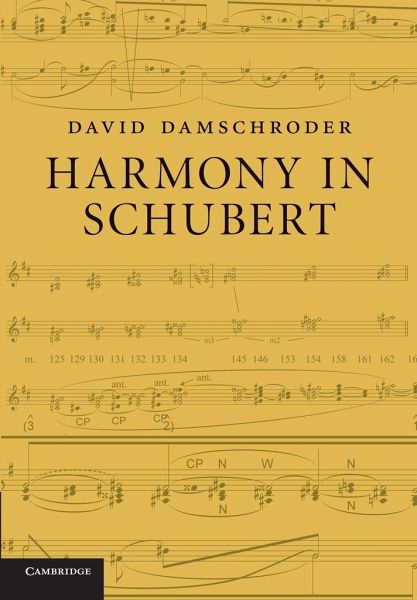
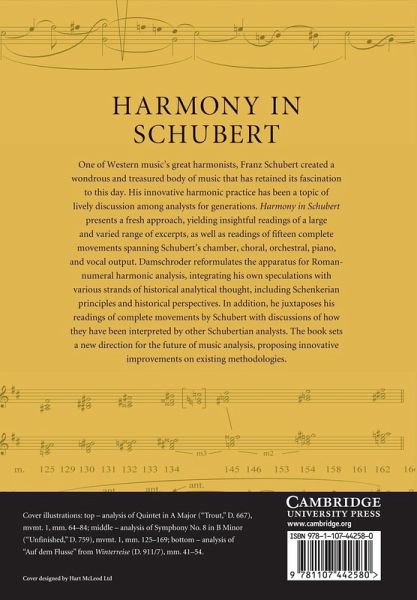
One of Western music's great harmonists, Franz Schubert created a wondrous and treasured body of music that has retained its fascination to this day. His innovative harmonic practice has been a topic of lively discussion among analysts for generations. Harmony in Schubert presents a fresh approach, yielding insightful readings of a large and varied range of excerpts, as well as readings of fifteen complete movements spanning Schubert's chamber, choral, orchestral, piano, and vocal output. Damschroder reformulates the apparatus for Roman-numeral harmonic analysis, integrating his own speculations with various strands of historical analytical thought, including Schenkerian principles and historical perspectives. In addition, he juxtaposes his readings of complete movements by Schubert with discussions of how they have been interpreted by other Schubertian analysts. The book sets a new direction for the future of music analysis, proposing innovative improvements on existing methodologies.