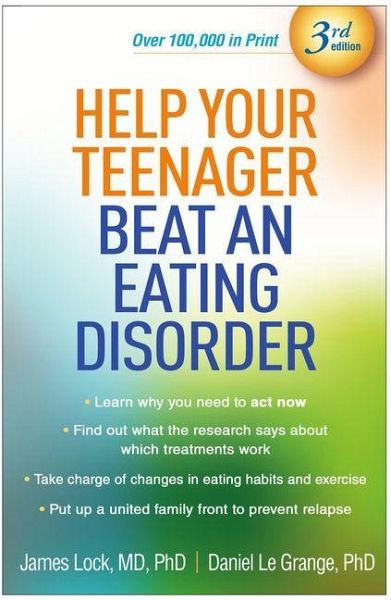
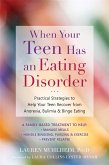
When your teenager shows signs of an eating disorder, where can you turn? Now in a revised and updated third edition, this trusted resource helps you separate fact from myth and play an active role in your child's recovery.
When your teenager shows signs of an eating disorder, where can you turn? Now in a revised and updated third edition, this trusted resource helps you separate fact from myth and play an active role in your child's recovery.
James Lock, MD, PhD, is the Eric Rothenberg, MD, Professor of Child Psychiatry and Pediatrics at Stanford University and Director of the Stanford Child and Adolescent Eating Disorders Program. Dr. Lock is committed to providing evidence-based treatments to children, adolescents, and their families. He is a Distinguished Fellow of the American Psychiatric Association and the American Academy of Child and Adolescent Psychiatry, and a recipient of the Agnes Purcell McGavin Award for Distinguished Career Achievement in Child and Adolescent Psychiatry from the American Psychiatric Association, the Price Family Foundation Award for Research Excellence from the National Eating Disorders Association, the Leadership Award in Research from the Academy of Eating Disorders, and Early and Mid-Career Development Awards from the National Institute of Mental Health. Daniel Le Grange, PhD, is Benioff UCSF Professor in Children's Health in the Department of Psychiatry and Behavioral Sciences and UCSF Weill Institute for Neurosciences and Director of the Eating Disorders Program at the University of California, San Francisco. He is Emeritus Professor at the University of Chicago, where he was Director of the Eating Disorders Program until 2014. Dr. Le Grange trained at the Institute of Psychiatry, Psychology and Neurology, University of London, and was a member of the team at the Maudsley Hospital in London that developed family-based treatment for anorexia nervosa. Over his career, he has treated numerous adolescents and families struggling with eating disorders. He is a recipient of the Leadership Award in Research from the Academy of Eating Disorders and an Early Career Development Award from the National Institute of Mental Health, and is a Fellow of the Academy of Eating Disorders.
Inhaltsangabe
I. Getting Started: First Steps toward Helping Your Child with an Eating Disorder 1. Act Now 2. Get Together 3. Don't Waste Time on "Why?" II. Understanding Eating Disorders 4. Know What You're Dealing With: The Complexity of Eating Disorders 5. Get Into Your Child's Head: The Distorted Thinking Behind Your Teenager's Behavior 6. Understand Your Options: What the Research Says about the Best Ways to Treat Anorexia Nervosa, Bulimia Nervosa, Binge Eating Disorder, and Avoidant/Restrictive Food Intake Disorder III. Making Treatment Work: How to Solve Everyday Problems to Help Your Child Recover 7. Taking Charge of Change: How to Apply Family Based Treatment to Help with Eating Disorders 8. Playing a Supporting Role: Other Ways You Can Be a Part of Your Child's Recovery 9. Harnessing the Power of Unity: How to Stay on the Same Page in Your Fight against Eating Disorders 10. Staying Empowered and Informed: How to Work with Professionals Who Are Trying to Help Your Child Resources Further Reading Index
I. Getting Started: First Steps toward Helping Your Child with an Eating Disorder 1. Act Now 2. Get Together 3. Don't Waste Time on "Why?" II. Understanding Eating Disorders 4. Know What You're Dealing With: The Complexity of Eating Disorders 5. Get Into Your Child's Head: The Distorted Thinking Behind Your Teenager's Behavior 6. Understand Your Options: What the Research Says about the Best Ways to Treat Anorexia Nervosa, Bulimia Nervosa, Binge Eating Disorder, and Avoidant/Restrictive Food Intake Disorder III. Making Treatment Work: How to Solve Everyday Problems to Help Your Child Recover 7. Taking Charge of Change: How to Apply Family Based Treatment to Help with Eating Disorders 8. Playing a Supporting Role: Other Ways You Can Be a Part of Your Child's Recovery 9. Harnessing the Power of Unity: How to Stay on the Same Page in Your Fight against Eating Disorders 10. Staying Empowered and Informed: How to Work with Professionals Who Are Trying to Help Your Child Resources Further Reading Index
Es gelten unsere Allgemeinen Geschäftsbedingungen: www.buecher.de/agb
Impressum
www.buecher.de ist ein Internetauftritt der buecher.de internetstores GmbH
Geschäftsführung: Monica Sawhney | Roland Kölbl | Günter Hilger
Sitz der Gesellschaft: Batheyer Straße 115 - 117, 58099 Hagen
Postanschrift: Bürgermeister-Wegele-Str. 12, 86167 Augsburg
Amtsgericht Hagen HRB 13257
Steuernummer: 321/5800/1497
USt-IdNr: DE450055826