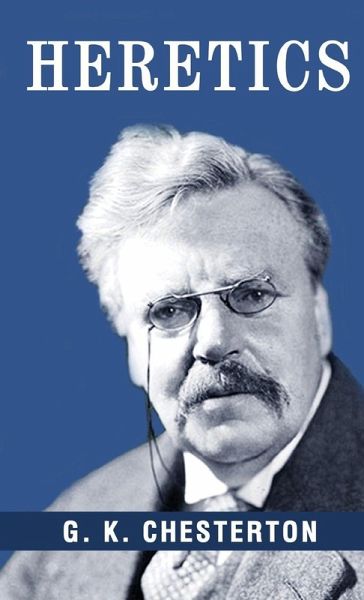
In Heretics, the topics Chesterton debates are as universal to the "vague moderns" of the 21st century as they were to those of the 20th. Focusing on "heretics" - those who pride themselves on their superiority to Christian views - Chesterton appraises prominent figures who fall into that category from the literary and art worlds. Luminaries such as Rudyard Kipling, George Bernard Shaw, H. G. Wells, and James McNeill Whistler come under the author's scrutiny, where they meet with equal measures of his characteristic wisdom and good humor. The topics he touches upon range from cosmology to…mehr
In Heretics, the topics Chesterton debates are as universal to the "vague moderns" of the 21st century as they were to those of the 20th. Focusing on "heretics" - those who pride themselves on their superiority to Christian views - Chesterton appraises prominent figures who fall into that category from the literary and art worlds. Luminaries such as Rudyard Kipling, George Bernard Shaw, H. G. Wells, and James McNeill Whistler come under the author's scrutiny, where they meet with equal measures of his characteristic wisdom and good humor. The topics he touches upon range from cosmology to anthropology to soteriology and he argues against French nihilism, German humanism, English utilitarianism, the syncretism of 'the vague modern', Social Darwinism, eugenics and the arrogance and misanthropy of the European intelligentsia. Together with Orthodoxy, this book is regarded as central to his corpus of moral theology.
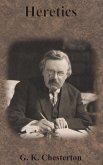
Gilbert Keith Chesterton was an English author, philosopher, Christian apologist, and literary critic, born on May 29, 1874, in Kensington, London, to parents Marie and Edward Chesterton. He was educated at St. Paul's Juniors and University College London before studying at the Slade School of Fine Art. Chesterton's career was diverse, spanning across fiction, essays, and philosophical works. He was especially renowned for creating the fictional priest-detective Father Brown. His writings often explored themes of faith, society, and morality, deeply influenced by his Christian beliefs. His key works, such as Orthodoxy and The Everlasting Man, cemented his reputation as an important intellectual figure. Chesterton was close friends with fellow writer Hilaire Belloc and was influenced by philosophers like Thomas Aquinas and Charles Dickens. He married Frances Blogg in 1901, and the couple remained together until his death on June 14, 1936, at the age of 62 in Beaconsfield, United Kingdom. Chesterton's works, particularly the Father Brown stories, continue to inspire readers and remain significant in detective fiction and Christian apologetics.
Es gelten unsere Allgemeinen Geschäftsbedingungen: www.buecher.de/agb
Impressum
www.buecher.de ist ein Internetauftritt der buecher.de internetstores GmbH
Geschäftsführung: Monica Sawhney | Roland Kölbl | Günter Hilger
Sitz der Gesellschaft: Batheyer Straße 115 - 117, 58099 Hagen
Postanschrift: Bürgermeister-Wegele-Str. 12, 86167 Augsburg
Amtsgericht Hagen HRB 13257
Steuernummer: 321/5800/1497
USt-IdNr: DE450055826