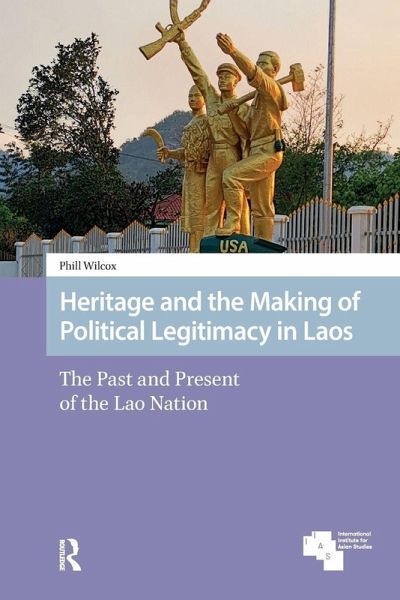
The Lao People's Democratic Republic is nearly fifty years old, and one of the few surviving one-party socialist states. Nearly five decades on from its revolutionary birth, the Lao population continues to build futures in and around a political landscape that maintains socialist rhetoric on the one hand and capitalist economics on the other. Contemporary Lao politics is marked by the use of cultural heritage as a source of political legitimacy. Researched through long-term detailed ethnography in the former royal capital of Luang Prabang, itself a UNESCO-recognized World Heritage Site since…mehr
The Lao People's Democratic Republic is nearly fifty years old, and one of the few surviving one-party socialist states. Nearly five decades on from its revolutionary birth, the Lao population continues to build futures in and around a political landscape that maintains socialist rhetoric on the one hand and capitalist economics on the other. Contemporary Lao politics is marked by the use of cultural heritage as a source of political legitimacy. Researched through long-term detailed ethnography in the former royal capital of Luang Prabang, itself a UNESCO-recognized World Heritage Site since 1995, this book takes a fresh look at issues of legitimacy, heritage, and national identity for different members of the Lao population. It argues that the political system has become sufficiently embedded to avoid imminent risk of collapse but suggests that it is facing new challenges primarily in the form of rising Chinese influence in Laos.
Phill Wilcox is a Research Associate in the Faculty of Sociology at Bielefeld University, Germany. Her book chapter 'Contested Heritage in Luang Prabang' was published as part of the Routledge Handbook of Urbanization in Southeast Asia in 2018.
Inhaltsangabe
List of Acronyms and Abbreviations Author's Note Acknowledgements 1 Introduction - Heritage State and Politics Being Revolutionary Being Lao Constructing the People's Democratic Republic Socialist Ideology - Capitalist Politics Nation State Fragility Cultural Intimacy of/in Laos Heritage With an Agenda Future Building in Laos Rising China The Book Future Directions References 2 Making the Past (Dis)appear: Heritage as Legitimacy in (Re)creating Luang Prabang Luang Prabang and the Creation of Nostalgia Dealing With 'Difficult Pasts' at the National Museum Heritage and Almsgiving 'We Don't Talk About It Openly': Timelessness and Silence An Economy of Selective History A Suitably Idealized Past Conclusions: Heritages and Future Directions References 3 Hmong (Forever) on the Margins: Crypto-Separatism and the Making of Ethnic Difference Ethnicity in Laos Dreams of Hmong Statehood and Zomia 'We Are Hmong' Difference as Belonging Zomia as a Persistent Alternative Conclusions: Reproducing Societal Inequality? References 4 One World: One Dream: Voices of Pessimism Strategies of Pragmatism and Facing the Rise of China 'One World: One Dream'? 'China Is Developed' 'We Will No Longer Have Jobs' Pessimism With Ambivalence: The New 'Things of the House' Final Thoughts - One Belt: Multiple Paths? References 5 Conclusion - Long Live the Revolution? Royal and Revolutionary Heritage Essentializing the State The Dynamics of Authoritarianism Difficult Heritages Difference as (Not) Belonging On China and Changing Laos Final Reflections References Bibliography Index.
List of Acronyms and Abbreviations Author's Note Acknowledgements 1 Introduction - Heritage State and Politics Being Revolutionary Being Lao Constructing the People's Democratic Republic Socialist Ideology - Capitalist Politics Nation State Fragility Cultural Intimacy of/in Laos Heritage With an Agenda Future Building in Laos Rising China The Book Future Directions References 2 Making the Past (Dis)appear: Heritage as Legitimacy in (Re)creating Luang Prabang Luang Prabang and the Creation of Nostalgia Dealing With 'Difficult Pasts' at the National Museum Heritage and Almsgiving 'We Don't Talk About It Openly': Timelessness and Silence An Economy of Selective History A Suitably Idealized Past Conclusions: Heritages and Future Directions References 3 Hmong (Forever) on the Margins: Crypto-Separatism and the Making of Ethnic Difference Ethnicity in Laos Dreams of Hmong Statehood and Zomia 'We Are Hmong' Difference as Belonging Zomia as a Persistent Alternative Conclusions: Reproducing Societal Inequality? References 4 One World: One Dream: Voices of Pessimism Strategies of Pragmatism and Facing the Rise of China 'One World: One Dream'? 'China Is Developed' 'We Will No Longer Have Jobs' Pessimism With Ambivalence: The New 'Things of the House' Final Thoughts - One Belt: Multiple Paths? References 5 Conclusion - Long Live the Revolution? Royal and Revolutionary Heritage Essentializing the State The Dynamics of Authoritarianism Difficult Heritages Difference as (Not) Belonging On China and Changing Laos Final Reflections References Bibliography Index.
Es gelten unsere Allgemeinen Geschäftsbedingungen: www.buecher.de/agb
Impressum
www.buecher.de ist ein Internetauftritt der buecher.de internetstores GmbH
Geschäftsführung: Monica Sawhney | Roland Kölbl | Günter Hilger
Sitz der Gesellschaft: Batheyer Straße 115 - 117, 58099 Hagen
Postanschrift: Bürgermeister-Wegele-Str. 12, 86167 Augsburg
Amtsgericht Hagen HRB 13257
Steuernummer: 321/5800/1497
USt-IdNr: DE450055826