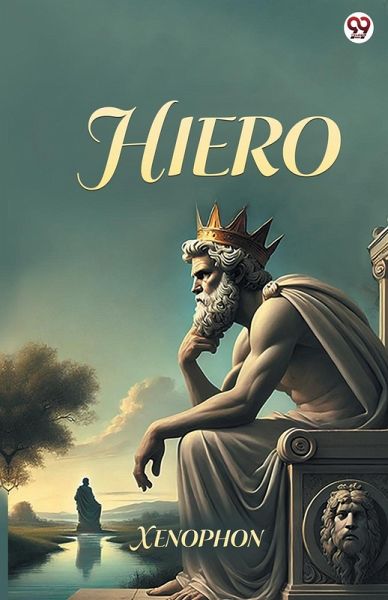
Hiero is a philosophical dialogue that explores political theory and ethics, focusing on the nature of tyranny. The conversation is between Simonides, a poet, and Hieron, the tyrant of Syracuse. The text examines the life of a ruler versus that of an ordinary citizen, particularly in terms of happiness, pleasure, and societal relationships. Hieron reveals that he finds his life as a tyrant filled with more pain and fewer pleasures than that of ordinary people, a surprising contrast to common beliefs about power. The dialogue touches on themes such as friendship, trust, the burdens of power,…mehr
Hiero is a philosophical dialogue that explores political theory and ethics, focusing on the nature of tyranny. The conversation is between Simonides, a poet, and Hieron, the tyrant of Syracuse. The text examines the life of a ruler versus that of an ordinary citizen, particularly in terms of happiness, pleasure, and societal relationships. Hieron reveals that he finds his life as a tyrant filled with more pain and fewer pleasures than that of ordinary people, a surprising contrast to common beliefs about power. The dialogue touches on themes such as friendship, trust, the burdens of power, and the constant threat of betrayal. Simonides argues that a ruler should receive respect and affection from his subjects, but Hieron counters that his rule inspires fear rather than genuine admiration. Through this exchange, the work sheds light on the complexities and contradictions inherent in despotic leadership, prompting reflections on the true nature of power and the impact it has on personal connections and happiness.
Xenophon was a Greek historian, soldier, and philosopher born in Athens around 430 BC. He was a student of Socrates and fought as a mercenary in various conflicts throughout his life. In 401 BC, Xenophon joined the expedition of Cyrus the Younger, a Persian prince who sought to overthrow his brother, the king of Persia. After Cyrus was killed in battle, Xenophon led a group of Greek soldiers known as the Ten Thousand on a dangerous retreat across enemy territory, an event he later wrote about in his famous work, the "Anabasis". Xenophon also wrote several other works, including the "Hellenica", which covers the events in Greece from 411 BC to 362 BC, and the "Cyropaedia", a fictionalized biography of Cyrus the Great. In addition to his military and historical pursuits, Xenophon was also interested in philosophy and wrote several works on ethics, including "Memorabilia", a collection of Socratic dialogues. He believed in the importance of piety, obedience to the law, and the virtues of the Greek city-state system. Xenophon spent his later years in the Greek city of Corinth, where he continued to write and engage in philosophical discussions. He died around 354 BC at an advanced age.
Es gelten unsere Allgemeinen Geschäftsbedingungen: www.buecher.de/agb
Impressum
www.buecher.de ist ein Internetauftritt der buecher.de internetstores GmbH
Geschäftsführung: Monica Sawhney | Roland Kölbl | Günter Hilger
Sitz der Gesellschaft: Batheyer Straße 115 - 117, 58099 Hagen
Postanschrift: Bürgermeister-Wegele-Str. 12, 86167 Augsburg
Amtsgericht Hagen HRB 13257
Steuernummer: 321/5800/1497
USt-IdNr: DE450055826