Thorsten Teutenberg (Institute of Energy and Environmental Technolo
High-Temperature Liquid Chromatography
A User's Guide for Method Development
Thorsten Teutenberg (Institute of Energy and Environmental Technolo
High-Temperature Liquid Chromatography
A User's Guide for Method Development
- Gebundenes Buch
- Merkliste
- Auf die Merkliste
- Bewerten Bewerten
- Teilen
- Produkt teilen
- Produkterinnerung
- Produkterinnerung
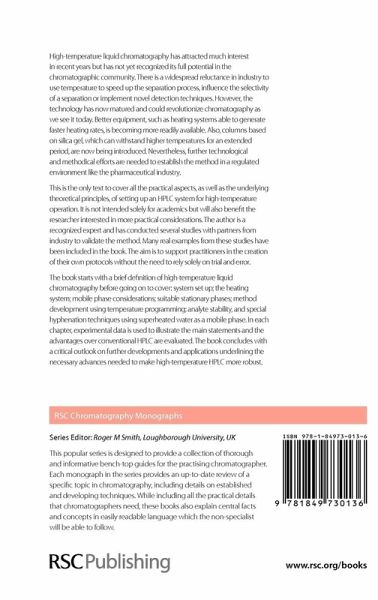
This unique book covers all the practical aspects of setting up an HPLC system for high temperature operation.
Andere Kunden interessierten sich auch für
Tibor Cserhati (Hungary Hungarian Academy of Sciences)Cyclodextrins in Chromatography130,99 €
M. KastnerProtein Liquid Chromatography207,99 €
Diane C Turner (UK Anthias Consulting Ltd)Gas Chromatography-Mass Spectrometry48,99 €
High Performance Liquid Chromatography: Advances in Chromatography131,99 €
John N. Abelson / Melvin I. Simon / Barry L. Karger / William Hancock (Volume ed.)High Resolution Separation and Analysis of Biological Macromolecules, Part B: Applications133,99 €
Handbook of Advanced Chromatography /Mass Spectrometry Techniques177,99 €
Colin F. PooleThe Essence of Chromatography80,99 €-
-
-
This unique book covers all the practical aspects of setting up an HPLC system for high temperature operation.
Produktdetails
- Produktdetails
- RSC Chromatography Monographs
- Verlag: Royal Society of Chemistry
- Seitenzahl: 220
- Erscheinungstermin: 3. Juni 2010
- Englisch
- Abmessung: 242mm x 164mm x 19mm
- Gewicht: 486g
- ISBN-13: 9781849730136
- ISBN-10: 184973013X
- Artikelnr.: 29987198
- Herstellerkennzeichnung
- Libri GmbH
- Europaallee 1
- 36244 Bad Hersfeld
- gpsr@libri.de
- RSC Chromatography Monographs
- Verlag: Royal Society of Chemistry
- Seitenzahl: 220
- Erscheinungstermin: 3. Juni 2010
- Englisch
- Abmessung: 242mm x 164mm x 19mm
- Gewicht: 486g
- ISBN-13: 9781849730136
- ISBN-10: 184973013X
- Artikelnr.: 29987198
- Herstellerkennzeichnung
- Libri GmbH
- Europaallee 1
- 36244 Bad Hersfeld
- gpsr@libri.de
Thorsten Teutenberg obtained his doctorate from the University of Bochum in 2004. His thesis was on the development of a specially designed heating system for high-temperature liquid chromatography. He subsequently joined the Institut f³r Energie- und Umwelttechnik e. V. in Duisburg where he became responsible for a small working group within the Department of Research Analysis focused on method development strategies for high temperature liquid chromatography. Currently, he heads a number of joint research projects, with partners from university and industry, aimed at implementing high temperature liquid chromatography as a routine method. His special interest is the understanding of the temperature dependence of physicochemical solvent properties of binary liquid mixtures used for reversed phase HPLC. Future research interests include multidimensional liquid chromatography, capillary and nano HPLC as well as systematic optimization strategies for an efficient method development.
A brief definition of high-temperature liquid chromatography
System set up for high temperature liquid chromatography
The heating system
Mobile phase considerations
Suitable stationary phases
Method development using temperature programming Analyte stability
Special hyphenation techniques using superheated water as a mobile phase
A critical outlook

System set up for high temperature liquid chromatography
The heating system
Mobile phase considerations
Suitable stationary phases
Method development using temperature programming Analyte stability
Special hyphenation techniques using superheated water as a mobile phase
A critical outlook
A brief definition of high-temperature liquid chromatography
System set up for high temperature liquid chromatography
The heating system
Mobile phase considerations
Suitable stationary phases
Method development using temperature programming Analyte stability
Special hyphenation techniques using superheated water as a mobile phase
A critical outlook
System set up for high temperature liquid chromatography
The heating system
Mobile phase considerations
Suitable stationary phases
Method development using temperature programming Analyte stability
Special hyphenation techniques using superheated water as a mobile phase
A critical outlook