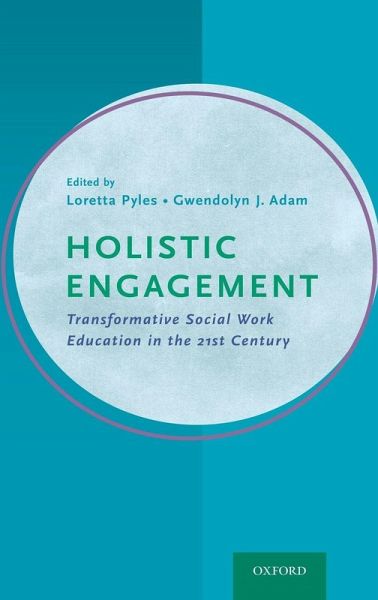
This text offers innovation and a call to action for educators -- engage fully to engage students fully. With stories from the classroom, Holistic Engagement invites and challenges social work, human services and counseling educators to seek meaning in their methods and content in the processes of teaching. Empirically grounded, the authors propose a new model for advancing pedagogy to draw from many ways of knowing and wisdom across traditions. Through rich analysis of globalization, higher education and the social work profession, as well as first person accounts, they co-create a story of…mehr
This text offers innovation and a call to action for educators -- engage fully to engage students fully. With stories from the classroom, Holistic Engagement invites and challenges social work, human services and counseling educators to seek meaning in their methods and content in the processes of teaching. Empirically grounded, the authors propose a new model for advancing pedagogy to draw from many ways of knowing and wisdom across traditions. Through rich analysis of globalization, higher education and the social work profession, as well as first person accounts, they co-create a story of holistic pedagogies being employed across the globe. Aiming toward transformative social work practice, the authors discuss the ways that they engage with the whole person (body, mind, heart, culture and spirit) and reveal how such participatory pedagogies strengthen presence, attunement, empathy, professional self-care and the integrative capabilities of social work students and human service professionals. Drawing from a wide range of literature and traditions, from Freire's critical pedagogy to the neuroscience of mindfulness, these engaging essays have much to offer both seasoned and new social work educators, while creating an integrative and realistic conceptual home for them. The authors discuss the uses of theatre, the arts, ritual, mindfulness, critical dialogue, yoga and many other methods that upend the traditional social work classroom. These approaches are used at the undergraduate and graduate levels in a range of courses, including policy, theory and practice. The auto-ethnographical nature of many of the essays will invite educators to reflect on their own pedagogies as they consider the rewards and risks of going beyond the cognitive and engaging the whole person.
Loretta Pyles, PhD, MA, is Associate Professor in the School of Social Welfare at the State University of New York at Albany. She is an engaged scholar concerned with transformative social change and holistic social work practice and pedagogy. Her scholarship has centered on the ways that individuals, organizations and communities resist and respond to poverty, violence and disasters in a policy context of neoliberal global capitalism and social welfare retrenchment. She is a certified yoga instructor and utilizes mindfulness and embodied learning in her pedagogy, both in the classroom and in the community. Gwendolyn J. Adam, PhD, MSW, LICSW, is an Associate Professor at Central Connecticut State University, School of Education and Professional Studies. With a focus on mindful and experiential leadership, accountability in practice and education, and interdisciplinary teamwork, Dr. Adam has developed training curricula, a national strategic plan, competency assessment models and community-based services. She is committed to living and being fully, imperfectly, and to promoting compassionate presence.
Inhaltsangabe
* Part I: Theoretical and Empirical Foundations of Holistic Engagement * Chapter 1: Educating Transformative Social Workers: The Case for Holistic Pedagogies * Loretta Pyles and Gwendolyn J. Adam * Chapter 2: A New Model for Holistic Engagement: A Foundation for Social Work Pedagogies * Gwendolyn J. Adam and Loretta Pyles * Part II: Dialogue, Participation and Critical Pedagogy * Chapter 3: Learning in Community: A Transformative Healing Educational Model for Teaching Community Organizing * Terry Mizrahi, Esperanza Martell, Kate Cavanagh, and Allison Weingarten * Chapter 4: "By the End of The Term, You Will Have Gained Power in the Classroom and I Will Have Lost None: " The Pedagogical Value of Discomfort and Vulnerability in the Teaching of Community Practice * Steve Burghardt * Chapter 5: Conversation and Dialogue in Social Work Education * By Benjamin Shepard * Chapter 6: A Deliberate Pedagogy: Introducing the Hidden Curriculum, Social Pedagogy and the Common Third * Mette Christiansen * Part III: Theater, Arts and the Human Spirit * Chapter 7: Mimesis: A Theory for Holistic Engagement * Phil Dybicz * Chapter 8: Improvisation: A Practice for Praxis * Uta Walter * Chapter 9: Teaching to the Holistic Self: A Case Study of a Critical Social Work Classroom * Juliana Svistova, Lara Bowen, and Meera Bhat * Part IV: Mindfulness and Integrative Social Work * Chapter 10: There Is A Path. You Are On It. It Does Lead Somewhere. * David Pettie * Chapter 11: Is Mindfulness Value Free? Tip Toeing through the Mindfield of Mindfulness * Robyn Lynn, Jo Mensinga, Beth Tinning, Kelly Lundman * Chapter 12: Promoting Integrative Mind-Body-Spirit Practice to Advance Holistic Social Work Education * Salome Raheim and Jack J. Lu * Chapter 13: Pedagogy for an Integrative Practice: Experiential Unity Theory and Model * Alyson Quinn * Chapter 14: Re-Constructing Social Work Education: The Path Forward for Holistic Pedagogies * Loretta Pyles and Gwendolyn J. Adam
* Part I: Theoretical and Empirical Foundations of Holistic Engagement * Chapter 1: Educating Transformative Social Workers: The Case for Holistic Pedagogies * Loretta Pyles and Gwendolyn J. Adam * Chapter 2: A New Model for Holistic Engagement: A Foundation for Social Work Pedagogies * Gwendolyn J. Adam and Loretta Pyles * Part II: Dialogue, Participation and Critical Pedagogy * Chapter 3: Learning in Community: A Transformative Healing Educational Model for Teaching Community Organizing * Terry Mizrahi, Esperanza Martell, Kate Cavanagh, and Allison Weingarten * Chapter 4: "By the End of The Term, You Will Have Gained Power in the Classroom and I Will Have Lost None: " The Pedagogical Value of Discomfort and Vulnerability in the Teaching of Community Practice * Steve Burghardt * Chapter 5: Conversation and Dialogue in Social Work Education * By Benjamin Shepard * Chapter 6: A Deliberate Pedagogy: Introducing the Hidden Curriculum, Social Pedagogy and the Common Third * Mette Christiansen * Part III: Theater, Arts and the Human Spirit * Chapter 7: Mimesis: A Theory for Holistic Engagement * Phil Dybicz * Chapter 8: Improvisation: A Practice for Praxis * Uta Walter * Chapter 9: Teaching to the Holistic Self: A Case Study of a Critical Social Work Classroom * Juliana Svistova, Lara Bowen, and Meera Bhat * Part IV: Mindfulness and Integrative Social Work * Chapter 10: There Is A Path. You Are On It. It Does Lead Somewhere. * David Pettie * Chapter 11: Is Mindfulness Value Free? Tip Toeing through the Mindfield of Mindfulness * Robyn Lynn, Jo Mensinga, Beth Tinning, Kelly Lundman * Chapter 12: Promoting Integrative Mind-Body-Spirit Practice to Advance Holistic Social Work Education * Salome Raheim and Jack J. Lu * Chapter 13: Pedagogy for an Integrative Practice: Experiential Unity Theory and Model * Alyson Quinn * Chapter 14: Re-Constructing Social Work Education: The Path Forward for Holistic Pedagogies * Loretta Pyles and Gwendolyn J. Adam
Es gelten unsere Allgemeinen Geschäftsbedingungen: www.buecher.de/agb
Impressum
www.buecher.de ist ein Internetauftritt der buecher.de internetstores GmbH
Geschäftsführung: Monica Sawhney | Roland Kölbl | Günter Hilger
Sitz der Gesellschaft: Batheyer Straße 115 - 117, 58099 Hagen
Postanschrift: Bürgermeister-Wegele-Str. 12, 86167 Augsburg
Amtsgericht Hagen HRB 13257
Steuernummer: 321/5800/1497
USt-IdNr: DE450055826