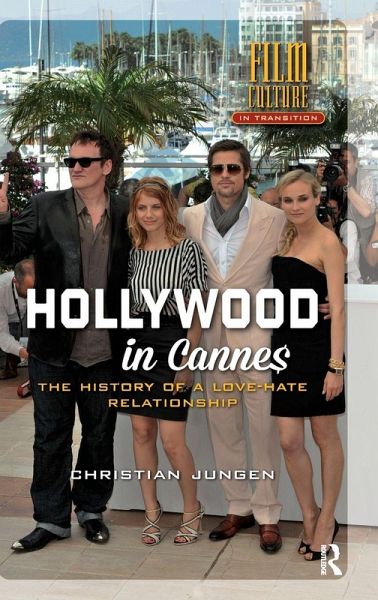
Using case studies, Jungen recounts the history of the Cannes Film Festival from an American perspective surveying the complex interplay of talent, money and corporate clout. He traces the growing influence of the Hollywood studios on the festival's rise to the key film event.
Using case studies, Jungen recounts the history of the Cannes Film Festival from an American perspective surveying the complex interplay of talent, money and corporate clout. He traces the growing influence of the Hollywood studios on the festival's rise to the key film event.
Christian Jungen is film critic of Swiss newspaper NZZ am Sonntag, the Sunday edition of Neue Zürcher Zeitung. He is president of the Swiss Film Critics Association. He gave seminars on the history of film festivals at the Ruhr-Universität Bochum. Recipient of the Prix Pathé for excellence in film journalism 2011.
Inhaltsangabe
Acknowledgments, Introduction 1 The Festival as a means to promote European national cultures, 1939-1968 1.1 With Hollywood against Hollywood 1.2 The Festival as a definitional context for national cinema 1.3 Hollywood's handicap on the diplomatic scene 1.4 The art vs. commerce conflict 1.4.1 The false allure of the free visa 1.5 US government interests in the Cold War 2 The star as a symbiosis between Hollywood and Cannes 2.1 Stars as means of market control 2.2 Cannes legitimates itself with Hollywood stars 2.3 The rise of Brigitte Bardot 2.4 Fear of scandal: Hollywood skimps on stars 2.4.1 Warner Brothers loses interest in Cannes: What ever happened to Bette Davis? 3 The auteur in commercial Hollywood 3.1 The emergence of the politique des auteurs in Cahiers du Cinéma 3.2 The politique at the Festival 3.2.1 The Nouvelle Vague becomes a brand at Cannes 3.2.2 Alfred Hitchcock: The "Father of the Nouvelle Vague" as publicity genius 3.3 Criticism of the fora for critical reception 3.3.1 Hollywood's hegemonic claims 3.3.2 The American score with the jury 3.3.3 Film critics as spoilsports 3.3.4 Preemption by film programmers 4 A new harmony courtesy of New Hollywood, 1969-1981 4.1 The selection process is reformed 4.1.2 Denationalization through coproductions 4.2.2 The end of an era: 1968 interrupts the festival 4.4 Cannes as a success story for Hollywood in crisis 4.4.1 The film market 4.4.2 Columbia's success with EASY RIDER 4.4.3 With M*A*S*H, Fox becomes the first major to win the Palme d'Or 4.4.4 Warner Brothers celebrates its fiftieth anniversary at Cannes 4.4.5 Artistic grounds for success 4.5 What can films do for the festival? 4.5.1 American critics discover Cannes 4.5.2 Hollywood's industry press 4.5.3 Cannes on American TV: Dreams for breakfast 4.6 Trans-Atlantic harmony ends 4.6.1 Coppola triumphs with APOCALYPSE NOW 4.6.2 Cimino fails with HEAVEN'S GATE 5 Perils and possibilities for blockbusters, 1975-1997 5.1 Cannes as an avoidable risk 5.1.1 High-concept blockbusters drive out auteur films; marketing neutralizes critics 5.1.2 The multiplex and MTV revolution 5.1.3 "Pictures that people in Kansas City want to see" from Paramount 5.1.4 The Palme d'Or as an art film stigma for THE MISSION 5. 2 Hollywood's strategies to exploit media concentration 5.2.1 Out of competition, outside criticism 5.2.1.1 E.T. feels at home at Cannes 5.2.2 The politique des acteurs 5.2.2.1 Muscular action heroes 5.2.2.2 Arnold Schwarzenegger makes his movie career on the beach 5.2.2.3 Schwarzenegger's flop with LAST ACTION HERO 5.2.2.4 Consequences of the strategy of "with Cannes against Cannes" 5.3 The Festival's politique des acteurs 5.3.1 The Montée des Marches 5.3.2 Sharon Stone becomes a star overnight 5.4 The independents conquer Cannes 6 Cultural exception versus monoculture, 1994-2008 6.1 The new ice age, 1994-2000 6.1.1 Hollywood makes Hollyworld 6.1.2 The GATT negotiations 6.1.3 Cannes as a means to promote cultural diversity 6.1.4. No US blockbusters in competition 6.2 The festival as launch pad, 2001-2008 6.2.1 Global launches 6.2.2 Cannes as gateway to the world market 6.2.3 Veni, Vidi, "Vinci": THE DA VINCI CODE cracks the critics, Conclusion, Bibliography, Appendix, Index,
Acknowledgments, Introduction 1 The Festival as a means to promote European national cultures, 1939-1968 1.1 With Hollywood against Hollywood 1.2 The Festival as a definitional context for national cinema 1.3 Hollywood's handicap on the diplomatic scene 1.4 The art vs. commerce conflict 1.4.1 The false allure of the free visa 1.5 US government interests in the Cold War 2 The star as a symbiosis between Hollywood and Cannes 2.1 Stars as means of market control 2.2 Cannes legitimates itself with Hollywood stars 2.3 The rise of Brigitte Bardot 2.4 Fear of scandal: Hollywood skimps on stars 2.4.1 Warner Brothers loses interest in Cannes: What ever happened to Bette Davis? 3 The auteur in commercial Hollywood 3.1 The emergence of the politique des auteurs in Cahiers du Cinéma 3.2 The politique at the Festival 3.2.1 The Nouvelle Vague becomes a brand at Cannes 3.2.2 Alfred Hitchcock: The "Father of the Nouvelle Vague" as publicity genius 3.3 Criticism of the fora for critical reception 3.3.1 Hollywood's hegemonic claims 3.3.2 The American score with the jury 3.3.3 Film critics as spoilsports 3.3.4 Preemption by film programmers 4 A new harmony courtesy of New Hollywood, 1969-1981 4.1 The selection process is reformed 4.1.2 Denationalization through coproductions 4.2.2 The end of an era: 1968 interrupts the festival 4.4 Cannes as a success story for Hollywood in crisis 4.4.1 The film market 4.4.2 Columbia's success with EASY RIDER 4.4.3 With M*A*S*H, Fox becomes the first major to win the Palme d'Or 4.4.4 Warner Brothers celebrates its fiftieth anniversary at Cannes 4.4.5 Artistic grounds for success 4.5 What can films do for the festival? 4.5.1 American critics discover Cannes 4.5.2 Hollywood's industry press 4.5.3 Cannes on American TV: Dreams for breakfast 4.6 Trans-Atlantic harmony ends 4.6.1 Coppola triumphs with APOCALYPSE NOW 4.6.2 Cimino fails with HEAVEN'S GATE 5 Perils and possibilities for blockbusters, 1975-1997 5.1 Cannes as an avoidable risk 5.1.1 High-concept blockbusters drive out auteur films; marketing neutralizes critics 5.1.2 The multiplex and MTV revolution 5.1.3 "Pictures that people in Kansas City want to see" from Paramount 5.1.4 The Palme d'Or as an art film stigma for THE MISSION 5. 2 Hollywood's strategies to exploit media concentration 5.2.1 Out of competition, outside criticism 5.2.1.1 E.T. feels at home at Cannes 5.2.2 The politique des acteurs 5.2.2.1 Muscular action heroes 5.2.2.2 Arnold Schwarzenegger makes his movie career on the beach 5.2.2.3 Schwarzenegger's flop with LAST ACTION HERO 5.2.2.4 Consequences of the strategy of "with Cannes against Cannes" 5.3 The Festival's politique des acteurs 5.3.1 The Montée des Marches 5.3.2 Sharon Stone becomes a star overnight 5.4 The independents conquer Cannes 6 Cultural exception versus monoculture, 1994-2008 6.1 The new ice age, 1994-2000 6.1.1 Hollywood makes Hollyworld 6.1.2 The GATT negotiations 6.1.3 Cannes as a means to promote cultural diversity 6.1.4. No US blockbusters in competition 6.2 The festival as launch pad, 2001-2008 6.2.1 Global launches 6.2.2 Cannes as gateway to the world market 6.2.3 Veni, Vidi, "Vinci": THE DA VINCI CODE cracks the critics, Conclusion, Bibliography, Appendix, Index,
Es gelten unsere Allgemeinen Geschäftsbedingungen: www.buecher.de/agb
Impressum
www.buecher.de ist ein Internetauftritt der buecher.de internetstores GmbH
Geschäftsführung: Monica Sawhney | Roland Kölbl | Günter Hilger
Sitz der Gesellschaft: Batheyer Straße 115 - 117, 58099 Hagen
Postanschrift: Bürgermeister-Wegele-Str. 12, 86167 Augsburg
Amtsgericht Hagen HRB 13257
Steuernummer: 321/5800/1497
USt-IdNr: DE450055826