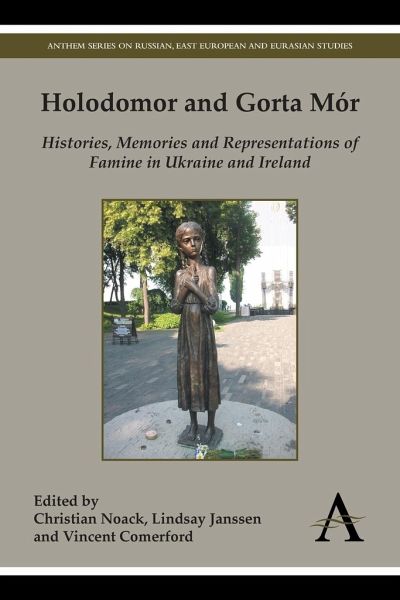
A comparative study of the famines of Ireland (1845-51) and Ukraine (1932?33), and how historical experiences of famine were translated into narratives that supported political claims for independent national statehood.
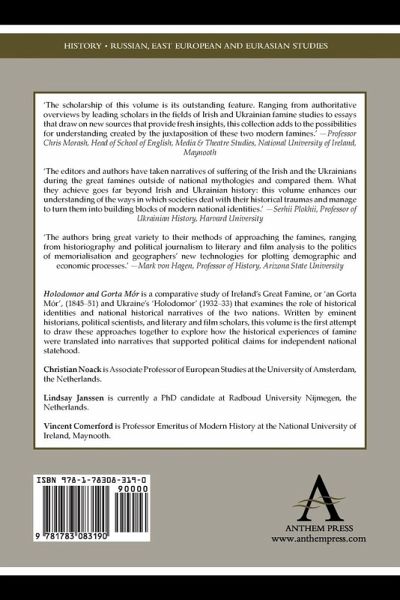
A comparative study of the famines of Ireland (1845-51) and Ukraine (1932?33), and how historical experiences of famine were translated into narratives that supported political claims for independent national statehood.
Christian Noack is Associate Professor of European Studies at the University of Amsterdam, the Netherlands. Lindsay Janssen is currently a PhD candidate at Radboud University Nijmegen, the Netherlands. Vincent Comerford is Professor Emeritus of Modern History at the National University of Ireland, Maynooth.
Inhaltsangabe
List of Figures; Acknowledgements; Introduction: ‘Holodomor and Gorta Mór: Histories, Memories and Representations of Famine in Ukraine and Ireland’ – Christian Noack, Lindsay Janssen and Vincent Comerford; PART I: HISTORIES, HISTORIOGRAPHY AND POLITICS: Chapter 1: ‘Holodomor in Ukraine 1932–1933: An Interpretation of Facts’ – Stanislav V. Kulchytskyi (Translated from Russian by Christian Noack); Chapter 2: ‘Ethnic Issues in the Famine of 1932–1933 in Ukraine’ – David R. Marples; Chapter 3: ‘Grievance, Scourge or Shame? The Complexity of Attitudes to Ireland’s Great Famine’ – Vincent Comerford; PART II: PUBLIC COMMEMORATION: Chapter 4: ‘History and National Identity Construction: The Great Famine in Irish and Ukrainian History Textbooks’ – Jan Germen Janmaat; Chapter 5: ‘Teaching Hunger: The Great Irish Famine Curriculum in New York State Schools’ – Maureen O. Murphy; Chapter 6: ‘Remembering Famine Orphans: The Transmission of Famine Memory between Ireland and Quebec’ – Jason King; Chapter 7: ‘The Irish Famine and Commemorative Culture’ – Emily Mark-FitzGerald; PART III: TRAUMA AND VICTIMISATION: Chapter 8: ‘Holodomor and the Politics of Memory in Ukraine after Independence’ – Heorhiy Kasianov (Translated from Russian by Christian Noack); Chapter 9: ‘The Great Irish Famine in Stories for Children in the Closing Decades of the Twentieth Century’ – Celia Keenan; Chapter 10: ‘Collective Trauma in a Feature Film: “Golod-33” as One-of-a-Kind’ – Olga Papash (Translated from Russian by Christian Noack); PART IV: NEW SOURCES AND NEW APPROACHES TO THE IRISH AND UKRAINIAN FAMINES: Chapter 11: ‘In Search of New Sources: Polish Diplomatic and Intelligence Reports on the Holodomor’ – Jan Jacek Bruski (Translated from Polish by Alicja Waligóra-Zblewska and Christian Noack); Chapter 12: ‘Oral History, Oral Tradition and the Great Famine’ – Maura Cronin; Chapter 13: ‘Mapping Population Change in Ireland 1841–1851: Quantitative Analysis Using Historical GIS’ – Mary Kelly, A. Stewart Fotheringham and Martin Charltoni; Index
List of Figures; Acknowledgements; Introduction: ‘Holodomor and Gorta Mór: Histories, Memories and Representations of Famine in Ukraine and Ireland’ – Christian Noack, Lindsay Janssen and Vincent Comerford; PART I: HISTORIES, HISTORIOGRAPHY AND POLITICS: Chapter 1: ‘Holodomor in Ukraine 1932–1933: An Interpretation of Facts’ – Stanislav V. Kulchytskyi (Translated from Russian by Christian Noack); Chapter 2: ‘Ethnic Issues in the Famine of 1932–1933 in Ukraine’ – David R. Marples; Chapter 3: ‘Grievance, Scourge or Shame? The Complexity of Attitudes to Ireland’s Great Famine’ – Vincent Comerford; PART II: PUBLIC COMMEMORATION: Chapter 4: ‘History and National Identity Construction: The Great Famine in Irish and Ukrainian History Textbooks’ – Jan Germen Janmaat; Chapter 5: ‘Teaching Hunger: The Great Irish Famine Curriculum in New York State Schools’ – Maureen O. Murphy; Chapter 6: ‘Remembering Famine Orphans: The Transmission of Famine Memory between Ireland and Quebec’ – Jason King; Chapter 7: ‘The Irish Famine and Commemorative Culture’ – Emily Mark-FitzGerald; PART III: TRAUMA AND VICTIMISATION: Chapter 8: ‘Holodomor and the Politics of Memory in Ukraine after Independence’ – Heorhiy Kasianov (Translated from Russian by Christian Noack); Chapter 9: ‘The Great Irish Famine in Stories for Children in the Closing Decades of the Twentieth Century’ – Celia Keenan; Chapter 10: ‘Collective Trauma in a Feature Film: “Golod-33” as One-of-a-Kind’ – Olga Papash (Translated from Russian by Christian Noack); PART IV: NEW SOURCES AND NEW APPROACHES TO THE IRISH AND UKRAINIAN FAMINES: Chapter 11: ‘In Search of New Sources: Polish Diplomatic and Intelligence Reports on the Holodomor’ – Jan Jacek Bruski (Translated from Polish by Alicja Waligóra-Zblewska and Christian Noack); Chapter 12: ‘Oral History, Oral Tradition and the Great Famine’ – Maura Cronin; Chapter 13: ‘Mapping Population Change in Ireland 1841–1851: Quantitative Analysis Using Historical GIS’ – Mary Kelly, A. Stewart Fotheringham and Martin Charltoni; Index
Es gelten unsere Allgemeinen Geschäftsbedingungen: www.buecher.de/agb
Impressum
www.buecher.de ist ein Internetauftritt der buecher.de internetstores GmbH
Geschäftsführung: Monica Sawhney | Roland Kölbl | Günter Hilger
Sitz der Gesellschaft: Batheyer Straße 115 - 117, 58099 Hagen
Postanschrift: Bürgermeister-Wegele-Str. 12, 86167 Augsburg
Amtsgericht Hagen HRB 13257
Steuernummer: 321/5800/1497
USt-IdNr: DE450055826