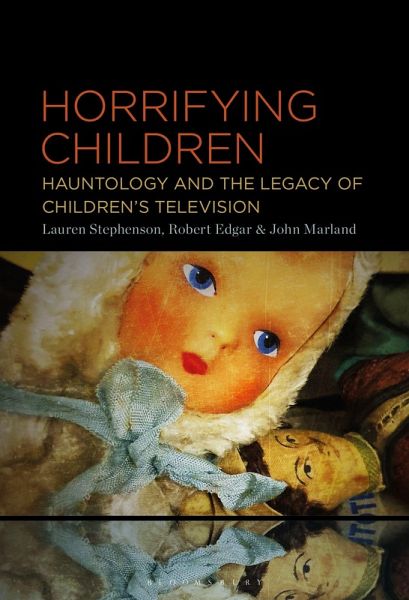
Horrifying Childrenexamines weird and eerie children's television and literature via critical analysis, memoir and autoethnography. There has been an explosion of interest in the impact of children's television and literature of the late twentieth century. In particular, the 1970s, '80s and '90s are seen as decades that shaped a great deal of the contemporary cultural landscape. Television of this period dominated the world of childhood entertainment, drawing freely upon literature and popular culture, like the Garbage Pail Kids and Stranger Things, and much of it continues to resonate…mehr
Horrifying Childrenexamines weird and eerie children's television and literature via critical analysis, memoir and autoethnography. There has been an explosion of interest in the impact of children's television and literature of the late twentieth century. In particular, the 1970s, '80s and '90s are seen as decades that shaped a great deal of the contemporary cultural landscape. Television of this period dominated the world of childhood entertainment, drawing freely upon literature and popular culture, like the Garbage Pail Kids and Stranger Things, and much of it continues to resonate powerfully with the generation of cultural producers (fiction writers, screenwriters, directors, musicians and artists) that grew up watching the weird, the eerie and the horrific: the essence of 21st-century Hauntology. In these terms this book is not about children's television as it exists now, but rather as it features as a facet of memory in the 21st century. As such it is the legacy of these television programmes that is at the core of Horrifying Children. The 'haunting' of adults by what we have seen on the screen is crucial to the study. This collection directly addresses that which 'scared us' in the past insomuch as there is a correlation between individual and collective cultural memory, with some chapters providing an opportunity for situating existing explorations and understandings of Gothic and Horror TV within a hauntological and experiential framework.
Lauren Stephenson is a Lecturer in Film and Media Studies at York St. John University, UK. She specialises in teaching and researching on horror cinema, gender roles and representation in contemporary British and American cinema and American cinema and society. She has published on British Horror Television, the contemporary Gothic and women horror filmmakers. Robert Edgar is Associate Professor of Creative Writing in the York Centre for Writing at York St John University, UK. He is currently leading MA, MFA and PhD programmes. His teaching specialisms are in scriptwriting, adaptation and genre fiction. He has published widely on screenwriting, film language, popular music adaptation and science-fiction. John Marland is a Senior Lecturer in Literature Studies at York St John University, UK. He teaches gothic fiction, film adaptation and modern drama. His research interests include the use of silence on page, stage and screen. He has published on scriptwriting, visual semiotics and adaptation.
Inhaltsangabe
List of Figures List of Contributors Acknowledgements Introduction: The Edwardian Legacy and Children's Fiction Lauren Stephenson, Robert Edgar and John Marland (York St. John University, UK) Part I: Hauntings and Spectres 1.'What is it like to be dead and a ghost? Oh, do tell me Tom, I've been simply longing to know': Hauntology and Spectrality in the 1989 BBC Television Series Tom's Midnight Garden Stella Miriam Pryce (University of Cambridge, UK) 2. Coming of Age in The Owl Service: England and the Uncertain Future Fernando Gabriel Pagnoni Berns (University of Buenos Aires, Argentina) 3. 'Oh please, let us come undone!' States of Independence: Female Temporality in the Supernatural Children's Television and Literature of the 1970s and '80s Fiona Cameron (Bangor University, North Wales) 4. 'It came from beneath the sink': Children's Horror Television as an Uncanny Mirror Merinda Staubli (RMIT University in Melbourne, Australia) 5. An Adult Nightmare: Garbage Pail Kids and the Fear of the Queer Child Max Hart (independent scholar) 6. The Transgender Twist: Mermen and Gender-nonconformity in Round the Twist Jackson Phoenix Nash (independent scholar) 7. Weird Doubling in Wes Craven's Stranger in Our House (1978) Miranda Corcoran (University College Cork, Ireland) 8. Suburban Eerie: The Demon Headmaster (BBC1, 1996-8) and The Demon Headmaster (CBBC, 2019) as Neoliberal Folk Horror Adam Whybray (University of Suffolk, UK) 9. 'My Carnaby cassock': Jimmy Savile, Jim'll Fix It and Top of the Pops Benjamin Halligan (University of Wolverhampton, UK) Part II: Memory, Process and Practice 10. The Technological Uncanny: The Role of Memory Prosthetics in Hauntological Practice Michael Schofield (University of Leeds, UK) 11. The Pandemic and The Bomb Flannán Delaney (independent scholar) 12. Killing a Cow on Kids' TV: The Case of Die Sendung mit der Maus Alexander Hartley (Harvard University, USA) 13. Confronting Ghosts: The Inherited Horrors of the Kent State Shooting Elizabeth Tussey (independent scholar) 14. Creeping Dread in The Singing, Ringing Tree: East German Cinematic Fairytale as Children's Tea-Time Entertainment Wayne Johnson (York St John University, UK) 15. 'May cause drowsiness': A (False) Memory of Weekday Morning Television in the Mid-1970s Through the Filter of Prepubescent Illness and Sedation Jez Conolly (independent scholar) 16. Bleak Adventures in Kenneth Johnson's V Keith McDonald (York St John University, UK) 17. Don't Turn Tail from Horror: Using Eco-Horror in the Secondary School Classroom Hollie Adams (independent scholar) Index
List of Figures List of Contributors Acknowledgements Introduction: The Edwardian Legacy and Children's Fiction Lauren Stephenson, Robert Edgar and John Marland (York St. John University, UK) Part I: Hauntings and Spectres 1.'What is it like to be dead and a ghost? Oh, do tell me Tom, I've been simply longing to know': Hauntology and Spectrality in the 1989 BBC Television Series Tom's Midnight Garden Stella Miriam Pryce (University of Cambridge, UK) 2. Coming of Age in The Owl Service: England and the Uncertain Future Fernando Gabriel Pagnoni Berns (University of Buenos Aires, Argentina) 3. 'Oh please, let us come undone!' States of Independence: Female Temporality in the Supernatural Children's Television and Literature of the 1970s and '80s Fiona Cameron (Bangor University, North Wales) 4. 'It came from beneath the sink': Children's Horror Television as an Uncanny Mirror Merinda Staubli (RMIT University in Melbourne, Australia) 5. An Adult Nightmare: Garbage Pail Kids and the Fear of the Queer Child Max Hart (independent scholar) 6. The Transgender Twist: Mermen and Gender-nonconformity in Round the Twist Jackson Phoenix Nash (independent scholar) 7. Weird Doubling in Wes Craven's Stranger in Our House (1978) Miranda Corcoran (University College Cork, Ireland) 8. Suburban Eerie: The Demon Headmaster (BBC1, 1996-8) and The Demon Headmaster (CBBC, 2019) as Neoliberal Folk Horror Adam Whybray (University of Suffolk, UK) 9. 'My Carnaby cassock': Jimmy Savile, Jim'll Fix It and Top of the Pops Benjamin Halligan (University of Wolverhampton, UK) Part II: Memory, Process and Practice 10. The Technological Uncanny: The Role of Memory Prosthetics in Hauntological Practice Michael Schofield (University of Leeds, UK) 11. The Pandemic and The Bomb Flannán Delaney (independent scholar) 12. Killing a Cow on Kids' TV: The Case of Die Sendung mit der Maus Alexander Hartley (Harvard University, USA) 13. Confronting Ghosts: The Inherited Horrors of the Kent State Shooting Elizabeth Tussey (independent scholar) 14. Creeping Dread in The Singing, Ringing Tree: East German Cinematic Fairytale as Children's Tea-Time Entertainment Wayne Johnson (York St John University, UK) 15. 'May cause drowsiness': A (False) Memory of Weekday Morning Television in the Mid-1970s Through the Filter of Prepubescent Illness and Sedation Jez Conolly (independent scholar) 16. Bleak Adventures in Kenneth Johnson's V Keith McDonald (York St John University, UK) 17. Don't Turn Tail from Horror: Using Eco-Horror in the Secondary School Classroom Hollie Adams (independent scholar) Index
Es gelten unsere Allgemeinen Geschäftsbedingungen: www.buecher.de/agb
Impressum
www.buecher.de ist ein Internetauftritt der buecher.de internetstores GmbH
Geschäftsführung: Monica Sawhney | Roland Kölbl | Günter Hilger
Sitz der Gesellschaft: Batheyer Straße 115 - 117, 58099 Hagen
Postanschrift: Bürgermeister-Wegele-Str. 12, 86167 Augsburg
Amtsgericht Hagen HRB 13257
Steuernummer: 321/5800/1497
USt-IdNr: DE450055826