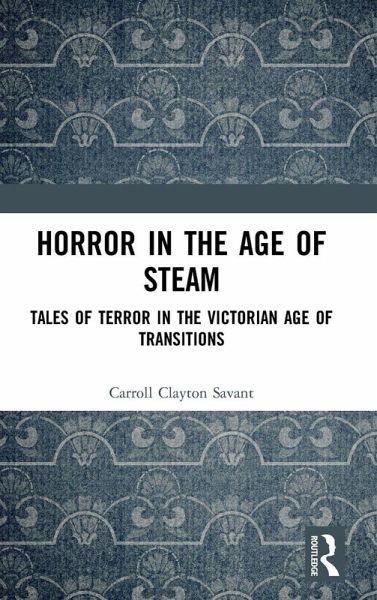
Faced with scientific innovation and industrial advancement, Victorians sought new ways to deal with their new moment in history. Many turned to artistic movements of the past; there were authors, however, who created new forms of storytelling, the horror story, to illustrate the terrors of an age in transition.
Faced with scientific innovation and industrial advancement, Victorians sought new ways to deal with their new moment in history. Many turned to artistic movements of the past; there were authors, however, who created new forms of storytelling, the horror story, to illustrate the terrors of an age in transition.
Carroll Clayton Savant holds a PhD in literary studies from the University of Texas at Dallas. He is an Associate Professor of English and teaches literature, composition, and humanities at Tarrant County College, where he has created classes on horror, science fiction, dystopian realities, and the voices of minority cultures. Savant has written and published extensively on the relationship between music and literature in Victorian society, primarily through the works of George Eliot, Thomas Hardy, and George Gissing. His scholarship has appeared in The Victorian, The Victorian Web, and through the San Francisco State University Press and Salem Press. He is an academically trained musicologist with a background as a concert pianist and orchestral musician. His current research interests include the work of the Brownings, the history of the novel, and studying Steampunk cultures.
Inhaltsangabe
Introduction Chapter One: "If Ever I Saw Horror in the Human Face, It Was Then": Victorian Horror and the Terrifying Aesthetic of the Taboo in an Unstable World Chapter Two: "The Monstrous Serpents of Smoke": The Hellscape of the Industrial Factory in Elizabeth Gaskell's Mary Barton and North and South and Victorian Fears of an Industrializing Economy Chapter Three: Greeks, Freaks, and Raving Lunatics: The Monstrous World of Science in Emily Brontë's Wuthering Heights Chapter Four: Hysterical Angels and Loud-Mouthed Hussies: Anne Brontë's The Tenant of Wildfell Hall and the Transformation of Gendered Voices in Victorian England
Introduction
Chapter One: "If Ever I Saw Horror in the Human Face, It Was Then": Victorian Horror and the Terrifying Aesthetic of the Taboo in an Unstable World
Chapter Two: "The Monstrous Serpents of Smoke": The Hellscape of the Industrial Factory in Elizabeth Gaskell's Mary Barton and North and South and Victorian Fears of an Industrializing Economy
Chapter Three: Greeks, Freaks, and Raving Lunatics: The Monstrous World of Science in Emily Brontë's Wuthering Heights
Chapter Four: Hysterical Angels and Loud-Mouthed Hussies: Anne Brontë's The Tenant of Wildfell Hall and the Transformation of Gendered Voices in Victorian England
Introduction Chapter One: "If Ever I Saw Horror in the Human Face, It Was Then": Victorian Horror and the Terrifying Aesthetic of the Taboo in an Unstable World Chapter Two: "The Monstrous Serpents of Smoke": The Hellscape of the Industrial Factory in Elizabeth Gaskell's Mary Barton and North and South and Victorian Fears of an Industrializing Economy Chapter Three: Greeks, Freaks, and Raving Lunatics: The Monstrous World of Science in Emily Brontë's Wuthering Heights Chapter Four: Hysterical Angels and Loud-Mouthed Hussies: Anne Brontë's The Tenant of Wildfell Hall and the Transformation of Gendered Voices in Victorian England
Introduction
Chapter One: "If Ever I Saw Horror in the Human Face, It Was Then": Victorian Horror and the Terrifying Aesthetic of the Taboo in an Unstable World
Chapter Two: "The Monstrous Serpents of Smoke": The Hellscape of the Industrial Factory in Elizabeth Gaskell's Mary Barton and North and South and Victorian Fears of an Industrializing Economy
Chapter Three: Greeks, Freaks, and Raving Lunatics: The Monstrous World of Science in Emily Brontë's Wuthering Heights
Chapter Four: Hysterical Angels and Loud-Mouthed Hussies: Anne Brontë's The Tenant of Wildfell Hall and the Transformation of Gendered Voices in Victorian England
Es gelten unsere Allgemeinen Geschäftsbedingungen: www.buecher.de/agb
Impressum
www.buecher.de ist ein Internetauftritt der buecher.de internetstores GmbH
Geschäftsführung: Monica Sawhney | Roland Kölbl | Günter Hilger
Sitz der Gesellschaft: Batheyer Straße 115 - 117, 58099 Hagen
Postanschrift: Bürgermeister-Wegele-Str. 12, 86167 Augsburg
Amtsgericht Hagen HRB 13257
Steuernummer: 321/5800/1497
USt-IdNr: DE450055826