How Europeans View and Evaluate Democracy
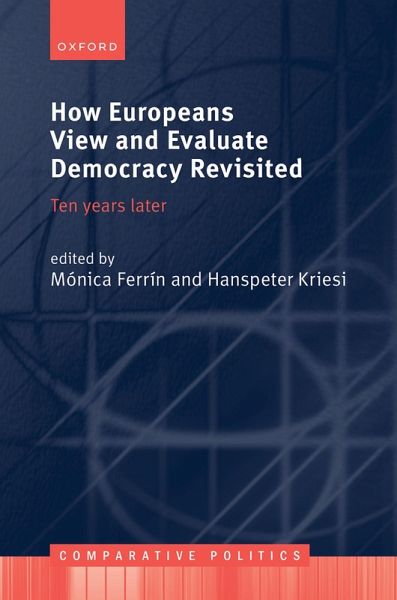
Herausgeber: Ferrín, Mónica; Kriesi, Hanspeter
How Europeans View and Evaluate Democracy
Herausgeber: Ferrín, Mónica; Kriesi, Hanspeter
- Gebundenes Buch
Andere Kunden interessierten sich auch für
How People View Democracy50,99 €
Andrew ReynoldsDesigning Democracy in a Dangerous World96,99 €
Thomas PoguntkePolitical Parties and the Crisis of Democracy164,99 €
Rubén Ruiz-RufinoDemocracy Under Strain126,99 €
W. M. BucknallThe Rights of Neutrals and Belligerents: From the Modern Point of View25,99 €
Charles Newton WheelerThe Irish Republic; an Analytical History of Ireland,1914-1918, With Particular Reference to the Easter Insurrection (1916) and the German "plots." Also a Sketch of De Valera's Life by Harry J. Boland, his Private Secretary; a Close-up View of Countess Ma34,99 €
P. H. VigorThe Soviet View of Disarmament56,99 €-
-
-
Produktdetails
- Verlag: Oxford University Press
- Seitenzahl: 368
- Erscheinungstermin: 13. Mai 2025
- Englisch
- Abmessung: 240mm x 164mm x 28mm
- Gewicht: 702g
- ISBN-13: 9780198883319
- ISBN-10: 0198883315
- Artikelnr.: 73480246
- Herstellerkennzeichnung
- Libri GmbH
- Europaallee 1
- 36244 Bad Hersfeld
- gpsr@libri.de
Mónica FerrÃn is an associate professor at University of A Coruña (Spain). She worked previously at Collegio Carlo Alberto in Turin and at the University of Zurich. Her main fields of research are public opinion, political participation and gender inequality in the public sphere. Hanspeter Kriesi is a part-time professor for Comparative Politics at the European University Institute in Florence. Previously, he held the Stein-Rokkan Chair at this university, as well as positions at the universities of Amsterdam, Geneva, and Zurich. 2017, he received the Mattei-Dogan Prize, and in 2022, honorary doctorates from the University of Lucerne and the Mid-Sweden University in Sundsvall. Together with colleagues from the LSE and the University of Milano he is currently working on an ERC Synergy project on the impact of the multiple crises on the resilience of the European Union.
* 1: Mónica FerrÃn and Hanspeter Kriesi: Introduction
* 2: Ruxandra Comanaru and Rory Fitzgerald: The challenges of repeat
measurement in times of the COVID-19 pandemic
* Part I: Views of democracy
* 3: Enrique Hernández: Stability and change in Europeans' views of
democracy
* 4: Mónica FerrÃn and Levente Littvay: Populism as an alternative
model of democracy: measuring and profiling the supporters of the
populist model
* 5: Hanspeter Kriesi: Stability and change in the structure of
Europeans' views of democracy
* 6: Besir Ceka and Pedro C. Magalhães: The correlates of European
citizens' views of democracy
* 7: Claudia Landwehr and Armin Schÿfer: Changes in Europeans'
evaluations of democracy
* Part II: evaluations of democracy
* 8: Mariano Torcal and Alexander H. Trechsel: The evaluation of
democratic performance from a comparative longitudinal perspective
* 9: Irene Palacios: The relationship between views and evaluations of
democracy
* 10: Bernhard Wessels: Stability and change - legitimacy and populism
* Part III: Additional questions going beyond views and evaluations
* 11: Sergio Martini: Support for democracy and support for autocracy:
two sides of the same coin?
* 12: Micha? Kotnarowski, Rados?aw Markowski: Political legitimacy and
satisfaction with democracy in Europe
* 13: Mónica FerrÃn, Enrique Hernández and Pedro Riera: Democratic
views and voting behavior
* 14: Dietlind Stolle: Conclusion: For Europeans, democracy is alright

* 2: Ruxandra Comanaru and Rory Fitzgerald: The challenges of repeat
measurement in times of the COVID-19 pandemic
* Part I: Views of democracy
* 3: Enrique Hernández: Stability and change in Europeans' views of
democracy
* 4: Mónica FerrÃn and Levente Littvay: Populism as an alternative
model of democracy: measuring and profiling the supporters of the
populist model
* 5: Hanspeter Kriesi: Stability and change in the structure of
Europeans' views of democracy
* 6: Besir Ceka and Pedro C. Magalhães: The correlates of European
citizens' views of democracy
* 7: Claudia Landwehr and Armin Schÿfer: Changes in Europeans'
evaluations of democracy
* Part II: evaluations of democracy
* 8: Mariano Torcal and Alexander H. Trechsel: The evaluation of
democratic performance from a comparative longitudinal perspective
* 9: Irene Palacios: The relationship between views and evaluations of
democracy
* 10: Bernhard Wessels: Stability and change - legitimacy and populism
* Part III: Additional questions going beyond views and evaluations
* 11: Sergio Martini: Support for democracy and support for autocracy:
two sides of the same coin?
* 12: Micha? Kotnarowski, Rados?aw Markowski: Political legitimacy and
satisfaction with democracy in Europe
* 13: Mónica FerrÃn, Enrique Hernández and Pedro Riera: Democratic
views and voting behavior
* 14: Dietlind Stolle: Conclusion: For Europeans, democracy is alright
* 1: Mónica FerrÃn and Hanspeter Kriesi: Introduction
* 2: Ruxandra Comanaru and Rory Fitzgerald: The challenges of repeat
measurement in times of the COVID-19 pandemic
* Part I: Views of democracy
* 3: Enrique Hernández: Stability and change in Europeans' views of
democracy
* 4: Mónica FerrÃn and Levente Littvay: Populism as an alternative
model of democracy: measuring and profiling the supporters of the
populist model
* 5: Hanspeter Kriesi: Stability and change in the structure of
Europeans' views of democracy
* 6: Besir Ceka and Pedro C. Magalhães: The correlates of European
citizens' views of democracy
* 7: Claudia Landwehr and Armin Schÿfer: Changes in Europeans'
evaluations of democracy
* Part II: evaluations of democracy
* 8: Mariano Torcal and Alexander H. Trechsel: The evaluation of
democratic performance from a comparative longitudinal perspective
* 9: Irene Palacios: The relationship between views and evaluations of
democracy
* 10: Bernhard Wessels: Stability and change - legitimacy and populism
* Part III: Additional questions going beyond views and evaluations
* 11: Sergio Martini: Support for democracy and support for autocracy:
two sides of the same coin?
* 12: Micha? Kotnarowski, Rados?aw Markowski: Political legitimacy and
satisfaction with democracy in Europe
* 13: Mónica FerrÃn, Enrique Hernández and Pedro Riera: Democratic
views and voting behavior
* 14: Dietlind Stolle: Conclusion: For Europeans, democracy is alright
* 2: Ruxandra Comanaru and Rory Fitzgerald: The challenges of repeat
measurement in times of the COVID-19 pandemic
* Part I: Views of democracy
* 3: Enrique Hernández: Stability and change in Europeans' views of
democracy
* 4: Mónica FerrÃn and Levente Littvay: Populism as an alternative
model of democracy: measuring and profiling the supporters of the
populist model
* 5: Hanspeter Kriesi: Stability and change in the structure of
Europeans' views of democracy
* 6: Besir Ceka and Pedro C. Magalhães: The correlates of European
citizens' views of democracy
* 7: Claudia Landwehr and Armin Schÿfer: Changes in Europeans'
evaluations of democracy
* Part II: evaluations of democracy
* 8: Mariano Torcal and Alexander H. Trechsel: The evaluation of
democratic performance from a comparative longitudinal perspective
* 9: Irene Palacios: The relationship between views and evaluations of
democracy
* 10: Bernhard Wessels: Stability and change - legitimacy and populism
* Part III: Additional questions going beyond views and evaluations
* 11: Sergio Martini: Support for democracy and support for autocracy:
two sides of the same coin?
* 12: Micha? Kotnarowski, Rados?aw Markowski: Political legitimacy and
satisfaction with democracy in Europe
* 13: Mónica FerrÃn, Enrique Hernández and Pedro Riera: Democratic
views and voting behavior
* 14: Dietlind Stolle: Conclusion: For Europeans, democracy is alright