- Gebundenes Buch
- Merkliste
- Auf die Merkliste
- Bewerten Bewerten
- Teilen
- Produkt teilen
- Produkterinnerung
- Produkterinnerung
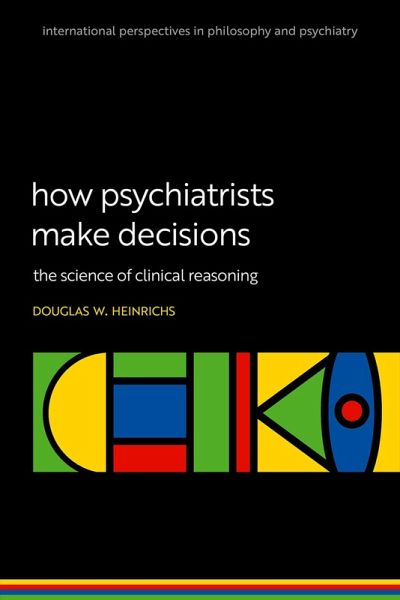
In this book, Heinrichs makes explicit the underlying methodology of the clinical reasoning of experienced psychiatrists.
Andere Kunden interessierten sich auch für
Joseph John MurphyHabit and Intelligence in Their Connexion With the Laws of Matter and Force34,99 €
Richard G. ErskineLife Scripts131,99 €
Joseph John MurphyHabit and Intelligence in Their Connexion With the Laws of Matter and Force: A Series of Scientific Essays; Volume 134,99 €
Johan HjortThe Unity of Science30,99 €
Paul BloomPsych23,92 €
Thimo BuchmüllerWhat I don't know won't hurt me? Decisionmaking under ambiguity compared to decisions under risk17,95 €
Seymour EisemanDecisions96,99 €-
-
-
In this book, Heinrichs makes explicit the underlying methodology of the clinical reasoning of experienced psychiatrists.
Produktdetails
- Produktdetails
- Verlag: Oxford University Press
- Seitenzahl: 272
- Erscheinungstermin: 27. August 2025
- Englisch
- Abmessung: 213mm x 160mm x 15mm
- Gewicht: 567g
- ISBN-13: 9780198960706
- ISBN-10: 0198960700
- Artikelnr.: 73544978
- Herstellerkennzeichnung
- Libri GmbH
- Europaallee 1
- 36244 Bad Hersfeld
- gpsr@libri.de
- Verlag: Oxford University Press
- Seitenzahl: 272
- Erscheinungstermin: 27. August 2025
- Englisch
- Abmessung: 213mm x 160mm x 15mm
- Gewicht: 567g
- ISBN-13: 9780198960706
- ISBN-10: 0198960700
- Artikelnr.: 73544978
- Herstellerkennzeichnung
- Libri GmbH
- Europaallee 1
- 36244 Bad Hersfeld
- gpsr@libri.de
Douglas W. Heinrichs is a practitioner of general psychiatry and psychopharmacology. Having completed his medical and psychiatric training at Georgetown University, University of Cincinnati, and University of Maryland, Heinrichs has spent nearly a decade in clinical research and teaching at University of Maryland, concentrating on schizophrenic disorders. He has also spent 40 years of private practice in general psychiatry and psychopharmacology and is active in, and on, the executive committee of the Association for the Advancement of Philosophy and Psychiatry.
* Epigraph
* 1: Introduction: The need to articulate a method of clinical
reasoning in psychiatry
* 2: Does evidence-based medicine provide a clinical method?
* 3: The role of models in clinical reasoning: The case of Ms K
* 4: Changing goals and changing models: The case of Mr Z
* 5: Models and patient values: The case of Mr D
* 6: Shifting and conflicting models: The case of Ms M
* 7: The POP model of clinical reasoning: Description and implications
* 8: How we reason and make decisions
* 9: The role of model construction in developing expertise in
psychiatry
* 10: Justifying knowledge claims in psychiatric reasoning
* 11: Conclusions and future directions
* References
* 1: Introduction: The need to articulate a method of clinical
reasoning in psychiatry
* 2: Does evidence-based medicine provide a clinical method?
* 3: The role of models in clinical reasoning: The case of Ms K
* 4: Changing goals and changing models: The case of Mr Z
* 5: Models and patient values: The case of Mr D
* 6: Shifting and conflicting models: The case of Ms M
* 7: The POP model of clinical reasoning: Description and implications
* 8: How we reason and make decisions
* 9: The role of model construction in developing expertise in
psychiatry
* 10: Justifying knowledge claims in psychiatric reasoning
* 11: Conclusions and future directions
* References
* Epigraph
* 1: Introduction: The need to articulate a method of clinical
reasoning in psychiatry
* 2: Does evidence-based medicine provide a clinical method?
* 3: The role of models in clinical reasoning: The case of Ms K
* 4: Changing goals and changing models: The case of Mr Z
* 5: Models and patient values: The case of Mr D
* 6: Shifting and conflicting models: The case of Ms M
* 7: The POP model of clinical reasoning: Description and implications
* 8: How we reason and make decisions
* 9: The role of model construction in developing expertise in
psychiatry
* 10: Justifying knowledge claims in psychiatric reasoning
* 11: Conclusions and future directions
* References
* 1: Introduction: The need to articulate a method of clinical
reasoning in psychiatry
* 2: Does evidence-based medicine provide a clinical method?
* 3: The role of models in clinical reasoning: The case of Ms K
* 4: Changing goals and changing models: The case of Mr Z
* 5: Models and patient values: The case of Mr D
* 6: Shifting and conflicting models: The case of Ms M
* 7: The POP model of clinical reasoning: Description and implications
* 8: How we reason and make decisions
* 9: The role of model construction in developing expertise in
psychiatry
* 10: Justifying knowledge claims in psychiatric reasoning
* 11: Conclusions and future directions
* References