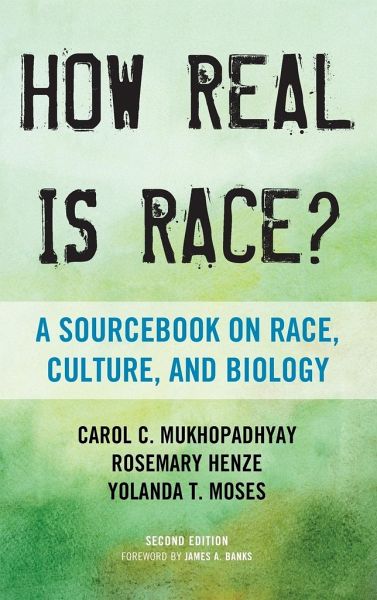
Drawing on biocultural perspectives, How Real Is Race? Second Edition employs an activity-oriented approach to engage readers in unraveling—and rethinking—the contradictory messages we so often hear about race.
Drawing on biocultural perspectives, How Real Is Race? Second Edition employs an activity-oriented approach to engage readers in unraveling—and rethinking—the contradictory messages we so often hear about race.
Carol C. Mukhopadhyay (professor emerita of anthropology, San Jose State University) has 40 years of experience teaching, consulting, researching, and publishing on issues of cultural diversity and education related to race, ethnicity and gender, in both the United States and India. She is a key advisor for the American Anthropological Association's public information project, RACE. Rosemary Henze (professor of linguistics and language development, San Jose State University) has a background in education, anthropology, and linguistics, and has been an ESL teacher. She worked with K-12 schools for 14 years as a consultant, researcher, and curriculum designer on bilingual, multicultural, and antiracist education and has researched education in Greece, Alaska, Hawaii, and Nicaragua. Yolanda T. Moses (professor of anthropology and Associate Vice Chancellor for Excellence, Diversity and Equity, University of California, Riverside) has spent more than 25 years researching, writing, and teaching in the United States, the Caribbean, South Africa, and Brazil. She has held national leadership roles in the American Anthropological Association, City College of New York (CUNY), and American Association of Higher Education and chairs the National Advisory Board for the American Anthropological Association's Understanding Race and Human Variation project (RACE).
Inhaltsangabe
Foreword by James A. Banks Acknowledgments Introduction Part 1: The Fallacy of Race as Biology Introduction to Part 1 1 Why Contemporary Races Are Not Scientifically Valid 2 Human Biological Variation: What We Don't See 3 If Not Race, How Do We Explain Biological Differences? 4 More Alike Than Different, More Different Than Alike Part 2: Culture Creates Race Introduction to Part 2 5 Culture Shapes How We Experience Reality 6 Culture and Classification: Race Is Culturally Real 7 Race and Inequality: Race as a Social Invention to Achieve Certain Goals 8 Cross-Cultural Overview of Race 9 If Race Doesn't Exist, What Are We Seeing? Sex, Mating, and Race Part 3: Race and Hot-Button Issues in Schools Introduction to Part 3 10 When is it racism? Who is a racist? 11 The Academic Achievement Gap and Equity 12 Assemblies, Clubs, Slurs, and Racial Labels 13 Interracial Flirting and Dating in Schools Part 4: Resources References Key Websites (Annotated) List of Activities Index About the Authors Endorsements
Foreword by James A. Banks Acknowledgments Introduction Part 1: The Fallacy of Race as Biology Introduction to Part 1 1 Why Contemporary Races Are Not Scientifically Valid 2 Human Biological Variation: What We Don't See 3 If Not Race, How Do We Explain Biological Differences? 4 More Alike Than Different, More Different Than Alike Part 2: Culture Creates Race Introduction to Part 2 5 Culture Shapes How We Experience Reality 6 Culture and Classification: Race Is Culturally Real 7 Race and Inequality: Race as a Social Invention to Achieve Certain Goals 8 Cross-Cultural Overview of Race 9 If Race Doesn't Exist, What Are We Seeing? Sex, Mating, and Race Part 3: Race and Hot-Button Issues in Schools Introduction to Part 3 10 When is it racism? Who is a racist? 11 The Academic Achievement Gap and Equity 12 Assemblies, Clubs, Slurs, and Racial Labels 13 Interracial Flirting and Dating in Schools Part 4: Resources References Key Websites (Annotated) List of Activities Index About the Authors Endorsements
Es gelten unsere Allgemeinen Geschäftsbedingungen: www.buecher.de/agb
Impressum
www.buecher.de ist ein Internetauftritt der buecher.de internetstores GmbH
Geschäftsführung: Monica Sawhney | Roland Kölbl | Günter Hilger
Sitz der Gesellschaft: Batheyer Straße 115 - 117, 58099 Hagen
Postanschrift: Bürgermeister-Wegele-Str. 12, 86167 Augsburg
Amtsgericht Hagen HRB 13257
Steuernummer: 321/5800/1497
USt-IdNr: DE450055826