
Andere Kunden interessierten sich auch für
 Please Don't Leave Me18,99 €
 Job Card17,99 €
 Don't Leave Me15,99 €
 Reasons to Leave11,99 €
 Love Me Loud, Leave Me Brave16,99 €
 Slainte! The Athlone Job17,99 €
 Shorty McCabe on the Job18,99 €




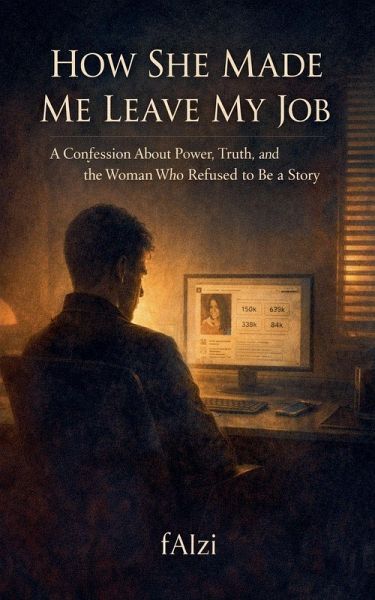
Elias Thorne is very good at his job. Too good. As the star investigative journalist at a ruthless digital magazine, Elias has mastered the modern art of destruction. He doesn't chase truth-he engineers narratives. With surgical precision, he turns private pain into public spectacle, harvesting outrage, clicks, and careers ruined in real time. To him, people are not souls; they are sources. Not lives, but plot devices. Every story is a kill, and Elias is at the top of the food chain. Until Clara Vance. Assigned to uncover a scandal buried deep within a reclusive billionaire family, Elias expects another clean hunt. The file on Clara is thin-no social media, no public presence, no visible weaknesses. She is an archivist, a woman who spends her days preserving forgotten letters, old maps, and the quiet confessions of the dead. To Elias, her anonymity is not a shield-it is a challenge. If he can't hack her digitally, he will infiltrate her personally. What begins as a calculated performance-a staged meeting in a bookshop, a carefully crafted academic persona, a slow manipulation designed to earn trust-begins to fracture in ways Elias does not anticipate. Clara does not respond the way his past targets have. She does not overshare. She does not perform. She listens. She watches. And in her presence, Elias feels something unsettling: the sense that he is being seen, not as the man he pretends to be, but as the hollow machinery beneath. As Elias embeds himself deeper into Clara's world, he builds a double life with terrifying ease. By day, he writes a devastating exposé designed to destroy her reputation. By night, he finds himself drawn into long silences, shared walks, and conversations that refuse to be weaponized. The lines between hunter and human begin to blur. The persona he created to trap her starts to feel more real than the man who built it. Clara, however, is not unaware. In a stunning reversal of perspective, the narrative turns its gaze onto Elias himself. Clara is not a victim waiting to be exposed-she is an observer, an archivist of character. She notices the micro-performances, the rehearsed vulnerability, the way Elias speaks of love like a climax he is waiting to monetize. She understands something Elias does not: that truth is not extracted under pressure, but revealed in stillness. The confrontation between them is not explosive-it is devastatingly quiet. No shouting. No melodrama. Just a single, annihilating realization delivered with surgical calm: "You don't love people," Clara tells him. "You love them for a plot point." In that moment, Elias's career collapses-not because he is fired, but because he finally understands what he has become. Faced with an impossible choice between professional success and moral annihilation, Elias does something unprecedented: he walks away. He deletes his entire body of work. He abandons the throne he fought so hard to claim. He leaves journalism without applause, explanation, or redemption arc. What follows is not a story of instant transformation, but one of slow, brutal reckoning. Stripped of status, blacklisted, and forced into anonymity, Elias must confront the terrifying silence left behind when the performance ends. He attempts to write fiction and fails. Attempts irony and feels disgust. Every dishonest sentence collapses under the imagined weight of Clara's gaze. For the first time, he is forced to write without an audience-without metrics, without validation, without cruelty. The result is the book you are holding.