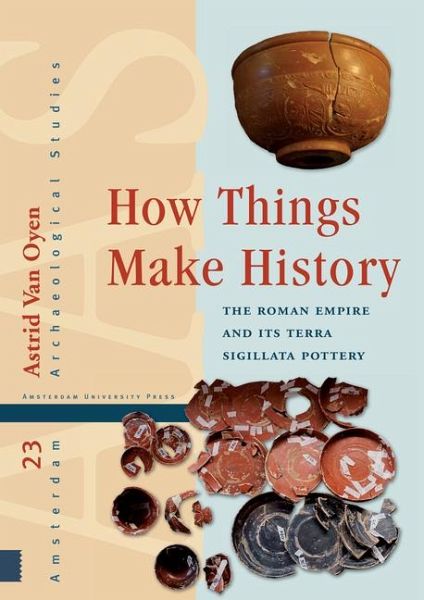
Bright red terra sigillata pots dating to the first three centuries CE can be found throughout the Western Roman provinces. The pots' widespread distribution and recognisability make them key evidence in the effort to reconstruct the Roman Empire's economy and society. Drawing on recent ideas in material culture, this book asks a radically new question: what was it about the pots themselves that allowed them to travel so widely and be integrated so quickly into a range of contexts and practices? To answer this question, Van Oyen offers a fresh analysis in which objects are no longer passive props, but rather they actively shape historical trajectories.…mehr
Bright red terra sigillata pots dating to the first three centuries CE can be found throughout the Western Roman provinces. The pots' widespread distribution and recognisability make them key evidence in the effort to reconstruct the Roman Empire's economy and society. Drawing on recent ideas in material culture, this book asks a radically new question: what was it about the pots themselves that allowed them to travel so widely and be integrated so quickly into a range of contexts and practices? To answer this question, Van Oyen offers a fresh analysis in which objects are no longer passive props, but rather they actively shape historical trajectories.
Astrid Van Oyen is Assistant Professor of Classical Archaeology at Cornell University. Her interests concern the archaeology and history of Roman Italy and the Western Provinces, with a focus on empire and imperialism, materiality, and socio-economics. She has written about post-colonialism, networks, Roman villas, and city-countryside relations. She is the PI of the Marzuolo Archaeological Project (MAP), investigating dynamics of rural innovation in Roman Italy.
Inhaltsangabe
PREFACE 1. On avoiding retrospection 2. Bright red shiny pots: Is there more to terra sigillata? 3. Practice before type: Sigillata production at lezoux (1st-2nd centuries AD) 4. Points of redefinition: Distribution, firing lists, and kiln loads (1st century AD) 5. the Question of stability: Sigillata and 'Rhenish' wares between Lezoux and Trier (2nd-3rd centuries AD) 6. Before meaning: Reproduction and consumption of terra sigillata and 'Rhenish' wares in Essex (2nd-3rd centuries AD) 7. Things in history/things a history, APPENDIX 1. STAMP ASSEMBLAGES, REFERENCES, INDEX.
Es gelten unsere Allgemeinen Geschäftsbedingungen: www.buecher.de/agb
Impressum
www.buecher.de ist ein Internetauftritt der buecher.de internetstores GmbH
Geschäftsführung: Monica Sawhney | Roland Kölbl | Günter Hilger
Sitz der Gesellschaft: Batheyer Straße 115 - 117, 58099 Hagen
Postanschrift: Bürgermeister-Wegele-Str. 12, 86167 Augsburg
Amtsgericht Hagen HRB 13257
Steuernummer: 321/5800/1497
USt-IdNr: DE450055826